
We are honored to present CUNY Adjunct Incubator work. Please read about Seth Fein’s (LaGuardia Community College) public scholarship and its impact below.

All Is Not Lost ∞ Noguchi near Milton in Queens is a distributary. This documentary essay’s themes overflowed its trunk tributary; my film, contemplating contemporaneous outlier artists, Joseph Cornell (1903-1972) and Isamu Noguchi (1904-1988), through their work and lives at different ends of Queens, inexorably cut channels that converged to form this film—a distributary wending through Long Island City (LIC), across the last 75 years.
All is not lost is another way to say, you never know what you will find. This distributary began with graffiti. An anonymous artist painted an uncited phrase along the plinth of the massive factory facing Noguchi’s live-in studio across narrow 10th Street. I could not get past the four monosyllabic words; for they ignited insight about what I was doing in LIC, what I do more widely: finding in the present what’s not lost from the past. Consequently, the incidentally encountered four-word epigram became this four-part short’s intentionally invoked epigraph.

Part One locates Noguchi’s 1961 move to Queens in interborough history. It contemplates the artist’s repurposing of a commercial space to live and work in very industrial LIC—as his crossriver contemporaries moved to live and work in rapidly deindustrializing SoHo—as a product of his outlier identity and multidisciplinary practice, which bridged factories and museums, manufactured designs for consumers as well as carved stone and welded metal for collectors and developers. Consequently, the mature Noguchi’s work synergized with the work (and works) of his new LIC neighbors.
Noguchi’s new neighbors included Abraham Dreier (1888-1979), who had built two mammoth foundries on either side of the small red-brick warehouse that became the artist’s new studio. Both buildings still stand, and the one closest to Noguchi’s lair—the one bearing our sprayed epigraph—still bears Dreier’s stenciled surname. Uncannily, in a neighborhood where gentrification has disappeared most functioning factories, Dreier’s building has recently contained a metal works and still houses a stone-cutting enterprise (fabricators of materials Noguchi favored). This atavism indexes, as our film shows, how the steelmaker’s and artmaker’s crossborough careers shadow one another in form and geography through time, yielding a clearer understanding of the work of each. All is not lost ∞
Part Two visualizes two branded fortresses of gentrification—the Noguchi Museum and Costco—facing each other across Vernon Boulevard. Together they guard two crucial-but-nebulous borders: between Astoria and LIC and between present and past. Noguchi’s self-designed 27,000 square-foot museum and garden opened in 1985 in the photo-engraving factory, just across 33rd Road from his studio, which the artist had purchased eleven years earlier and subsequently repurposed for posterity; eleven years later, Costco repurposed Dreier’s second capacious LIC foundry as its 130,000 square-foot outlet and 500-space parking lot. Our film suggests how the linked architectural patrimonies of these fastidiously designed indoor/outdoor complexes in the gentrifying area’s past clarify their profound-if-obscured functional synergies in the present. All is not lost ∞

Part Three hinges in split-screen the coeval-but-distinct migrations generated by Noguchi’s and Costco’s coeval-but-distinct gentrifications, which one trek reifies and the other defies (as sampled in our “Gentrifications Migrations” teaser). The two migrations pass, but do not regard one another. Global gentry visit Noguchi’s museum while local inhabitants of public housing—Queensbridge, Ravenswood, and Woodside apartments—push carts across many blocks to purchase discount staples in an enclave designed for drivers, not these long-distance walkers who stride past Noguchi’s onetime studio. The steady-if-elliptical march of those who reside in the human warehouses that Robert Moses constructed over 75 years ago at the margins of what was then a factory zone connects present and past, gentrification and industrialization, in Long Island City. All is not lost ∞
View the teaser here:
Part Four runs through CUNY in LIC. In LaGuardia Community College, I unexpectedly encountered Noguchi’s Figure Emerging (1982) in the courtyard where I prepared to lecture. Like Noguchi and Costco, LaGuardia emerged in LIC’s postindustrial gentrification, expanding block by contiguous block, purchasing and repurposing defunct factories between the early 1970s and early 1990s. At the end of the 1980s, the college coveted the acquisition of one of the recently deceased artist’s granite fountains—like The Well (1982) in The Noguchi Museum’s garden today—for the sculpture garden it planned in its newly designed Building E, formerly the Equitable Bag Company’s works, scheduled to open in 1990. As our “LaGuardia Emerging” teaser suggests, the Noguchi Foundation eventually rejected this request, imposing instead the “hot-dipped galvanized” steel figure installed awkwardly there today. View the teaser here:
Evidently, LaGuardia has advanced this project, which was underway before I taught there, before I found Noguchi there. But more than encountering Figure Emerging in Building E or researching its patrimony in the college’s archives, thinking about gentrification in LIC from within LaGuardia in LIC nourished this project. Too, teaching at CUNY has served this work beyond the valued support of the Center for the Humanities grant, in too many ways to detail meaningfully here. But none supersedes my association with documentarian Aley Seoudy, whom I met when he was a student in my Nonfiction Film course at Brooklyn College, years before we began collaborating on nonfiction films, including All is Not Lost ∞.
• • •
The unattributed graffitied epigram, our film’s epigraph, is from John Milton’s Paradise Lost, published over 350 years ago. While the artist did not cite the poet, they did punctuate his words: with a lemniscate. The infinity sign is an enigmatic inflection—all is not lost forever—things (including graffiti) return, or at least fragments can be found? In any case, ∞ was prophetic as well as poetic.
All is Not Lost ∞ is now missing, if not lost. The graffiti has been intentionally painted over, erasing what I first filmed on Dreier’s building two-and-a-half years ago. But it’s not the first time that that graffiti has been covered. Editing my footage, I discerned the outlines of a prior rendering (which I had not noticed when filming) that had also been painted over but was nevertheless perceivable beneath its erasure and re-rendering (see this essay’s header).
Perhaps the Milton graffiti’s better-concealed last rendering will resurface or, more likely, eventually be repainted on this palimpsest? Who knows? What I do know is that if we did not document it, we would not know about it now; and even more meaningly, the ideas it generated about the histories around Noguchi (and Dreier) in (and beyond) LIC—and about the practice of history as documentary art—would not have materialized as they have here.
Documenting is not seeing. Seeing depends on not (only) what the camera captures but what one finds around and through what’s captured. Only then: all is not lost. Although Milton’s words no longer appear on Dreier’s still-standing bygone foundry, opposite Noguchi’s still-standing bygone studio, the graffiti recorded for this film, like those buildings, are a source for imagining the past in the present. All is not lost ∞, indeed.
CAI Awardee and Producer/Director

Seth Fein
Seth Fein is a historian and filmmaker. He operates Seven Local Film, which he founded in Jackson Heights, Queens, where he lives. Within CUNY, he has taught Film at Brooklyn College, including its Feirstein Graduate School of Cinema, as well as at LaGuardia Community College.
Co-Producer

Aley Seoudy
Aley Seoudy is a video editor and cinematographer. He completed his BFA in documentary film production in Brooklyn College and is Associate Producer at Seven Local Film.
Read More about the CAI Awardees and Their Projects Below
News & Distributaries
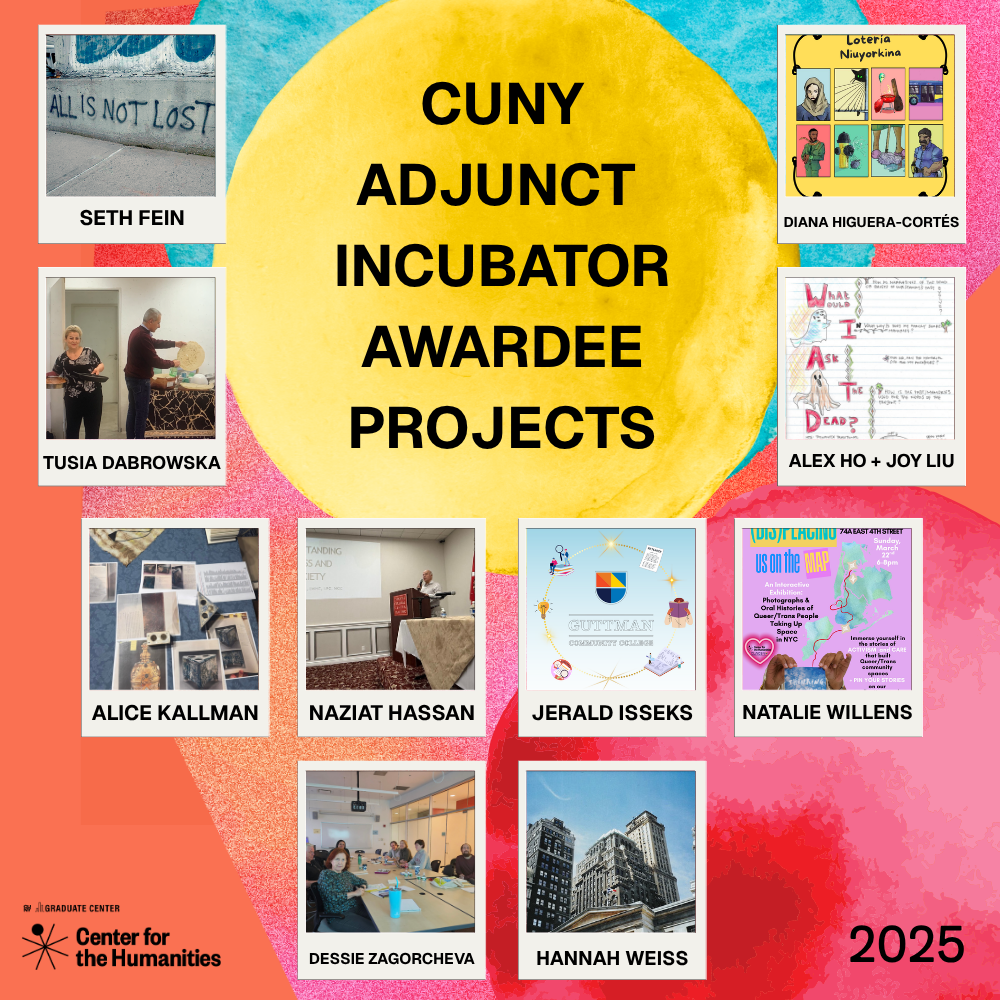
Celebrating the 2025 CUNY Adjunct Incubator Award Projects: Public Scholarship and Social Justice
Distributaries
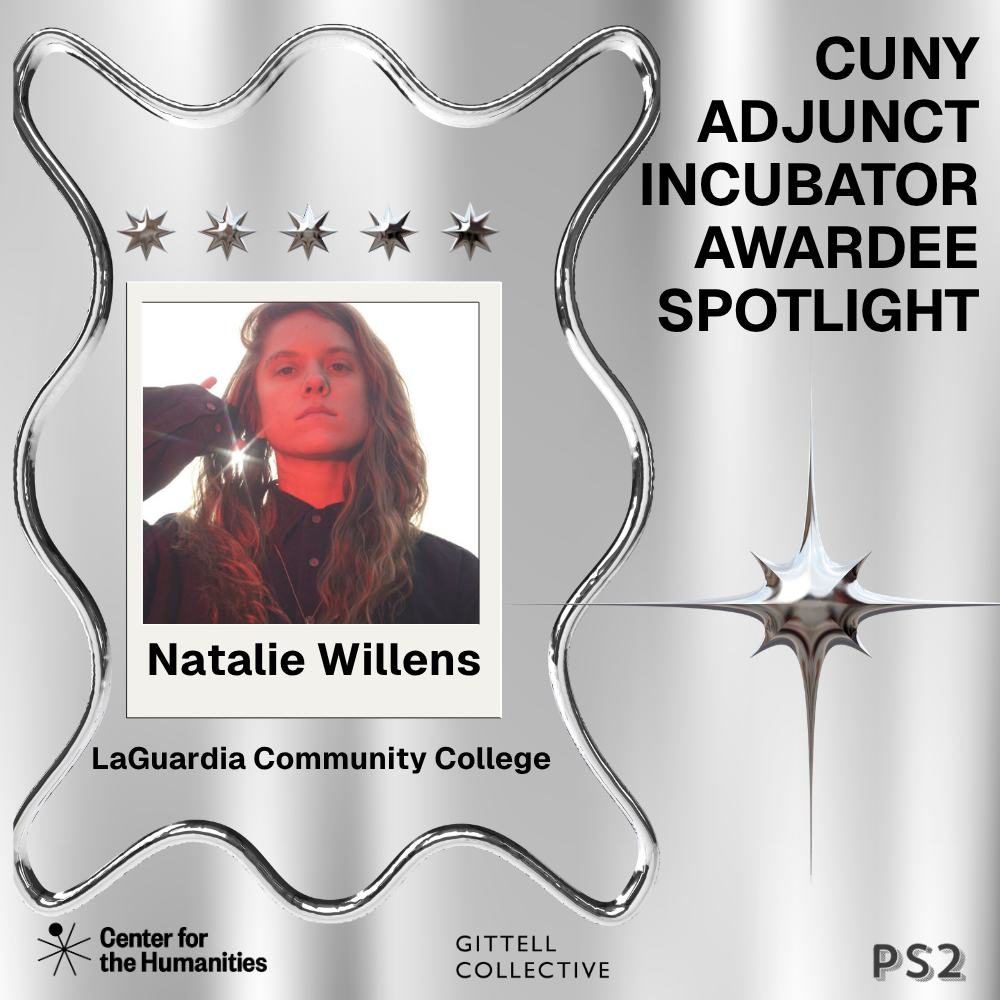
(Dis)placing Us on the Map: An Interactive Exhibition and Reflection
Distributaries

Enhancing Media Literacy Skills in the Digital Age
Distributaries
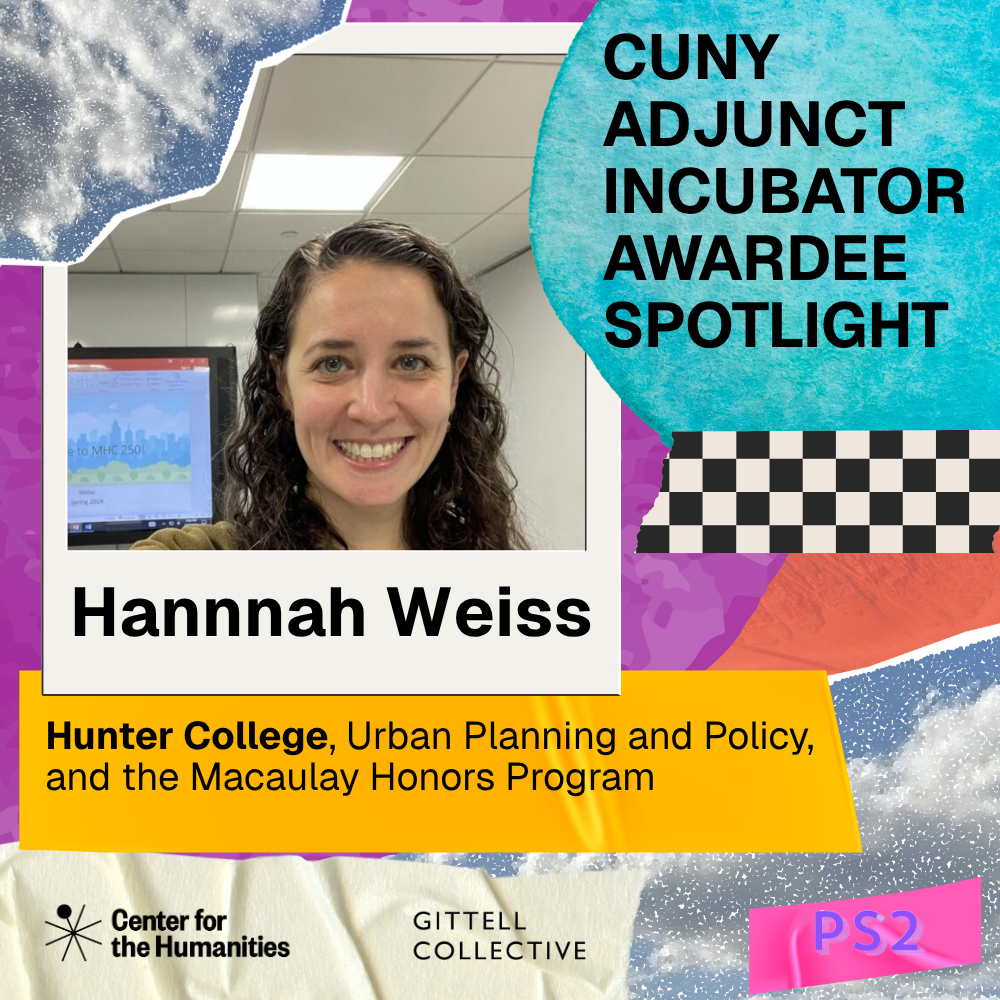
Investigating the Intersection of Housing & Immigration
Distributaries

La Lotería Niuyorkina: A pedagogical toolkit to explore Spanish varieties through the Linguistic Landscape
Distributaries

Participatory Research in Social Justice at Guttman Community College
Distributaries

Where Europe starts: Interviews with Seven Migrants from Africa and the Middle East who Crossed the Białowieża Forest to Seek Asylum in the E.U.
Distributaries

Ghost Notes: A Journaling Practice for Taiwanese American Autoethnography
Distributaries
