La Lotería Niuyorkina: A pedagogical toolkit to explore Spanish varieties through the Linguistic Landscape
February 17, 2026

We are honored to present CUNY Adjunct Incubator work. Please read about Diana Higuera-Cortes’ (Lehman College, Spanish; Queens College, Latinx Studies) public scholarship and its impact below. Don’t miss the launch event for La Lotería Niuyorkina, the educational game, on March 12th.
Project Background
The idea of a Loteria Niyorkina (an educational game designed for Spanish as a Heritage Language students to explore the city’s linguistic landscape) surged in the Spring 2024. I was revising some teaching materials when I came across different versions of the traditional Mexican Loteria made in the USA. People in Texas, California, and Chicago had developed their own Loterias with representative elements of their regions. I was fascinated by their work, and I immediately searched the web for a New York version of the game. Although I could not find anything featuring the city, I quickly came up with the idea of creating one with my Spanish students. At the time, I was assigned to teach Spanish 203, “Elements of Contemporary Spanish Language,” a third-level class for Spanish as Heritage Speakers at Lehman College. I had planned and organized my class to study the Linguistic Landscape of the Bronx and other places where the students lived. Since students had to develop a project analyzing the presence of Spanish in street signs, graffiti, businesses, and other public spaces, I also asked them about the most common words that defined their day-to-day language experience.
Later on, the CUNY Adjunct Incubator released its call for applications to fund projects across CUNY campuses. The call was the perfect opportunity to materialize the project and to share it with adjunct faculty alike. As I was fortunate to be awarded the funds, I began developing the Loteria near the end of the Fall 2024 semester. I asked students to elaborate on a list of “Spanglish terms” that were frequently used in their communities. Because we had discussed Spanish as a local language in New York, and Spanglish as a common phenomenon in the context of two languages, students elaborated a list of unique words that represented specific places, objects, and characters of the LatinX scene in New York City. This list of words became the very first stage of the Lotería and the items we currently see on the cards and boards.
In addition to the student’s contributions, the project needed strong illustrations that would carry the game’s identity. During a FanZine activity I proposed for my Intro to LatinX Ethnic Identity class at Queens College, I was captivated by the creativity and talent of one student, Mateo Oldenburg.
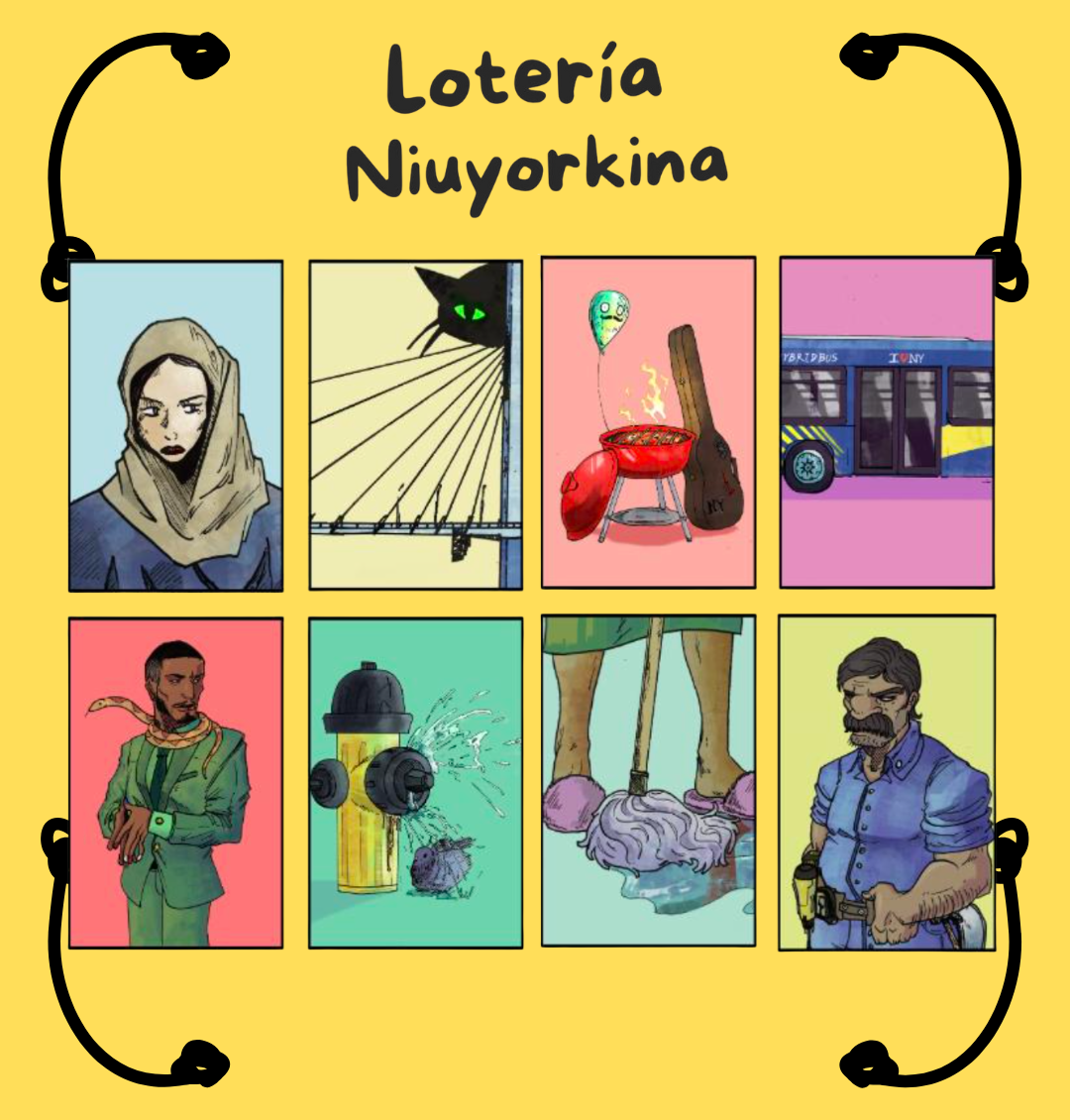
Oldenburg expressed his feelings about the presidential election results with an image of America being torn apart by a screw, and the text “We are… (screwed).” The picture was not only highly elaborate, but the message was easy to engage with and understand. I asked him to participate in the project by illustrating the Lotería items, and he eagerly accepted the invitation. Over the summer, he worked on the drawings and added his own interpretation of the words using his signature illustration style.

View more images and illustrations created by Mateo Oldenburg from the game La Lotería Niuyorkina in the slideshow gallery below:


As a result of nearly a year of work, the final product, La Loteria Niuyorkina, is available to all as a pedagogical game/toolkit and Open Educational Resource (OER). I aimed to create a game that adjuncts and graduate students can access through a CUNY Commons page—the game and related materials are available online here as a PDF file, along with five lesson plans and a list of related OER resources, ensuring that students will not have to purchase expensive textbooks to take part in a Spanish course.
Although the game is designed for Spanish as a Heritage Language students, it can also be used by other Spanish and Latinx Studies faculty within the CUNY system. I believe the study of the Linguistic Landscape and common Spanglish words, expressions, and vocabulary helps individuals understand the city’s multiculturality and the context in which LatinX communities have lived for many decades. Spanish is not just a language recently introduced by recent migratory flows. It is a language that has been present in the United States since the 16th century.
Thanks to the generous support of the CUNY Adjunct Incubator award, this project is also offered as an alternative to adjunct faculty who constantly have to create class materials. Since many of the Heritage Language courses do not have a defined textbook, instructors must create new guides, projects, and materials, a time-consuming issue for overworked adjuncts who teach several classes at different institutions. Moreover, some pre-established curricula and handout syllabi focus on the acquisition of grammar structures and cultural elements of the Hispanic world outside of the United States. This issue is based on language ideologies that continue to place hierarchies of language speakers, favoring some Spanish varieties and marginalizing others. As for Spanish heritage speakers in the USA, some teaching approaches and materials have promoted the idea of an incorrect language in need of “remedy”. The proposed Loteria and class materials seek to create a space for reflection about students’ linguistic practices, identity, and sociocultural issues within their communities.
The Game’s Structure
The game follows the structure of the traditional Mexican game, La Loteria de Don Clemente, a wonderful illustrated card game of chance similar to bingo played with a deck of cards instead of numbered balls. This game is usually played at family gatherings and game nights. The original game features a deck of cards. Each card depicts an image of an everyday object, its name, and a number.
Similarly, La Loteria Niuyorkina is composed of 24 items (cards) and 16 tablas (game boards) featuring places, events, characters, Spanglish words, and other elements representative of the LatinX culture in New York, and in the United States at large.
Please view the website where you can access the open-access resources for the game here.

Join us for the launch of La Lotería Niuyorkina: An Educational Game to Explore the City’s Linguistic Landscape on Thursday, March 12, at 6 pm in Room 5414 at the CUNY Graduate Center. Register here.
Awardee and Game Designer

Diana Higuera-Cortes
Diana Higuera-Cortes is a PhD student in the Latin American, Iberian, and Latino Cultures (LAILAC) program at the Graduate Center-CUNY. A former CUNY Humanities Alliance fellow, Diana teaches Spanish at Lehman College.

Mateo Rafael Oldenburg
Mateo Rafael Oldenburg (he/him/él) is a young Venezuelan American artist based in Queens, NY. He is also a second-year student at Queen’s College, where he intends to major in Design and Philosophy. He enjoys drawing and illustrating using different techniques such as graphite, charcoal, and ink. In his free time, he explores his passion for metal music by playing the guitar, singing, and playing with his band, Dracolich.
La Loteria Niuyorkina Launch Event