Where Europe starts: Interviews with Seven Migrants from Africa and the Middle East who Crossed the Białowieża Forest to Seek Asylum in the E.U.
December 16, 2025

We are honored to present CUNY Adjunct Incubator work. Please read about Tusia Dabrowska’s (Design, Queens College; Film Studies, John Jay College) public scholarship and its impact below.
Since 2022, I’ve filmed the migration crisis on the Polish-Belarusian border, where thousands of migrants cross one of the last primeval forests in Europe to seek asylum in the E.U. Until now, my work has focused on Polish aid volunteers. The CUNY Adjunct Incubator allowed me to document the experiences of migrants from Africa and the Middle East.
Beginning in 2021, Belarus, a Russia-propped dictatorship, artificially created new migration paths—which some describe as state-operated human trafficking—as part of its hybrid attack against the E.U. Since then, thousands of migrants—mostly from Africa and the Middle East—have crossed Białowieża, one of the last primeval forests in Europe, to seek asylum in the E.U. The forest is a natural border, but in response to the migration crisis, which sees over 100 crossings per day, the E.U. countries that border Belarus erected a wall.

A still from the film based on the artwork by a recent asylum seeker, Ramah Abo Zedan. May 2025.
Many eco-activists argue that the wall has devastating effects on an ecosystem that has thrived here for thousands of years. Migration activists note that the wall does not have a deterring effect and only increases chances of physical harm to the crossers. Along the wall, on both sides, border patrol efforts often turn into shows of force by competing armies.
As the Berlin-based Centre for East European and International Studies (ZOiS) points out, the majority of people in Poland, the E.U. country sharing the longest border with Belarus, favor strong border protections. This report includes findings that only 9% of young people believe that the Białowieża border crossers should have the right to apply for asylum.
In fact, in March of 2025, Poland introduced a ban on asylum for the Białowieża border crossers, claiming their entrance is part of an irregular migration pattern engineered by Poland’s hostile neighbor, Belarus. Against this background, since 2022, I have, on and off, documented the efforts of local women who volunteer to provide aid to migrants.

Mirosław Samosiuk and Barbara Kuzub-Samosiuk of Czeremszyna, a local folk band. Podlaskie, Poland. June 2023.
These women, who know the forest intimately, are limited by the EU trafficking laws in their ability to guide people to safety. So, they meet the crossers to give them food, clothing, and phone power banks.
Under the best conditions, crossing Białowieża takes about a week. It is a thick forest known for its marshlands and the last herds of European bison. Now, a heavily militarized zone, it is also a site of violence and abuse. The forest crossers I spoke to took between one and eleven months to cross.
Thanks to the CUNY Adjunct Incubator, I was able to interview seven migrants from Congo, Ethiopia, Guinea, Kurdistan, Syria, and Yemen. Five of them were under the age of thirty. Two were women. They lived in Warsaw, Cracow, Berlin, and Munich. They had been in Europe for a couple of months to four years. Only one was able to obtain a job.
During my trip, I visited Białowieża, where, at a local food festival, I met a young architect, a Syrian Druze, who had crossed the forest just weeks before. He told me that it is the highly aggressive military dogs that are the scariest in the forest. In Warsaw, I had tea with an Ethiopian teenager who fled genocide and spent eleven months in Białowieża. You learn which leaves you can chew on to quiet the hunger, she told me. Also in Warsaw, I interviewed a young Congolese man suffering from severe PTSD. He asked if I could buy him a KFC meal. Then, he told me about the first time he tried to cross. His group confused a fence protecting Belarusian army barracks for a border wall. How could he know the difference in the middle of a forest at night? And, anyway, in Congo, people know not to go into a jungle. In Cracow, I spoke to a young Guinean man. A delay in care at a hospital in Belarus turned a simple infection in his toes into a double amputation. He was eighteen then. “What you see in the forest, you just can’t imagine.”
In Berlin, I was treated to an exquisite Kurdish breakfast by a couple living in an asylum center. For three years now, their family of five has shared a single room, using a communal bathroom and kitchen. They crossed at the beginning of the crisis, in 2021. To do so, they had to sell a shop they owned in Kurdistan. They came to Europe to seek medical help for their oldest daughter. Off the record, I chatted with her. She showed me a lively stream of conversations on WhatsApp that keep her updated on her classmates in Kurdistan.

I asked about Berlin. She quietly said that she just wants a place to call home. And, finally, in Munich, I drank soda with a young Yemeni man with university degrees from Kuwait and asked him how he likes Europe. He can’t find a job and feels like he brought shame to his family. It weighs heavily on him. Nobody wants you here, he said.
After returning from my trip, I took a few weeks to reflect before I began reviewing the material and arranging it into a narrative. I’m currently working on a short video essay that pairs my conversations with migrants about their experience of crossing and four years with recordings of the local community and the mark the crisis leaves on them.
Here is a sample of the project:
While only snippets of the interviews will make it into the full video essay, the opportunity to travel internationally to meet my subjects, record them, and process the stories I heard has been invaluable. It expanded my research in significant ways, giving me a firsthand perspective― individual motivations, experiences, and the emotional toll of crossing Białowieża. It also allowed me to connect with a visual artist who shared with me drawings of his migration journey.
I hope my work will contribute toward filling the gaps in the historical record.
This project has received support from the Queens Arts Fund (2023), Puffin Foundation (2023), CUNY Adjunct Incubator (2025), and NYSCA (2026).

Tusia Dabrowska
Tusia Dabrowska makes eco-social performances, experimental films, and digital projects. Tusia teaches courses in the Design Program at Queens College and in Film Studies at John Jay College.
Read More about the CAI Awardees
News & Distributaries
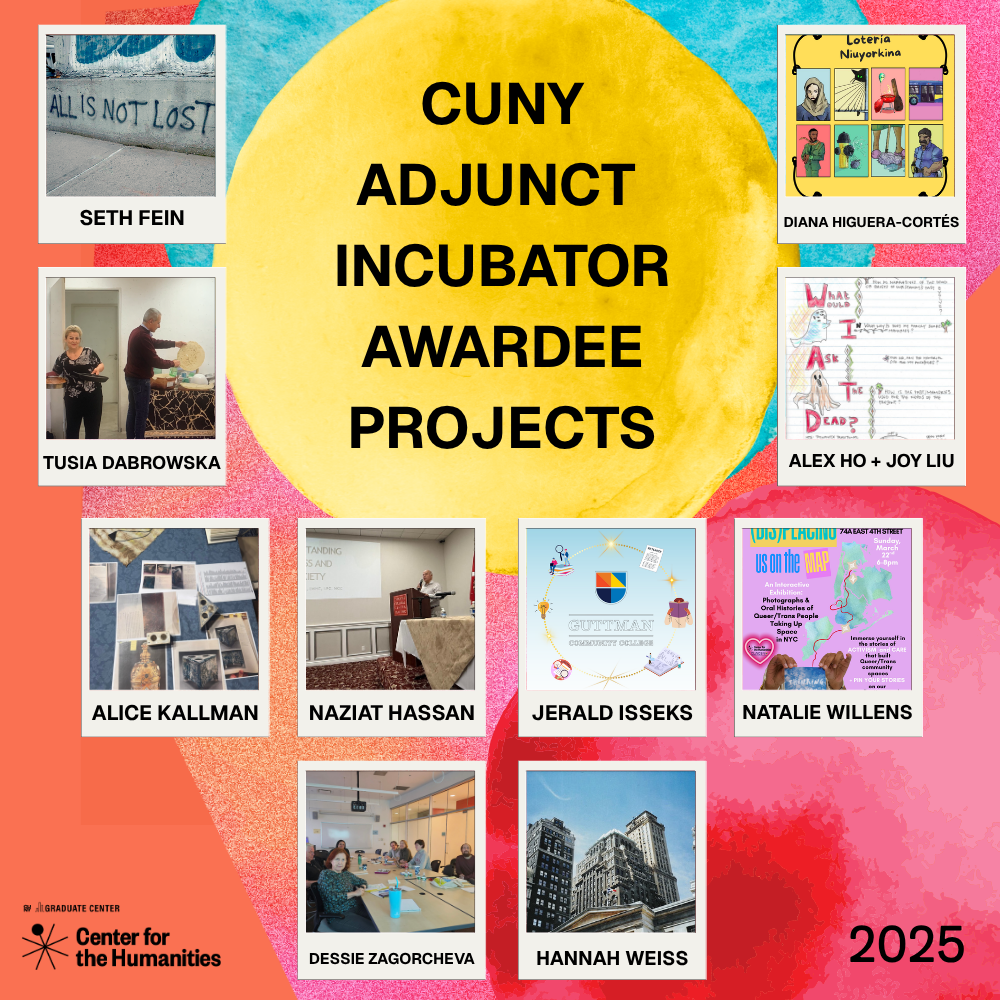
Celebrating the 2025 CUNY Adjunct Incubator Award Projects: Public Scholarship and Social Justice
Distributaries
(Dis)placing Us on the Map: An Interactive Exhibition and Reflection
Distributaries

La Lotería Niuyorkina: A pedagogical toolkit to explore Spanish varieties through the Linguistic Landscape
Distributaries

All Is Not Lost ∞ Noguchi near Milton in Queens
Distributaries

Participatory Research in Social Justice at Guttman Community College
Distributaries

Ghost Notes: A Journaling Practice for Taiwanese American Autoethnography
Distributaries

Syrian Culinary Superstitions
Distributaries

Well-being and Resilience: Mental Health and Stress Management Workshop Series
News