Participatory Research in Social Justice at Guttman Community College
December 16, 2025

We are honored to present CUNY Adjunct Incubator work. Please read about Jerald Isseks’ (Guttman Community College) public scholarship and its impact below.
I teach first-year undergraduate students in American Studies at Guttman Community College. Over the past few years, my students have designed and conducted participatory action research (PAR) projects as the culminating experience of many of my courses, most notably in “Introduction to Social Justice,” a curricular hallmark of our First-Year Experience program. Since my students have, from what I’ve seen, generally responded favorably to this challenge of PAR, I decided we could benefit from the potential support offered by the CUNY Adjunct Incubator Award. The award could help us solidify an ongoing PAR program at Guttman by bringing more attention on campus to students’ projects as well as by helping fund a culminating event where students could present their work.
While I think the Incubator award helped strengthen our PAR program, I know that it also provided me with the opportunity to reflect further on the process of facilitating PAR and the issues that come with this type of student-led research.
Student “Choice”
In my experience, it is difficult to facilitate participatory action research (PAR) in compulsory educational settings, and it surfaces some of the ethical and sociopolitical quandaries that underlie schooling in general. Those dilemmas are often about young people’s agency and choice within these institutions. To be sure, students are electing to attend college and theoretically can opt out whenever they want. Certainly, many do opt out: since 2008, the six-year completion rate for community college students has hovered around 40 percent; more than half of students leave within their first three years.
To me, these realities seem to drive home the fact that student “choice” in college today is not so clear-cut. Many students are technically choosing to come to my classes, but at the same time, might feel they have to be there due to economic perceptions or familial pressures. Moreover, many may appear to have “chosen” our college but in fact were pushed by a counselor to apply to only one school, or perhaps wanted to go somewhere else but weren’t admitted, couldn’t afford it, missed a deadline, or were bound by situational constraints. Some may not have believed they had a choice at all.
In youth educational contexts, PAR is meant to center students’ voices and invite their perspectives and leadership in order to disrupt the status quo in some way. This stance often clashes against the unquestioned conditions of schooling, where it can be less complicated for students to simply accept educators’ authority and control over them, and where they know they must comply in order to pass. Amidst such conditions, how can PAR projects be authentic reflections of student perspectives, and be truly student-generated and -led?

While I have not been able to resolve these tensions, I have arrived at a type of PAR facilitation in schools that depends on a great deal of structure, support, and flexibility. Students I have worked with tend to get excited about leading a project of their own that privileges local or community knowledge, but without clear instructions and project milestones, discrete team member roles and tasks, and authentic outlets for sharing their work in the community, it can be hard for everyone to maintain their enthusiasm and follow through with their initial vision.
Sustaining PAR Work
I incorporated these kinds of structures into the classroom experience of facilitating PAR this semester, as I have in the past, and I like to think that I am getting better at making this segment of my courses meaningful and generative for students. That said, the dilemmas inherent in doing this work at a place like Guttman remain palpable, and I continue to question and struggle with directing such a project even while I’m enthusiastically doing it. This semester, with the support and encouragement of the Adjunct Incubator Grant, I had the capacity to fund and organize an end-of-year event where my students showcased their work to their peers and to other members of the college community. Some of the projects their teams presented included a discussion of the experiences and new perils faced by migrant New Yorkers, a video in which Black residents of Flatbush describe their efforts to oppose gentrification, a slideshow chronicling insights gained in a study of voters’ disillusionment before and after the 2024 election, and a zine collecting narratives, legal options and rights for migrants under threat of state violence.
I think there is potential for a program like this to continue to work at Guttman, or at other colleges, with institutional support, interdisciplinary collaboration, and shared goals. It was essential, for example, that this semester several of my colleagues at Guttman took an interest in students’ projects, helped promote the showcase event, and attended it. Moreover, it was important that the ethos of experiential learning and civic participation be taken seriously and upheld actively across the college. Just as the body of academic literature on PAR attests to, I like to think that students came away from the experience feeling more authoritative about the sociopolitical issues affecting their communities, more knowledgeable and confident about the question of enacting social change, and perhaps more directed in their academic journeys. Most of all, I hope that these projects helped make students’ college experience more meaningful.
References
- National Student Clearinghouse Research Center (2022). “Completing College: National and State Reports.” February 2022. nscresearchcenter.org/wp-content/uploads/Completions_Report_2021.pdf.
- Weissman, Sarah (1 July 2021). Inside Higher Ed. Retrieved from: insidehighered.com/news/2021/07/02/nontuition-costs-burden-cuny-community-college-students.

Jerald Isseks
Jerald Isseks is a critical educational scholar, an organizer, and a writer who teaches in the First-Year Experience program at Guttman Community College.
Read More about the CAI Awardees
News & Distributaries
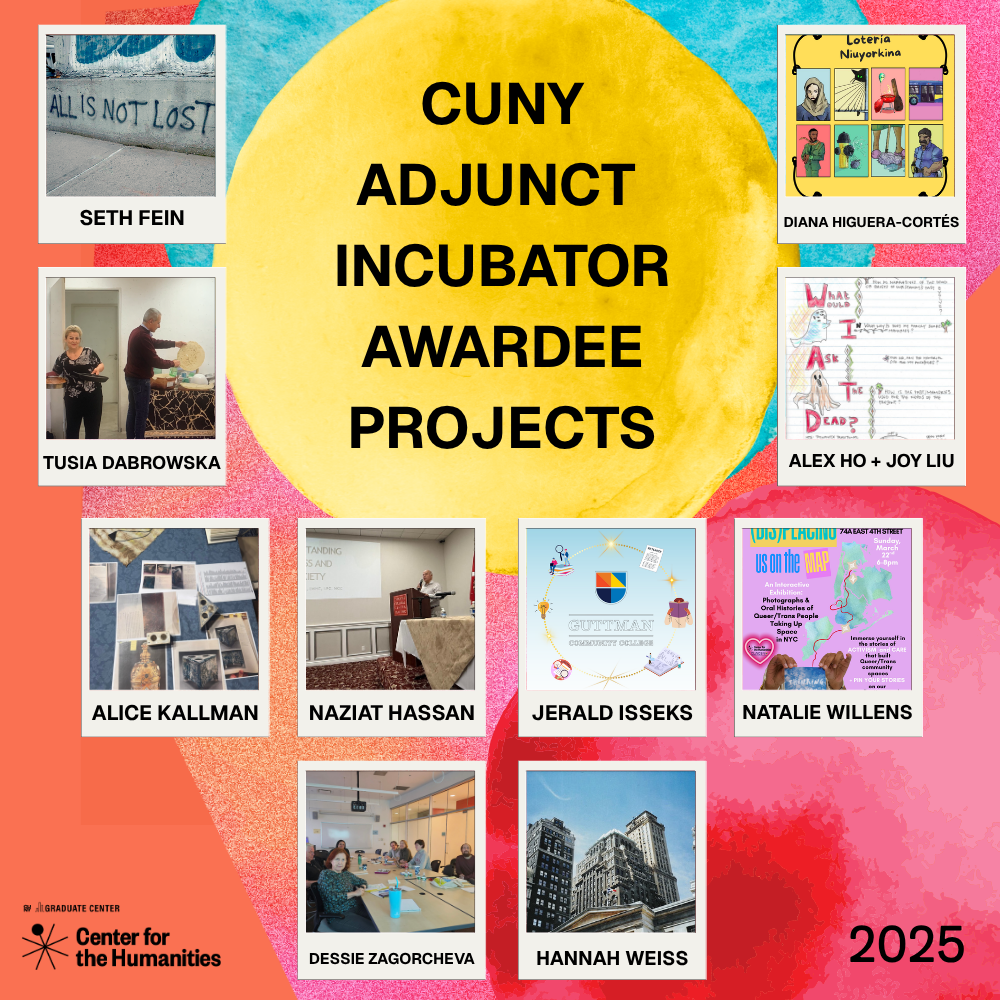
Celebrating the 2025 CUNY Adjunct Incubator Award Projects: Public Scholarship and Social Justice
Distributaries
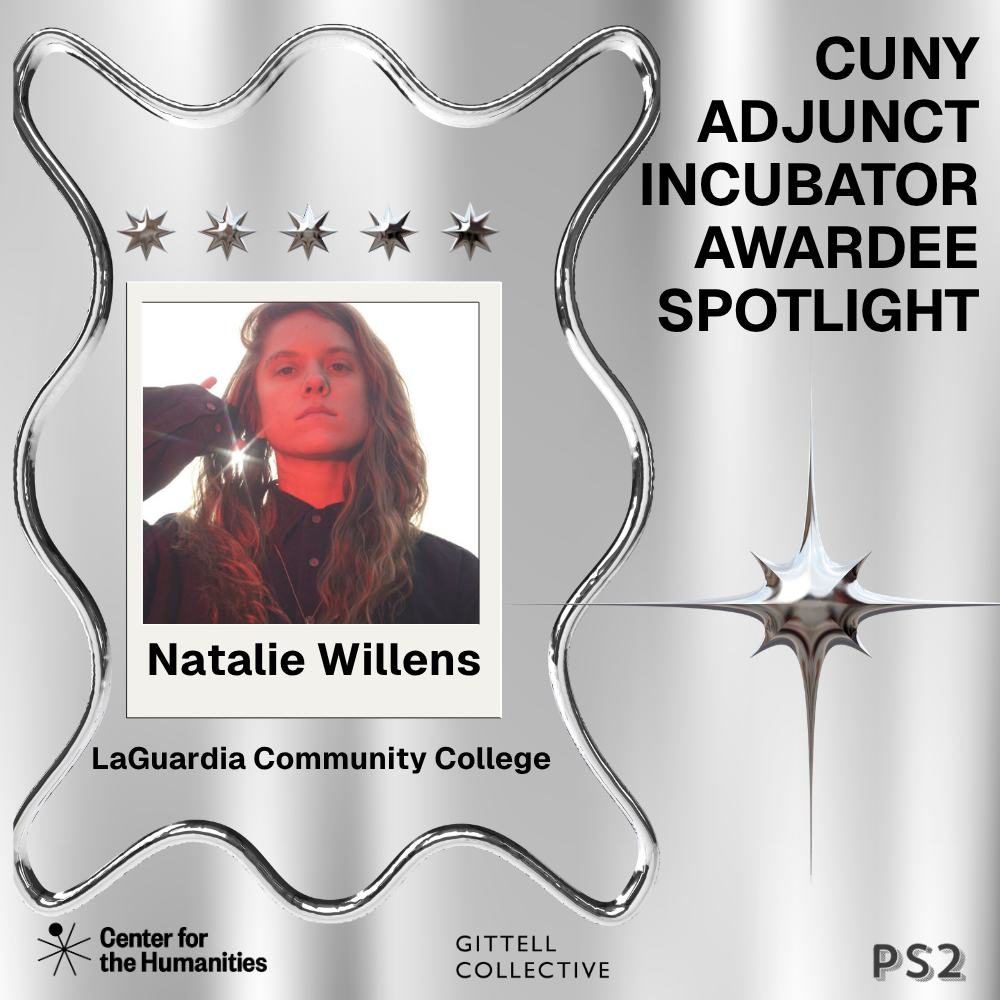
(Dis)placing Us on the Map: An Interactive Exhibition and Reflection
Distributaries

Enhancing Media Literacy Skills in the Digital Age
Distributaries
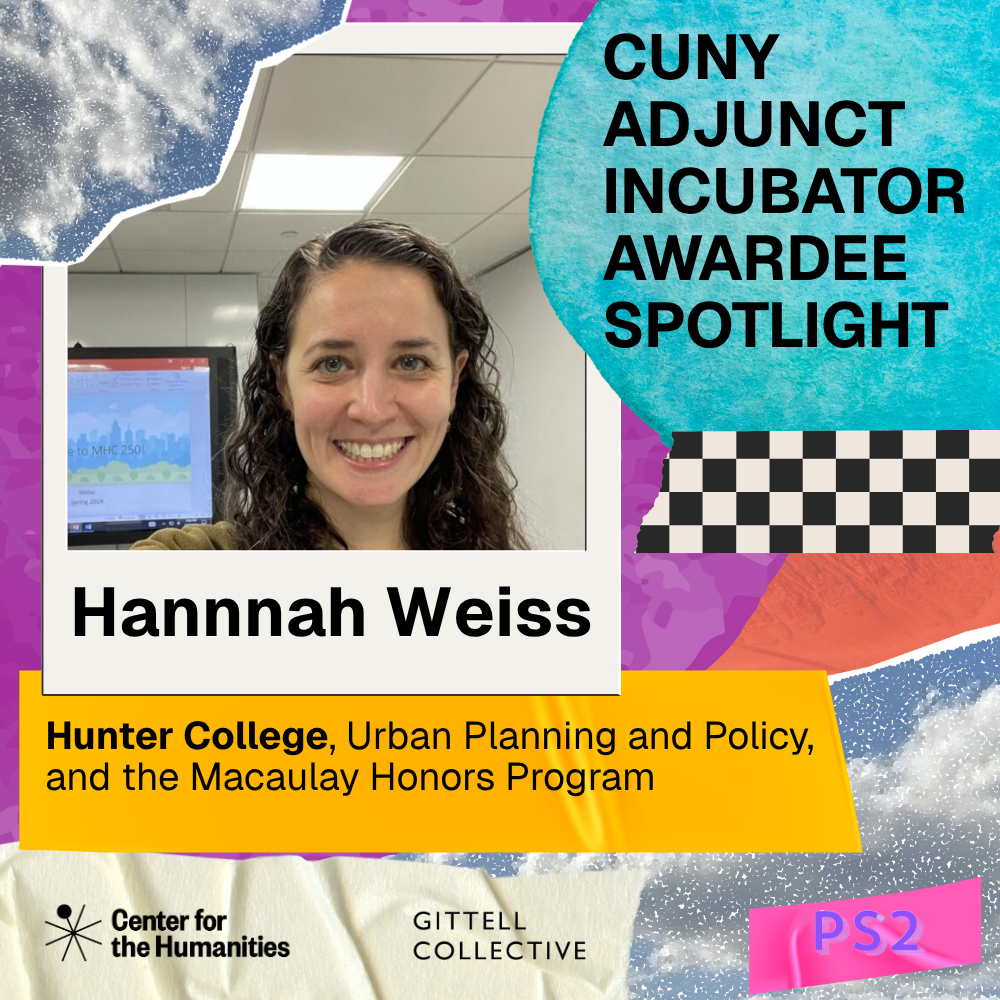
Investigating the Intersection of Housing & Immigration
Distributaries

La Lotería Niuyorkina: A pedagogical toolkit to explore Spanish varieties through the Linguistic Landscape
Distributaries

All Is Not Lost ∞ Noguchi near Milton in Queens
Distributaries

Where Europe starts: Interviews with Seven Migrants from Africa and the Middle East who Crossed the Białowieża Forest to Seek Asylum in the E.U.
Distributaries

Ghost Notes: A Journaling Practice for Taiwanese American Autoethnography
Distributaries

Syrian Culinary Superstitions
Distributaries

Well-being and Resilience: Mental Health and Stress Management Workshop Series
News
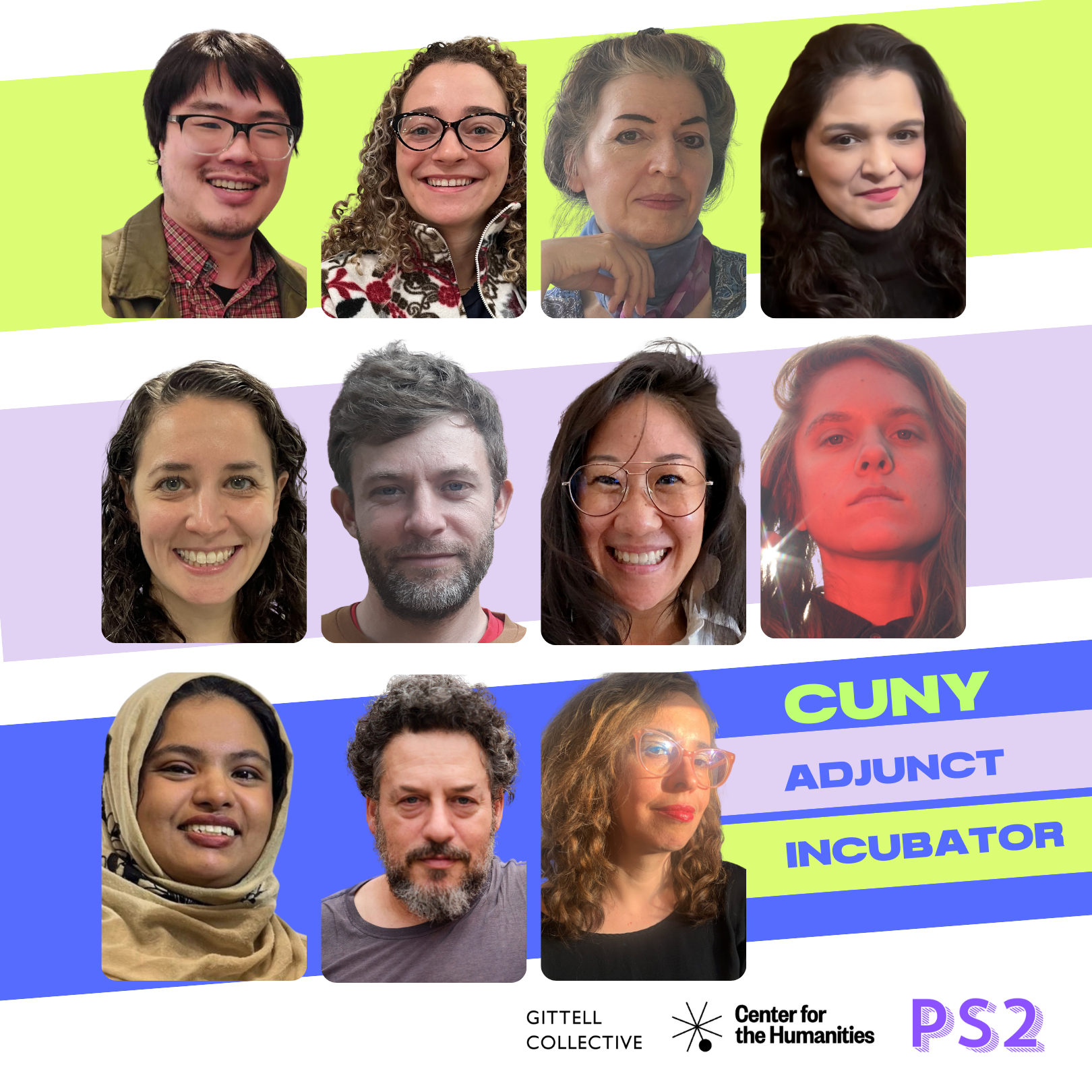
2025 CUNY Adjunct Incubator Awardees
Opportunities, News & Grants
