Ghost Notes: A Journaling Practice for Taiwanese American Autoethnography
December 12, 2025

We are honored to present CUNY Adjunct Incubator work. Please read about the public scholarship of Joy Liu and Alex Ho (Borough of Manhattan Community College, or BMCC) and its impact below.
Ghost Notes: A Journaling Practice for Taiwanese American Autoethnography
by Joy Liu and Alex Ho
As two CUNY adjuncts with shared interests built on our shared heritage backgrounds and work experiences, we undertook a project focusing on oral history or autoethnography methodologies as well as artmaking and reflection. We looked to the idea that we could follow an art sense of what we were moved to make and explore, as well as working in dialogue between two peers, for this summer season. Auto-ethnography – the analysis of one’s own sociological environment – and oral history collection – the preservation and analysis of oral storytelling – are key practices in our courses, but are not necessarily familiar to most students who may have more traditional views of scholarship. Nor are they methods that we have always felt equipped to execute and teach ourselves. Ultimately, our CAI project reoriented us to uphold essential pedagogical elements of these qualitative practices, as we practiced and discussed them in a safe, exploratory space.
The Theme of Haunting
We met on Zoom video conferences in a largely biweekly schedule where we tasked ourselves to identify four themes to discuss and fashion materials around. We were inspired by two recent Taiwan Studies books – “Haunted Modernities: Gender, Memory, and Placemaking in Postindustrial Taiwan” by Anru Lee and “Island X” by Wendy Cheng–as examples of studies into postwar Taiwanese communities that invoked particular themes of “haunting” and the “structure of feeling” of memorials to highlight issues of political and socioeconomic violence. “Haunted Modernities” was such an exciting jumping off point for both of us–looking at both the book and recorded book talks–that made us commit early on to centering the theme of haunting in our project, as a generative concept that allowed us to gracefully approach unresolved topics. We proposed three additional topics–islands, the Cold War, and (gendered) labor–finding additional shared texts that excited us, like Tonio Andrade’s “The Lost Colony” and “How Taiwan became Chinese”. However, we still found that the process was challenging because we spent a fair amount of energy in simply imparting and disentangling a few different family stories between the two of us, and we recorded them in a hodge-podge of Google slides and Google docs notetaking, but this left us again with simply the enthusiasm of having discussed these topics but not having an end point to hold these collections.
Some of the challenges we had were the simple task of conceiving of the idea of Taiwan, Taiwanese, and Taiwaneseness – already a complex, hybrid identity – along with tensions around our feeling of the “Taiwanese American” experience. These issues around identity seemed to hamper our ability to deeply invest in one story or another when they were so various and at times at odds with one another – the simple political tension between benshengren and waishengren identity formations, for instance. Nonetheless, as Taiwanese American who both also identify as benshengren, also known as the Minnan-speaking (southern Fujianese dialect), population that were relatively attached to the eventual development of Taiwanese independence and democracy in 1986-7, but who also are born from varied but related U.S. immigration circumstances of our parents in the 70s, where the KMT-U.S. alliance was a factor, the feeling of being invisibilized paired with strong emotional reactions to the topic of identity are telling for both of our personal histories.
Ultimately, we landed on the idea of a journaling process called “Ghost Notes”.
Drawing from Anru Lee’s argument in “Haunted Memories” that the bonds between the living and the dead (descendants and ancestors) are expressed through folk traditional rites that are meant to be a sincere communication with the dead, we looked to one main aspect of Chinese ancestral worship –the burning of ceremonial paper, often called “joss paper” (a Portuguese originated term) or “jinzhi” (“gold paper” in Chinese) or possibly most appropriately called “ghost money” –and decided to literalize this ritual. Where joss paper is meant to give the idea of material wealth to the afterlives of our deceased, we also thought of the idea of paper currency (“a bank note”) as a physical medium of communication (like a simple note) and asked ourselves, what if we could write the oral history questions, that we have had difficulty crafting, onto ghost money to be sent to our ancestors (and never to be answered)?

An original collage created in response to workbook prompts, including "What Would I Ask the Dead?"We pivoted to the idea of creating an inspiring and accessible journal or workbook as we came closer to our deadline in order to bring our teaching and learning practices into use. We decided that the open-endedness of our project could be modeled as a pre-writing exercise for individuals like ourselves, with diasporic backgrounds and involved in the intersection of humanities and social sciences, to help us bring a more considered autoethnographic perspective to our work. We have taken each of our themes and transformed them into evocative phrases that all involve haunting as headers for particular pages of our workbook: ”What Would I Ask the Dead?”, “Out of Place”, “The Absent Autoethnography”.

Haunting connotes reminders and realizations of the absence we store as children of the diaspora. We have begun the process of handwriting these pages and crafting question prompts to share with each other and for each of us to handwrite responses back. We are prioritizing the act of asking questions to remind us to guide each other to share and providing a place for it, whether by listening and conversation, or by giving space and lines in a notebook. This physical, tactile activity has the benefit of making us slow down and identify some clear questions and responses, but also allows us the play space to include doodles and to graphically organize our thoughts. We will be undertaking this throughout this fall season.
Our final “journaling practice” strategy creates a meaningful framework for identity, memory, and oral history expression and exploration. We allow ourselves the ability to craft and give attention to our family histories. For instance, in “Ghost Notes”, Joy wants to include the historical and political implications of her parents’ upbringings in the 50s and 60s in Taiwan, including their work lives and the influence of United States relations and aid on Taiwanese culture at the time. Joy envisions placing her parents’ stories alongside a paragraph explaining “Taiwan Miracle”, the postwar-Taiwan period of growth of manufacturing industries as the export processing zones of global economies.

Final Reflections
Ultimately, the 2025 CAI program has given us an indelible experience to make interventions into how we, as Taiwanese American ethnic studies teachers, bring ourselves into our work, giving us the responsibility to continue this work beyond this program’s timeframe. We intend for our “Ghost Notes” journaling practice to be a productive resource for any individual who is pursuing race and ethnic studies, especially for individuals who are interested in unpacking their diasporic identity. We hope that, as CUNY adjuncts, we can continue to carry the power of connecting artistic and complex themes, such as haunting, to our social science pedagogy, through potential events and publications.


Alex Ho
Alex Ho is an ethnic studies and media arts educator with ten years of education experience and a film and media. Alex teaches in the Department of Ethnic and Race Studies at Borough of Manhattan Community College (BMCC).

Joy Liu
Joy Liu is a Clinical Social Worker. A former Museum educator, Joy now teaches in the Department of Ethnic and Race Studies and the Department of Academic Literacy & Liguitics at Borough of Manhattan Community College (BMCC).
Read more about CAI Projects and Awardees
News & Distributaries
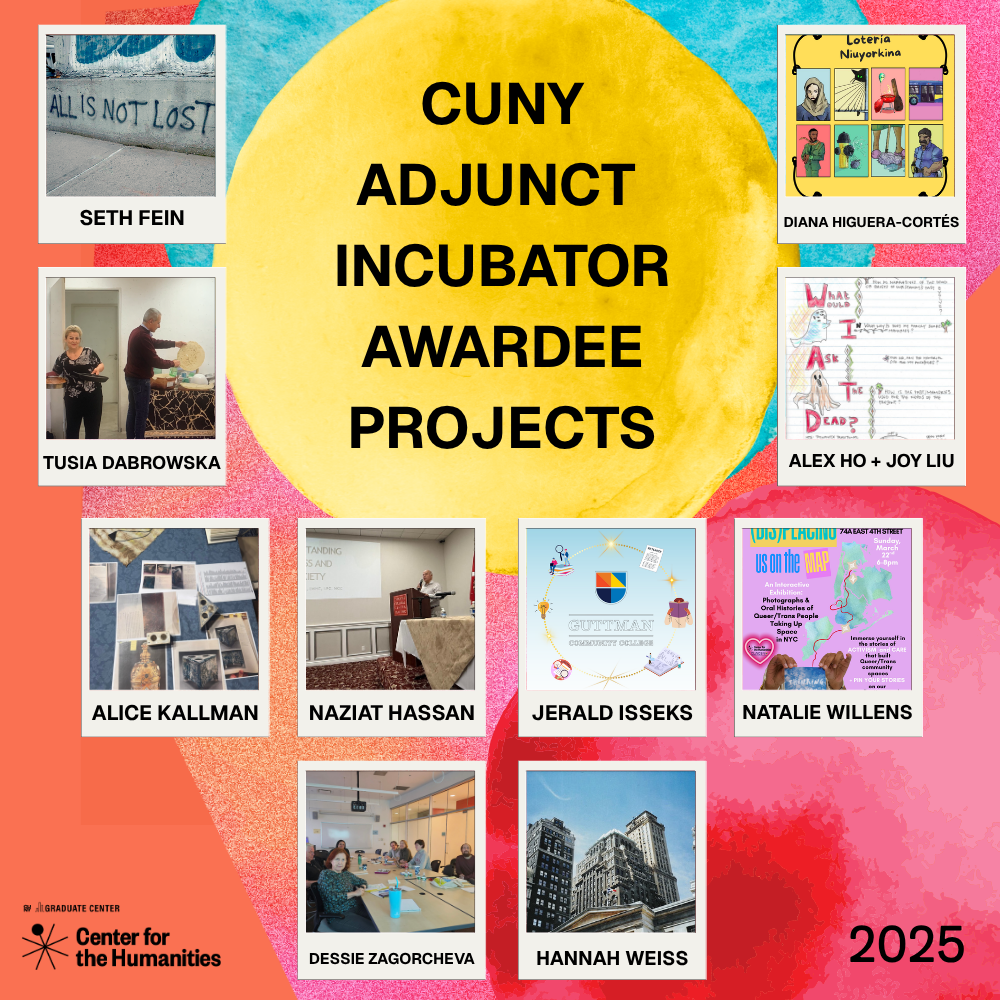
Celebrating the 2025 CUNY Adjunct Incubator Award Projects: Public Scholarship and Social Justice
Distributaries
(Dis)placing Us on the Map: An Interactive Exhibition and Reflection
Distributaries

Enhancing Media Literacy Skills in the Digital Age
Distributaries
Investigating the Intersection of Housing & Immigration
Distributaries

La Lotería Niuyorkina: A pedagogical toolkit to explore Spanish varieties through the Linguistic Landscape
Distributaries

All Is Not Lost ∞ Noguchi near Milton in Queens
Distributaries

Participatory Research in Social Justice at Guttman Community College
Distributaries

Where Europe starts: Interviews with Seven Migrants from Africa and the Middle East who Crossed the Białowieża Forest to Seek Asylum in the E.U.
Distributaries

Syrian Culinary Superstitions
Distributaries

Well-being and Resilience: Mental Health and Stress Management Workshop Series
News