We are honored to present CUNY Adjunct Incubator work. Please read about Alice Kallman’s (Mina Rees Library, CUNY Graduate Center) public scholarship and its impact below.
This summer, I was able to invest my time and resources into improving my Arabic and interviewing Syrians currently living outside of Syria due to the civil war that ended this past December. I continued interviewing Syrian Jewish family members, while also expanding my project to speak with Syrians who identified as Muslim, Muslim-raised agnostic, and individuals with mixed and overlapping Syrian, Bedouin, and Palestinian heritages. I was also able to devote more time to text-based research to accompany my findings, some of which explained the differences I found between regional and religious Syrian superstitions.
In broaching the subject of Syrian superstitions, I found certain beliefs to be common, such as the evil eye and protection from it via the chamseh and the color blue. However, many were also entirely new to me, including one told to me by an interviewee about pouring coffee: “For the people who drink bitter coffee, قهوة مُرَّة, Bedouins, when you pour the coffee, you have to start from the right side. Do not ever start from the left side, it’s disrespectful…there is a phrase: ‘دير القهوة على اليمين لو كان أبو زيد على الشمال’ Start from the right even if Abu Zayd is on the left.’”
I also learned that some superstitions I thought might be regional were actually specific to Syrian Jews. For example, growing up, I was always told to salt my eggs or risk invoking bad luck. A Syrian Jewish elder suggested that Jews salted the korban (sacrifice) in the days of the temple. She also said, “When in mourning, you eat a hard-boiled egg in Syrian bread and you don’t salt it.”
This tradition was unknown to my non-Jewish interviewees, but upon digging into the subject, I discovered a possible explanation—the Shulchan Arukh notes that eggs are considered meals for mourners, at least in part due to their round shape. Rashi states: “mourning (sorrow) is a wheel that revolves in the world (it touches everyone sooner or later as a revolving wheel touches every spot in turn)” (Bava Batra 16b).

The Table: My ceramic art displayed next to inspiration from books about medieval-era ceramic/metal art in the Middle East.
As for the power of salt, Sefer Melachim (The Book of Kings) II in 2:21 sees Elisha healing water that is stated to be “bad” by throwing salt into it; “He went to the spring and threw salt into it. And he said, ‘Thus said GOD: I heal this water; no longer shall death and bereavement come from it!’”
When asking other interviewees about salt, I came across an unrelated but interesting story with historical roots pointing to how empire and imperial expansion impact language. A Syrian Muslim interviewee told me about the roots of the Syrian slang word, toz.
“People used to traffic salt from Turkey to Syria during the Ottoman Empire, so if you’re only transporting salt, you won’t have to pay tax on it. So you would just tell the border policeman ‘toz’ [note: toz = Turkish word for salt] meaning ‘it’s only salt.’ And after a while, this word became in Arabic ‘I don’t care.’ So if someone says, ‘I’m going to do this to you, I’m going to tell your mom about what you’re doing,’ you’re just going to say, ‘Toz.’”

Amulets: A leather triangular pouch – an amulet containing a Quaranic verse – on a string next to a silver ornate khamseh on a string.
To synthesize these early findings, I created a dinner/showcase where I played audio clips from different interviews, cooked Syrian dishes (including kanafeh and the possibly-first-ever hummus recipe from 13th-century cookbook Kitab al-Wuslah ila l-habib), and displayed art I created as inspired by my research. Some interviewees were unable to attend in person but connected via video or were sent photos and recordings of the event.

Reflections
Future goals include deepening my research into whether and how the revolution has impacted this subject, as well as how traces of occupation or colonization (French, Ottoman, etc.) may tie into specific superstitions. Thinking about this subject ethnically and regionally, as opposed to nationally, is also part of my goal in combating both nationalist and Zionist ahistorical overlays onto a complex system.
I also hope to do my next round of interviews, ideally representing Syrian Kurds, Alwaites, and Christians, in Syria إن شاء اللّه


Alice Kallman
Alice Kallman is an adjunct reference librarian in the Dissertation Office at the Mina Rees Library at CUNY Graduate Center. Over the course of her studies, she worked at the New York Public Library and then with an oral history project at the Queens Public Library. Alice also works part-time at the Queens Public Library in the Correctional Outreach department, doing reentry programming for individuals returning home from incarceration.
Read More about the CAI Awardees & Projects
News & Distributaries
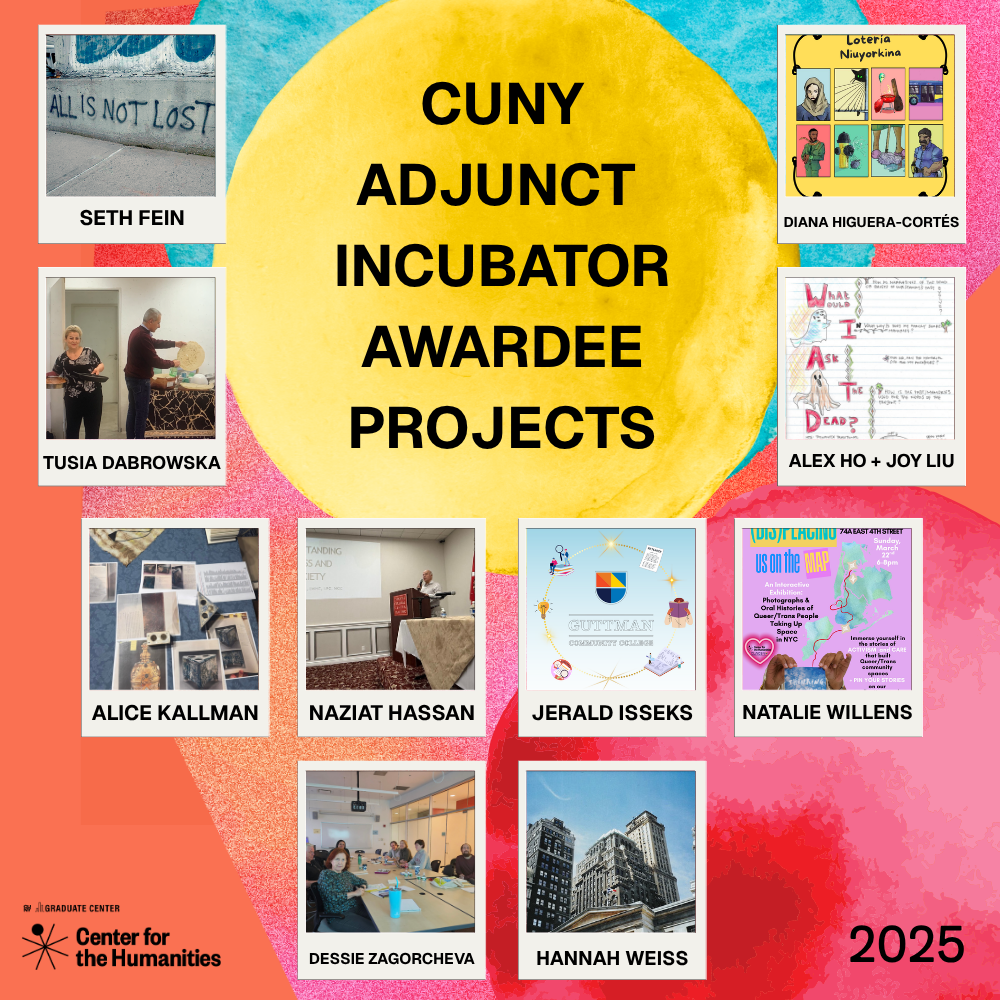
Celebrating the 2025 CUNY Adjunct Incubator Award Projects: Public Scholarship and Social Justice
Distributaries
(Dis)placing Us on the Map: An Interactive Exhibition and Reflection
Distributaries

Enhancing Media Literacy Skills in the Digital Age
Distributaries
Investigating the Intersection of Housing & Immigration
Distributaries

La Lotería Niuyorkina: A pedagogical toolkit to explore Spanish varieties through the Linguistic Landscape
Distributaries

All Is Not Lost ∞ Noguchi near Milton in Queens
Distributaries

Participatory Research in Social Justice at Guttman Community College
Distributaries

Where Europe starts: Interviews with Seven Migrants from Africa and the Middle East who Crossed the Białowieża Forest to Seek Asylum in the E.U.
Distributaries

Ghost Notes: A Journaling Practice for Taiwanese American Autoethnography
Distributaries

Well-being and Resilience: Mental Health and Stress Management Workshop Series
News