We are honored to present CUNY Adjunct Incubator work. Please read about Hannah Weiss’s (Hunter College, Urban Policy and Planning, and the Macaulay Honors Program) public scholarship and its impact below. Please check out the resources at the end of this piece.
Where would you go if you needed to hide?
Home is the obvious answer. As ICE raids on workplaces, transit, federal courthouses, community baseball games, and more render the public domain unsafe, especially for undocumented immigrants, staying home as much as possible makes sense.
But what if home carries its own challenges? Maybe the structure is in disrepair, the landlord is threatening eviction, the unit or occupancy status is technically illegal, or there is a roach infestation, people at home are unsafe, or there is no home at all. Immigration status complicates housing status.

Basements and other illegal dwellings
Many immigrants do not sign a lease, electing to live as they are: undocumented. As Hurricane Ida’s rains pounded down in 2021, flooding New York with record-breaking single-hour rainfall, 11 people tragically drowned in basement apartments in Queens; nearly all 11 were immigrants. They died in six apartments, five of which were illegally converted cellars and basements. Deeply affordable housing strikes a tenuous balance between quality and quantity. What standard should we hold housing to, knowing that the alternative may be no housing at all? How can we reach people in substandard housing to protect them from disasters, especially when they might be trying to live off the grid?
These basement apartments were illegal, and justifiably so, yet the threat of punishment may have sent people into deeper hiding, further ostracizing them from the very resources that might have saved their lives. A Hunter College student with family members who are undocumented shared, “I didn’t think you could be undocumented and have a lease. I thought you had to get something under the table or live with somebody or in the basement.” How can we educate people about their rights in ways they can act on, that are not just empty promises?
After Hurricane Ida, the city and state collaboratively launched a fund for survivors with property damage who did not qualify for federal emergency aid (FEMA) due to their immigration status. The fund totaled $27 million, of which only $2 million was distributed two years later when the fund was finally closed. Per the fund’s rules, each applicant could receive up to $72,000, but the average payout was $5,825 per person. Why? Applicants were required to purchase items for reimbursement before receiving the funds. If you are living in an illegally converted basement apartment, do you have a spare $72,000 lying around? The rules for the funds, like the housing rules, are not designed with the needs of undocumented immigrant neighbors in mind.
Housing Court: affirmative litigation and eviction prevention
Emphatically, Munonyedi Clifford, Attorney-in-Charge of the Citywide Housing Practice at The Legal Aid Society, notes that Housing Court was designed to empower tenants. Safe, decent, affordable housing was the goal. Today, Housing Court tenant activists primarily play defense in the fight against eviction, with any housing considered a victory.
Right to Counsel (RTC), a big but still incomplete win in this fight, provides free attorneys to tenants facing eviction. Immigration status is not a barrier to RTC representation since the program is largely funded by sources other than the federal government. Approximately 84% of tenants with a lawyer win their case in housing court and get to stay in their home. In 2024, 30% of tenants eligible for an RTC attorney were granted one, including undocumented clients. Only 50% of tenants show up for eviction proceedings at all, forfeiting their case and their home. Housing Court is not for the faint of heart.
Brooklyn’s Housing Court looks like a DMV. A long line snakes out the door and down the hallway. Everyone must go to Window 1 or Window 10 to get a number. Then, they wait. The waiting room is crowded and dingy, with linoleum floors like a school cafeteria and pews. Workers staff two additional windows, and six sit empty. If the city hired more people, the process would move faster and feel less dehumanizing. “Yellow 7 to window 8, yellow 7.” The room is peaceful but agitated. “This is like sitting in the welfare office, like this is ridiculous.” “I been here two hours.” “I didn’t want to spend all day here.” Being seen at the window is not the end of the line. More lines follow.
Every housing court in New York functions differently. There is one per borough, each shepherded by a different Administrator. All five offer the Right to Counsel program, although it is run differently in each borough. Brooklyn’s Housing Court is also organized around another pilot program, further meant to prevent eviction and homelessness.
Programs for tenants to pursue affirmative litigation, cases where they are on the offensive, seeking repairs and better living conditions, are harder to access. These are the sorts of cases Clifford says Housing Court was initially intended to adjudicate, and they are relatively rare.
Recently, Clifford has observed an “uptick in clients not wanting to litigate,” people who feel safer walking away from their home than leveraging Housing Court to fight a landlord for it, perhaps due in part to fears around ICE. ICE officers have not shown up at Housing Court, at least as of our conversation in August 2025, but her clients see their advertisements on TV and hear stories of them detaining people at federal courts, and that leaves an impression.
Further, Housing Court, for all its lofty ambitions, is not a safe space, Clifford admits. Cases are published online with both parties’ names and the full address in question. Before 2019, it was legal for landlords to use this information to deny housing to people who had previously sued a landlord for repairs. Today, the information is publicly available to and searchable by ICE (and everyone else).
If you are undocumented, even if you live in a legal dwelling, know your landlord, and know your rights, you are unlikely to seek repairs (launch affirmative cases) through Housing Court, given that doing so exposes your safest hiding space. Unwillingness to go on the offensive leaves undocumented immigrants vulnerable to landlord abuses, from refusing to make repairs, to shutting off heat and hot water, to changing the locks. In his book, Sheltered: Twenty Years in Housing Court, Sateesh Nori describes this system:
“Many landlords build their business plans around buying buildings cheap, without regard to the tenants who live in the building. These tenants build a community in the neighborhood around the building. The neighborhood becomes vibrant. Real estate values go up. The landlord realizes that they can charge more rent. They start evicting long-term tenants whose rents are limited by law. They make money. They buy more buildings.” (152) He asks himself, “Should I have worked to dismantle this system rather than uphold it?” (9)

Brief notes on areas for additional study
Threats to contact ICE
It is illegal for a landlord to threaten to call ICE in both New York City and New York state. Even asking about a potential tenant’s immigration status is not allowed, as it can be seen as discrimination. Still, we know that landlords have been threatening to report their tenants to immigration authorities for a long time, as observed by Matthew Main, a former CUNY Law Professor and Mobilization for Justice, Inc. Senior Staff Attorney, and others, who identify this as a form of illegal eviction. In these cases, tenants have the right to sue their landlord for harassment. Given that the crime (the landlord’s intimidation) is a threat to go to authorities, how can we ensure that victims feel safe reporting the crime to (albeit different) authorities? Immigrants deserve to feel safe at home.
Domestic violence
Domestic violence is a bellwether for economic and social crises. It increased during the COVID-19 pandemic and coincides with economic recessions and weather events that depress moods, isolate, and keep people indoors. Are undocumented immigrants especially vulnerable to domestic violence because of fears of leaving the house? If so, how can they be reached and helped, especially if they are not comfortable calling the police or going to the hospital?
Migrant shelters
Shelters are closed during the day and have time limits for how many nights clients can stay. Given Eric Adams’ cooperation with the Trump Administration, are these shelters safe places for undocumented immigrants? How is Mayor Zohran Mamdani administering these shelters? What services are people provided while they are staying in these shelters to connect them to permanent housing? Is their discharge address recorded anywhere that might be accessible to ICE officials?
Undocumented tenants using home as a hiding place do not want to be found, which makes it hard to ensure the housing is safe and offer legal counsel and protections against abusive landlords, intrusive rats, and other harmful living conditions. In these times, more must be done to empower our most vulnerable neighbors with information and resources. Schools are a trusted place that could be leveraged.
Proposal: Tenant Legal Clinics and Outreach through NYC Public Schools and CUNY Colleges / Universities
The following ideas stem in large part from a conversation with Hunter College student Noelia Vinas Tavarez.
In an increasingly hostile environment for immigrants, schools are seen as relatively trustworthy and safe places. Immigrant communities would benefit from additional information and resources to exercise their housing rights, and schools should be leveraged as a resource.
Lacking a full understanding of their rights, immigrant tenants may not recognize problems that they have the power to fix or know how to safely pursue solutions. We can change that. Specifically:
1. Know Your Rights tenant outreach flyers: K-12
- Led by the Mayor’s Office to Protect Tenants (MOPT), Mayor’s Public Engagement Unit (PEU), or Housing Preservation and Development agency (HPD), I propose a quick quantitative analysis to identify public/ charter/ magnet schools with the highest rates of immigrant student enrollment. This data might already exist.
- Any school with over X% immigrant families, with X set by the lead agency(ies) or determined through the analysis, should receive outreach flyers to be sent home in backpacks with all students.
- The flyers would include information on tenant rights, such as access to heat and hot water, protection from lockouts, and pest-free living conditions.
- The flyer would make clear that these rights and certain resources apply to all tenants, regardless of immigration status.
2. In-person Tenant Helpline event / Legal clinic: K-12
- Based on the data obtained in 1a, OCJ and PEU could host an in-person tenant helpline event with a free legal clinic, drawing on lawyers from the Right to Counsel network. My research indicates that schools would be an ideal place to host an event to educate, empower, and assist tenants, especially immigrant tenants, with affirmative litigation, applications for financial assistance, apartment searches, information on their rights, and more. PEU staff could assist with applications for other public benefits and provide information to complement the legal services.
3. Tabling and potential legal clinic: CUNY
- Tabling at CUNY colleges/universities spreads information to students and, indirectly, their families. CUNY colleges/universities have large immigrant populations, and CUNY students often live with or close to their families. On a recent trip to Hunter College, I saw a political campaign tabling alongside student groups, professional associations, and more. Tabling reaches young adults who might otherwise be hard to access, empowers them with information, and provides an immediate opportunity for them to ask questions; it puts a face on otherwise bureaucratic government resources and encourages people to seek out help.
- If possible, tabling teams would include a lawyer from one of OCJ’s partner nonprofits, in addition to representatives from PEU and HPD.
- Tabling could also advertise a legal clinic/in-person tenant helpline event that would then occur on campus.
Additional Resources
- Desmond, M. & Kinniburgh, C. (2018, Fall). The faces of eviction: Sociologist Matthew Desmond discusses the scope of the eviction epidemic— and how ordinary people are fighting back. Dissent.
- Desmond, M. (2016, March 5). The eviction economy. The New York Times.
- Garsd, J. (2025, July 3). Immigrants with no criminal convictions represent sharpest growth in ICE detention population. NPR WNYC.
- Moyer, M.W. (2020, December 7). Undocumented immigrants are half as likely to be arrested for violent crimes as U.S.-born citizens: Some of the most solid evidence to date shows that President Trump’s cornerstone immigration policy was built on a wholly false premise. Scientific American.
- Nunez, A. (2023, February 7). New data reveals how New York disbursed aid to undocumented immigrant victims during Hurricane Ida: Data first obtained by City Limits show the state gave out just over $2 million of the $27 million set aside for the relief fund. Al Dia.
- New York City Community Development Block Grant Disaster Recovery. (n.d.) Hurricane Ida: Overview. nyc.gov.
- Parra, D. (2021, December 1). Two months after Ida, only 32 undocumented New Yorkers have received storm damage relief funds. City Limits.
- Spauster, P. (2025, September 11). Fewer eligible tenants get ‘Right to Counsel’ after pandemic, program expansion: Report. City Limits.
- Sundaram, A. (2025, August 31). NYC immigration arrests and deportations surge after slow start, data shows. Gothamist.
- Xu, A. (2025, February 21). ‘Don’t Bully or Hurt Me’: Undocumented Immigrants Speak Out on Illegal Threats to Call ICE. Documented.
- Yam, K. & Venkatraman, S. (2021, October 18). Ida’s forgotten victims: Nearly all storm’s basement deaths were Asian residents, obscured by climate injustice. NBC News.

Hannah Weiss
Hannah Weiss is an adjunct lecturer in Urban Planning and Policy and the Macaulay Honors Program at Hunter College. She has worked on housing/homeless policy from different angles for 15 years.
Read More about the CAI Awardees
News
News & Distributaries
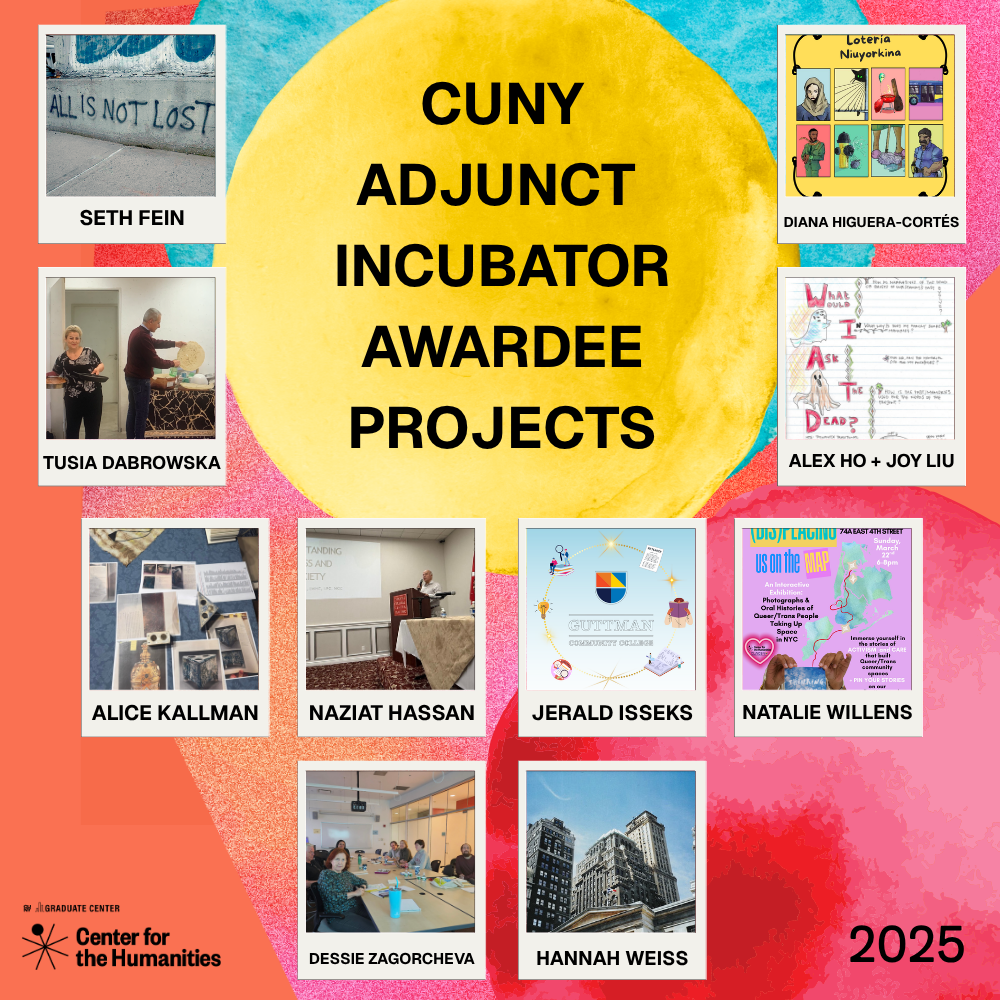
Celebrating the 2025 CUNY Adjunct Incubator Award Projects: Public Scholarship and Social Justice
Distributaries
(Dis)placing Us on the Map: An Interactive Exhibition and Reflection
Distributaries

La Lotería Niuyorkina: A pedagogical toolkit to explore Spanish varieties through the Linguistic Landscape
Distributaries

All Is Not Lost ∞ Noguchi near Milton in Queens
Distributaries

Participatory Research in Social Justice at Guttman Community College
Distributaries

Ghost Notes: A Journaling Practice for Taiwanese American Autoethnography
Distributaries

Syrian Culinary Superstitions
Distributaries

Well-being and Resilience: Mental Health and Stress Management Workshop Series
News