Between Delivery: Letter Threads After the Theresa Hak Kyung Cha Archive (Part II)
April 16, 2026

This series of letters emerged from Ju Ly Ban’s work as a Fellow for Lost & Found: The CUNY Poetics Document Initiative from the Center for the Humanities at the CUNY Graduate Center, grounded in archival engagement with the work and life of Theresa Hak Kyung Cha. Attuned to the fragments of her presence in the archive, the letters imagine otherwise by rethinking how she has been approached, interpreted, and held in relation.
Read Part I Here
Part II
Letter #4
Dear Isabelle and Cici,
It’s late as I write this, after what feels like a long stretch of quiet. I hope you’re both resting well in your corners of the world.
I’ve been turning over the clicks, the dust, and the lingering question marks left in my mind after reading your letters. If there’s one thing I’ve settled on, it’s this: our connection to Theresa and her work refuses simplicity. Haha. In other words, none of us can say that our draw to her writing is merely a shared kinship with a country (or countries) in Northeast Asia.
I mention this because, here in New York, the question often comes my way: “Have you read Dictee?” It seems inevitable that once someone learns I was born and raised in Korea. I’ve come to think of it as a gentler (or more pretentious) version of “Do you like kimchi?” though I confess my response carries a touch of defensiveness.
If I were to answer, I might say this: my relationship with Theresa is different from my relationship with kimchi. And yet, both are layered, complicated, and impossible to disentangle from who I am.
Today, though, I want to talk about dust.
I recently noticed that the Online Archive of California updated some Theresa-related materials. Especially, Isabelle, take a look at the photos. There are a few from her trip to Korea that might resonate with your recent visit.
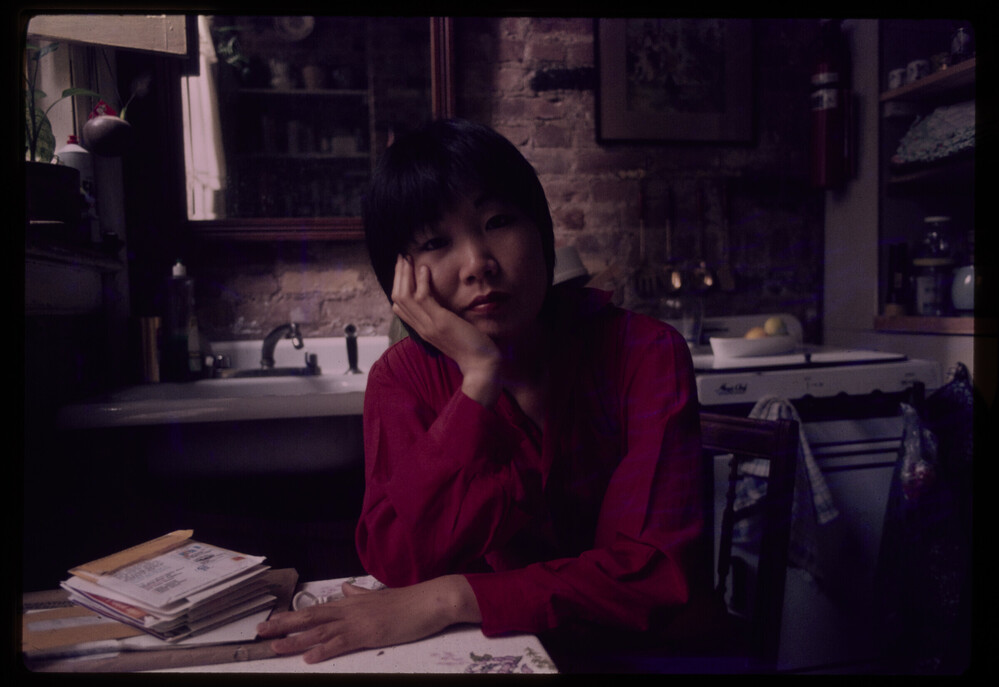
But the dust I’m lingering on today is in a newly updated photo titled Untitled (Theresa and family).1

Theresa Hak Kyung Cha: Untitled (Theresa and family), 1974-1981; 11 color slides.; 0 x 0 in.; University of California, Berkeley Art Museum and Pacific Film Archive; Gift of the Theresa Hak Kyung Cha Memorial Foundation
The setting is nighttime. The dim light suggests a kitchen. Theresa sits at a table, wearing a red long-sleeved shirt. She’s looking directly at the camera, her right hand cupping her chin. The fabric of her shirt—thin, neatly creased, as if new or carefully kept—falls softly over her frame. The lower half of her body disappears into shadow. My gaze lingers there, in that dark part of the image, before returning to the red of her garment. Her left hand rests lightly on the table, surrounded by scattered mail and papers. The weight of her arm, of her body pressing into the table, feels palpable. In that weight, I imagine a time and space I’ve never been to, but I know existed.
What strikes me most is that I’ve always known Theresa as a stoic, monochrome figure. A familiar image of the Asian woman in black and white. Until now, I don’t think I’ve ever been allowed to feel the weight of her presence in the photographs I’ve seen. This image offers a return of that weight, if I can call it that. I’m glad to share it with you.
What brought dust to mind as I studied this image was the red brick wall behind her. The kind I’ve only seen in kitchens like this since moving to New York. Those walls, with all the dust they shed, make me sneeze like crazy.
What I’m trying to say is this: dust isn’t something that only drifts in from far away. It’s created, scattered, and gathered close to us, often more intimately than we realize. I think about the dust in my own room, and I imagine the dust Theresa carried on her hands. In New York, Hawaii, Berkeley, Korea. And then, Cici, I reread White Dust From Mongolia you quoted, and I started thinking about the things that cross borders as effortlessly as dust: memory, violence, love, home, history. How they touch one another. How they mix, like dust from here blending with dust from there, without boundaries.
May this letter settle over you like dust. Quiet, unassuming, without a sneeze.
I’ll write to you again.
Hugs,
July
1 https://collection.bampfa.berkeley.edu/catalog/fbaf6dcb-a97f-458b-8ddd-5a23da3adc50
Letter #5
Dear July and Isabelle,
I am writing from Berlin, where I’ve been for a week now.
July, I read out your letter one night in my temporary Berlin apartment, accompanied by a cigarette. As I read, following your detailed description of Cha’s photograph, I imagined it as a film. Even without seeing the image myself, I pictured the close-up touches and greetings that introduced her through a sense of weight, which deliberately freed our ‘knowing of her’ from any existing frameworks. The weight feels generous, at ease.
My earliest memories of dust come through the objects meant to keep it away—a handkerchief, a fabric cover on a telephone. When I was little, my aunt would drape different fabrics over our furniture. The psychology and myth of this act of covering, of separating from dust, stays with me till today. Perhaps I saw dust through light—specifically, when I accidentally glimpsed a projector ray in darkness, dust motes twinkling before the lens. That was when I realized they were always there, and they were beautiful. Dust exists everywhere: in the red brick wall of Cha’s apartment, at airports, in my room as I’m typing. Yet I can’t always sense its presence. White Dust takes on new meaning now, after learning my great grandparents’ stories this summer. It makes me think about current geopolitical struggles, wars, and their relationship to distorted perspectives in any accounts that intentionally neglected the complexities of Northeast Asia.
Because of you two, and since my recent trip to Hong Kong and China, I’ve begun carrying Dictee with me again while traveling. Last night, before sleep, I read a few pages, then quickly flipped through the book, brushing the pages with my hands. I’d never paid such attention to the structure of Dictee before, but suddenly I could almost see how she assembled them through her hands. The structure became visible when I moved the pages in motion. I felt closer to her mind than I had in all these years. Among the index entries, my eyes stopped at TERPSICHORE CHORAL DANCE, reminding me of Isabelle’s research into Cha’s early dance training in Hawaii.
Speaking of hands and weight, in the photograph, one presses against the table, while another holds her cheek. They appear a bit larger than I’d imagined, yet somehow almost child-like—no rings, short nails.

Cha, Theresa Hak Kyung. Dictee. University of California Press, 2001. See “POLYMNIA SACRED POETRY,” p. 170.
Cici ended her letter with this quote, which is distinct from the line she referenced earlier: “my eyes stopped at TERPSICHORE CHORAL DANCE~”
Thinking of you.
Cici
Letter #6

A copy of Dictee by Theresa Hak Kyung Cha rests on a light wooden desk near a window. Sunlight falls on the book’s cover, which features a grayscale image of Cha. The photo was taken by Isabelle.
Dear July, dear Cici,
The weather is changing. For two weeks, a dark and heavy cloud slowly moved across the south of England, and London was steeped in a grey and misty fog, so persistent that its presence felt primordial. Two nights ago, I spotted the moon in the light-polluted skies, and the next morning, I woke to a fantastical blue, framed by my bedroom window. As I write this, the sun is warming my face, and I feel grateful, for the possibilities of change seem to persist in the absence of optimism.
The dust is settling.
About seven years ago, I lived with my friend in one of London’s oldest council estates. Built for East London’s factory workers, the Boundary Estate is made of red brick, walls that would make July sneeze.
My friend was looking for a job at the time, I worked at a gallery, and somehow, over the course of many months, we began playing out these archaic gender roles. He cleaned the house, did the laundry, went food shopping and by the time I got back from work, dinner was on the table. He would spend his days cleaning dust off shelves, every day, new thin layers of dust, and he would complain about it, the same way my mother did, always dusting, always muttering, day in and day out, where does all this dust come from.
Someone once told me that dust is made of dead skin. I never cared to find out if this is true, but the idea stuck—the thought that we are always surrounded by other people’s shedding, or even our own shedding, silent layers of time past. Unbeknownst to us, we live amongst the aged, past presence of ourselves and others.
I read Dictee again. I am becoming restless, for I feel that whatever it is that I am searching for cannot be found. I wonder if you ever had this feeling—this desire to find language in her work? To find a sentence that spills it out, declarative, defining, directional. I read, but it doesn’t feel like reading. I try to decipher, but all I see is a sandstorm of dead skin.
My camera is sitting behind me on my shelf. The tape is still in there—all I have to do is swivel around, grab the camera, press rewind, look through the viewfinder. And I would see my mother standing in front of King Sejong’s statue, standing in front of the man who gave modern-day Korea a system of writing by which we still abide today. I would see her taking pictures of the same heap of carved stone that Theresa’s brother sat beside, when she took a picture of him during their trip to Seoul to film White Dust.

Isabelle’s mother stands near the statue of King Sejong in Seoul, April 2024. Image from digitised Hi8 footage by Isabelle.
Be well, be held,
Isabelle