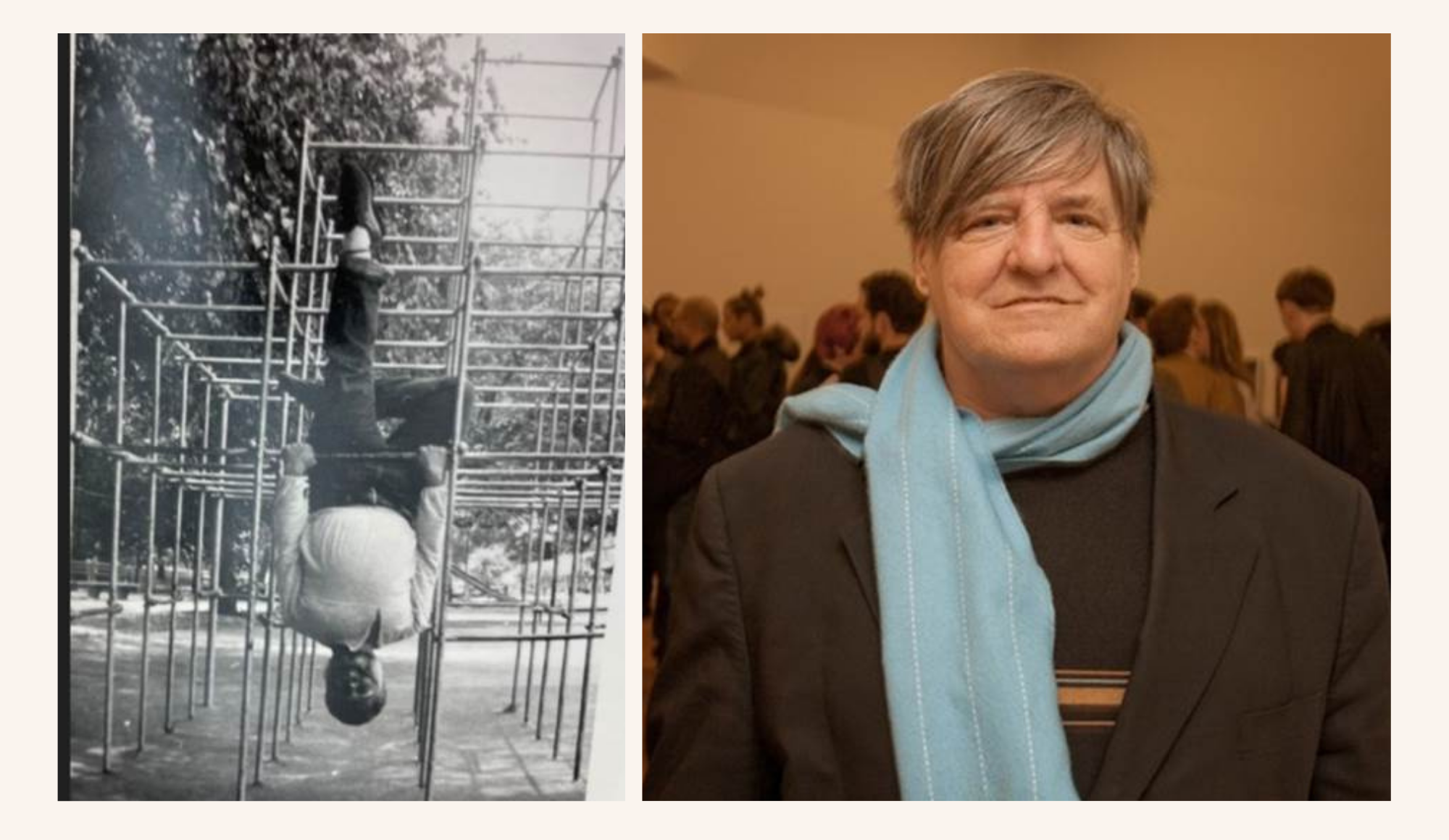
The following blog entry is a recollection of an archival research project by Lost & Found Fellow and CUNY Graduate Center student Rebecca Teich.
There is one story I could tell of the discovery of letters between New Narrative writer Kevin Killian and polymath science fiction, non-fiction, and cross-genre writer Samuel Delany, sometime between 1987 to 1993, that led me to the archive to uncover rich details of their relationship via their epistolary correspondence—some hidden truths, some whispered passion. But that isn’t true to what happened. The truth is not a disappointment from absence, but the revelation that such expectations are flatter, more linear, and narrower than what is found. From the findings, I offer a few short proliferations, detours, and provocations.
Proliferation:After a series of correspondences between the East Coast-based Samuel R. Delany and Bay Area-based Lew Ellingham, Ellingham sends Delany a much-requested draft of Ellingham’s biography of the poet, Jack Spicer, titled Poet be like God. In a letter dated May 6, 1984, Delany writes of being enraptured by the thousand-page manuscript. In no uncertain terms, Delany asserts the urgency and necessity of ushering this biography into the world, sending a 21-page letter to Ellingham in which he says that “to chronicle the survival—the blooming and rich flowering—of intellect and art in such circumstances as you’ve deliniated [sic] will—I promise you—change the map of America’s consciousness of its art.”

Detour: 1994, Killian sends a scathing letter condemning the inaugural issue of Gay and Lesbian Quarterly for their misspelling of Liza Minnelli’s name, claiming that this typographical imprecision amounts to GLQ “wielding their performative agency like a battle-ax against an American icon.”
Proliferation: Central to Delany’s letter to Ellingham is the point that Spicer doesn’t just designate the poet, but a social world. Delany asserts that the biography, rightfully, “is not so much about Spicer the poet/man (which, finally, is there in the poems), but about Spicer the social/aesthetic phenomenon.”
Provocation: This letter, too, could be said, is not the letter/the letter-writer. Rather, it is rife with Delany’s personal insight into the Spicer Circle-verse derived from hearsay, gossip, vivid experiences, and murmurings of mostly-but-not-entirely certain personal recollection, suggestions and affirmations around the readerly experience and philosophy of biographical narrative; factual additions to and metacritical musings on literary historical study; writerly advice on the uses and willful abnegations of conventional best practices in scholarly writing; delineations of queer generational shifts in explicit depictions of sex versus love; a paraliterary poetics of praise. Rather, this letter is itself a social/aesthetic phenomenon.
The genre-defying correspondence mirrors the rhizomatic world emblematized by Ellingham’s handwritten map of the sexual networks contained in the biography.
Detour: Found in Delany’s archive in one unlabeled folder: a pizza menu, a holiday broadside by Louise Glück, a three-part porn titled ‘Military Secrets,” and an ad for a skateboard.

Proliferation: Ellingham shows Killian the letter. Delivered in Delany’s direct, detailed style, of course, this web would tickle Killian’s famous obsession with gossip and Spicer. Killian responds that the letter “is part of a private correspondence, that’s true, but it contains a wealth of information on Spicer’s life & concerns that I think should be brought to the public” through Killian’s publication, Mirage, in a special Spicer-centered issue.

Detour: A postcard from “Sean,” who writes to Killian that “I have a new appreciation of you since you licked Sam’s ashes off your hand so spontaneously.” Presumably, this refers to the writer Sam D’Allessandro, who died of AIDS-related complications in 1988. Or, we might say, died of government abandonment and neglect. Or, we might say, whose prose works live in and across archives, including Killian’s.
Proliferation: A few months after Delany’s letter to Ellingham, Killian writes that, “I’ve long been a fan of yours and fans may ask great favors.” The favor is to publish the letter in Killian’s little magazine, Mirage. The admiration appears to be mutual, as Delany responds enthusiastically to the request and adds, “Let me just say how much I’ve enjoyed Mirage when I’ve seen it.” Delany agrees to let the letter be published in Mirage and entrusts himself to Killian’s editorial hand.

Figures 7 and 8. Samuel R. Delany. Yale Collection of American Literature, Beinecke Rare Book and Manuscript Library. Box 146.
Detour: An exchange between Delany and Gayatri Spivak to map out an agreement for Delany to donate his sperm to Spivak, but they wind up racking up immense lawyer fees due to a prolonged debate about the material-discursive force of paternity law.

Provocation: The exchanges between Delany, Ellingham, and Killian regarding the draft of Poet, be like God, occur in the context of the heights of the HIV/AIDS crisis. While the Spicer biography could be said to be the content of the letters, the epidemic is a part of the epistolary context. Or rather, the mutual imbrication between the social, the discursive, and the material is always at play. Delany, in his response to Killian’s request, begins with detailing his contemporaneous difficulties, including “the odd friend’s death (from AIDS) here and there all through it.” The HIV/AIDS epidemic, its vicissitudes and sites of surge, imprints on time and language.
In an earlier letter to Ellingham, January 23, 1987, Delany writes of complications proceeding with certain of his own manuscripts: “The AIDS situation has made much of what seemed so celebratory ten years back now look rather different…I don’t think the book is any less valid. But writing has certainly become much harder.”
Provocation: The tangle and tango between sexual subcultures and the articulable is particularly tight, particularly overt within the context of the devastation of the HIV/AIDS epidemic and attendant punitive sexual conservatism. Yet its presence is enduring; Delany draws out its vicissitudes in his letter to Ellingham, asking Ellingham to elaborate further on the divide between queer generations as it manifests in their writing: “You might then go on to suggest that the difference between the older and the younger gay members of the circle was simply that (for all the older member’s explorations of love), younger members had available this option of the articulation of sex itself that older members did not. (For that slightly older generation, sex was, to a large extent I think, outside of language, which is how it managed to be so involved with pain; the pain of the inarticulable.) But this is all political musings.”
Detour: In response to a request for his opinion on a recent review of science fiction, Delany begins the 40+ page letter with several pages of vivid description of his current urethral roles that involve temperature-monitoring anal probes and self-catheterizations—and walks his letter recipient through large and small arcs, the “over the years” and the “day-to-day” of his heroes journey of urine production, until, five pages later, he finally writes “That’s more than you want to know—or than I was intending to tell you. But let me get on to your letter.”
A story he frequently regales across letters is of attending a piss-centric night downtown (which he oft-euphemizes as “recycled beer”) where, at the end of the night, he found himself without his coat-checked clothes and covered in urine, having to make his way back to his home on the Upper West Side.
Proliferation: In 1995, Delany and Killian’s correspondence seems to pick up again—Killian writes to Delany asking for his Eulogy for the beat poet, Helen Adams, and for a testimonial to present regarding Robin Blazer, a key figure in the Berkeley Renaissance and the Spicer Circle. Delany, ever generous, sends along both the eulogy and testimonial. Delany is a commentative intermediary that Killian relies on sporadically for his insight into poetic world-work.

Detour: A bittersweet aside in the ‘95 Helen Adams letter from Delany to Killian, writes Delany: “I have to go up to Brewster, New York, in minutes and help a non-reading and writing friend (Maison Bailey) drive out to Long Island’s National Cemetery and find the grave of his lover-of-fifteen-years (Eddy) who died three weeks ago, but whose family glommed onto the body and went through the funeral and burial without so much as inviting Maison.” Maison Bailey has been Delany’s long-distance lover since the 80s.

Provocation: Delany and Bailey have maintained an intimacy more long-term, with less frequency, than that with either of their current cohabitational partners, which contains total respect for their other relationships and distinct lifestyles. There is a story within the cracks, of fluency in queer non-monogamy avant la self-help book lettre. In correspondence with Stefen Strysky, Delany claims that his novel Phallos contains wisdom regarding non-monogamy that he believes the contemporary self-help books, The Ethical Slut, How To Be A Couple and Still Be Free, and The Polyamory Reader, are missing. One might do well to turn back to Phallos and works like it, rather than the latest mythologically individualist self-help book to hit the stands. To return these multiplicitious intimacies to their long histories, from the individual/personal to the social/aesthetic.
Provocation: I turn Delany’s term “the spicer circle” toward him to think about The Delany-Poets Circle. Across the archive, I found Delany engaging with Rae Armantrout’s Language poetry, hunting down performance recordings of Amiri Baraka, New Narratize magazines, and homages to Sonia Sanchez. What makes Delany–in his post-transgressive world-making—so deeply attuned to experimental poetics?
Provocation: But also, the obsession is mutual. Delany is often the one non-poet at the poets-only party, invited to read at the Poetry Project and lead workshops at Naropa: Jack Kerouac School for Disembodied Poetics. What is it about Delany—as thinker, writer, figure—that so enraptures poets?
Provocation: This letter, and all of these letters, come into being less as a historical quest for further tidbits of fact about particular events, figures, and one-to-one relationships, and instead live as emblems of the impossibility of such a distilled fact. Each exchange and the compendiary of exchange exceeds the named recipient on the letter, where person/prose and social/aesthetic always kaleidoscopically expand and enmesh.
Author

Rebecca Teich
Lost & Found Archival Research Fellow
Related News
Distributaries

Between Delivery: Letter Threads After the Theresa Hak Kyung Cha Archive (Part II)
Distributaries

“Dear Future Buddhas”: Allen Ginsberg vs. the IRS
Fellowships, Opportunities & Grants

2026 Lost & Found Archival Research Grants
Distributaries
Discovering a Poet: Charles J. Olson’s Key West Experience
Projects & News

2025 Lost & Found Archival Research Fellows and Projects
Projects & News

2024 Lost & Found Archival Research Fellows and Projects
Related Events
Community Gathering, Conversation & Celebration
Poetics of Refusal

2026 Lost & Found Fellows Showcase: New Poetics and Archival Research Projects
Presentation
2025 Lost & Found Fellows Showcase: New Poetics and Archival Research Projects
Presentation
Lost & Found Fellows Showcase: New Poetics and Archival Research Projects
