Between Delivery: Letter Threads After the Theresa Hak Kyung Cha Archive (Part III)
September 8, 2026
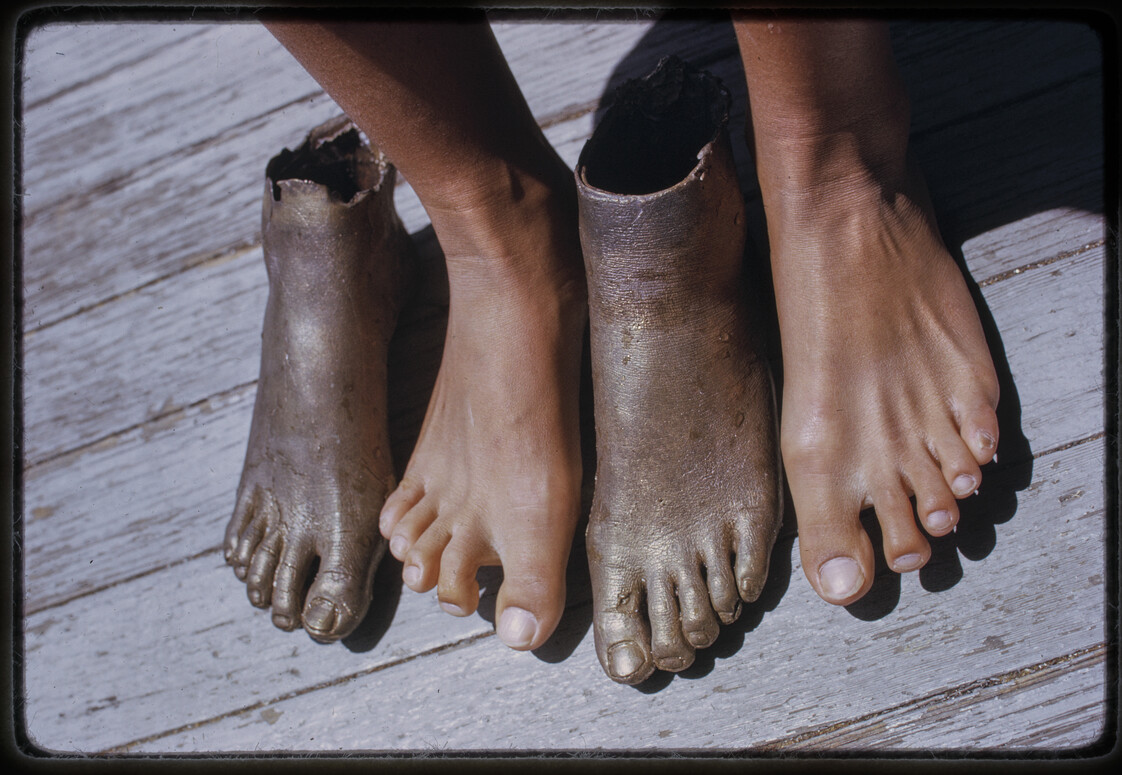
This series of letters emerged from Ju Ly Ban’s work as a Fellow for Lost & Found: The CUNY Poetics Document Initiative from the Center for the Humanities at the CUNY Graduate Center, grounded in archival engagement with the work and life of Theresa Hak Kyung Cha. Attuned to the fragments of her presence in the archive, the letters imagine otherwise by rethinking how she has been approached, interpreted, and held in relation.
Part III
Letter #7
Dear Isabelle and Cici,
I want to begin this letter with a passage from Dictee. The first paragraph of the CALLIOPE EPIC POETRY section on page 54. It starts with the lines: “I write. I write you.”
To remind you, the “I” here is the writer (often read as Theresa), and the “you” is her mother. Up to this point, she has been writing about her mother’s life. A young woman raised as the youngest child in Yongjeong, Manchuria; often unwell and in need of care; a teacher who earned her license and traveled to work at a small elementary school by train, only to fall ill. These stories carry Theresa’s care for her mother, a love that extends even before her birth. To me, “I write you” feels inseparable from “I love you.” The section I want to read with you drives this forward, with love at its center:
I write. I write you. Daily. From here. If I am not writing, I am thinking about writing. I am composing. Recording movements. You are here I raise the voice. Particles bits of sound and noise gathered pick up lint, dust. They might scatter and become invisible. Speech morsels. Broken chips of stones. Not hollow not empty. (56)
Isabelle, I think I understand something of what you feel when you read Dictee. It’s as though we’re all searching, almost desperately, for what we each hope to find in its pages. And, of course, that search leads us to an inevitable end—a dead end, maybe. The worst kind is when the failure remains unseen.
You asked if we’ve ever searched for “language” in her work. I don’t know if it’s language I’ve been looking for, but something near it. Let me share my response alongside this passage.
In these five sentences, Theresa repeats the word “write” four times. Writing fills her days. It becomes a vivid, layered process. Composing, recording, unfolding. It’s an act of care.
The space of “here” grows dense with meaning. “Here,” she encounters her mother. Yet, speaking directly to her seems out of reach. Raising her voice becomes another way of trying—another bridge toward connection. But…
I now know this “but” comes from my own longing. My desire to find something. The “particle bits of sound and noise” feel like fragments, a kind of failure. I stood before them, facing “speech morsels,” unsure what to do.
So I set my desire aside, just for a moment, and let her words lead me. Perhaps, then, I saw the “speech morsels” differently. Like Cici’s sparkling dust caught in the projector’s light, appearing unexpectedly. Yes, the “but” was mine. Theresa uses no negative conjunctions here. Instead, she insists: “not hollow, not empty.”
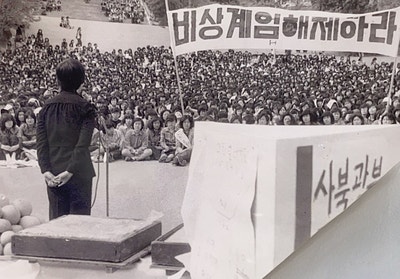
In May 1980, students at Ewha Womans University gathered at Ewha Square to demand the lifting of martial law (Ewha Voice). While this is not the exact photo July saw from Theresa’s Kodak film, the sign the students are holding is similar. This version was included for its visual clarity.
The emergency martial law declared in South Korea a few days ago left me seething, scrolling aimlessly through news updates in frustration and disbelief. It’s the first in 45 years, since Theresa’s visit to Korea in 1980. As a Korean passport holder with loved ones back home, the situation feels both infuriating and deeply humiliating. At one point, I tried to step away from the relentless updates by organizing photos on my phone. That’s when I came across an image I’d taken at the Whitney archive. One frame from Theresa’s Kodak film.
The photo shows a newspaper, surrounded by a Korean crowd holding a sign: “Lift the State of Emergency Martial Law.” I think she captured this during or shortly after her visit in 1980.
Staring at that image, I felt a connection with Theresa stretching across decades. Across time. Across place. Somewhere, maybe “here,” where I can only arrive through care. Care for myself. For Theresa. For my loved ones. For hers.
This letter runs long, and I’m grateful you’ve taken the time to read it. Isabelle, if you find more stories in Theresa’s photos, I hope you’ll share them with us. And Cici, the same hope extends to you. Perhaps there’s a light still spilling between your great-grandparents and the White Dust.
Hugs,
July
Letter #8
Dear Isabelle and July,
I opened Dictee last night before going to sleep.
Following my mind’s traces, I want to begin this letter with ERATO LOVE POETRY:
Then you, as a viewer and guest, enter the house. (98)
All along, you see her without actually seeing, actually having seen her. You do not see her yet. For the moment, you see only her traces. (100)
She asks if you want to sing a song and you move next to her on the bench and you sing for her as she plays for you. (110)
Perhaps she loved him. Her husband. Perhaps after all she did. She was his wife his possession she belonged to him her husband the man who claimed her and she could not refuse. (110)
“…[L]ove is repaid by love alone, and so I searched and I found the way to solace my heart by giving you Love for Love.” (111)
She forgets. She tries to forget. For the moment. For the duration of these moment. Disappearing into the whiteness. (113)
“The smallest act of PURE LOVE is of more value to her than all other works together.” (115)
In this section, “You” appears on both odd and even pages, though they seem loosely connected. On odd pages, “You” is the viewer and guest who witnessed “She” appearing on screen, and eventually disappeared herself. On even pages, “You” is Mother to the child, to the daughter.
She writes writing and she loves loving. May the addressee be her mother, the viewer, or the unknown emptiness. Her final removal of herself from the screen at the end, is disappearing herself the smallest act of pure love to claim her own will and very being? If so, is this a love letter farewell to her mother?
July questioned the need to search for “language” in Dictee. This quest leads me back to Fernand Deligny and Renaud Victor’s film Ce gamin, là (1976). During the Nazi occupation in France, when asylum served as a site to discard those deemed inadequate, they spent seven years living with autistic children in a self-organized commune in Cévennes.
“What to trust, when it fails, the language?” The film began with a question. Abandoning the asylum, he started his own communities with autistic children. Rather than healing or explaining them, he accompanied them, traced their wanderings through cartographical drawings. And eventually, he discovered that these children were unknowingly tracing out the underground root and passage of water. I want to suggest using this as an example and an inspiration to relate to reading Dictee. Instead of healing or searching, could we simply be with? Can we envision a form of quiet companionship?
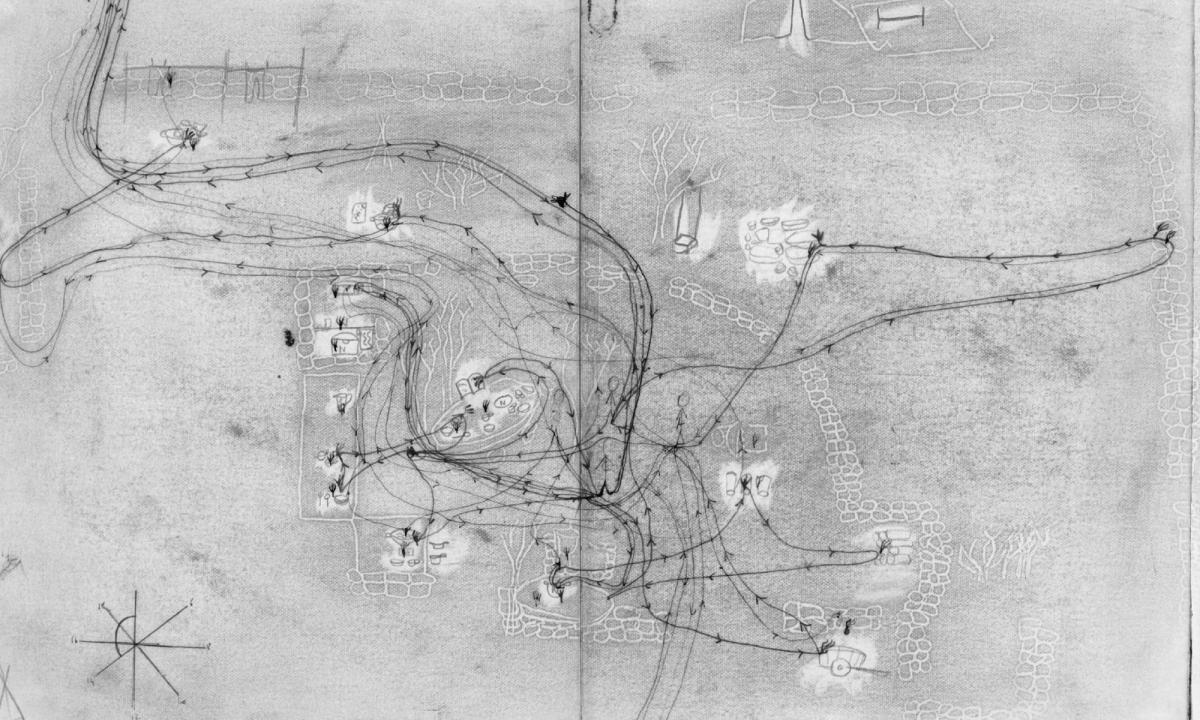
A Map tracking movement paths of children in Deligny’s network. Deligny, Fernand. Map from L’Arachnéen project. Ca. 1975, Cévennes, France. Archive Fernand Deligny.
Sorry for the delay in returning this letter. It has been nearly a month since the emergency martial law in South Korea. The pattern of historical events recurring to themselves becomes even more visible. I believe if she was there, she would fight against it, just like what you would do today.
I want to end this letter with a question that’s been revolving in my mind recently, though it may seem tangential: Does time exist? I went to a war cemetery on Christmas Day and it felt surprisingly peaceful and grounding.
With all the changes that will come, I hope we can always connect to the roots of our heart.
Cici
Letter #9
A winter sky in Basel, taken by Isabelle, January 2025
Dear both,
Winter always seems harsher after the holidays, its cold settling in more deeply. I returned to London a few days ago after spending a few weeks at my mother’s house on the outskirts of Basel. I brought Dictee with me, as I always do. Placing it in my bag has become second nature, almost muscle memory. It feels as though the book has become my shadow—wherever I go, it follows.
How distant you both feel right now—Cici in Hong Kong, July in New York.
I rearranged my desk. Instead of peering into the living room of the young family across the way, I now face the railroad tracks spilling out of King’s Cross Station. They stretch north and south, burrowing underground, running as far as Paris. In the distance, the Shard blinks at me, its red lights winking ceaselessly. The black sky feels quiet and all-encompassing, though I know that elsewhere the sun is rising, stubbornly. Perhaps obscured by smoke and flames, perhaps shrouded in the dust of destruction. Or perhaps clear and luminous, seen only by animals who understand time only through the warmth on their skin, waking their bodies.
Cici, your last letter has stayed with me. Your question—how we might envision a way of being together outside the confines of language—feels more urgent than ever. It seems that language has taken on a life of its own, fanning the flames of fear without regard. Who told you this? Where did you hear it? Where did you read it? Questions like these now feel unanswerable. Needless to say, it has become
increasingly difficult to speak with my mother. We no longer talk about her home, Korea. To her, it is a place of corruption, unfairness, a place in need of saving. To me, it is a place of endless rediscovery, an answer to questions I have not yet learned to ask her. The silences that follow our attempts at conversation are heavy, laden with unspoken knowledge—imprecise, foreboding, rootless, bodiles.
What to trust, then, when language fails us?
I watched Deligny’s film. “Speak as if it is natural to speak,” he said, perhaps to answer his own question. But what does it mean to speak naturally in the face of such great artifice? How can we speak naturally when language is burdened with the need to denounce, justify, explain, defend, contest? How do we exist together outside of language? How do we speak with intimacy when language itself feels heavy with conflict?
It seems as though he could only answer himself hypothetically, even paradoxically, suggesting that language, above all, is intrinsically artificial when set against our shared, corporeal existence.
The more time I spend with Cha—with Dictee—the more I feel that she, too, pondered this paradox. “My work is with language,” she wrote, “looking for the roots of language before it is born on the tip of the tongue.” Language before it leaves the body as voice, as speech. Language before it makes
contact with the air we breathe. A language buried deep within us, charged with intimacy, holding a knowing that burns and dissipates the moment it leaves the body.
The more time I spend with you both and with Cha, the more I understand: to speak as if it is natural to speak requires a certainty, a selfless devotion to language. To be in language, to speak through it, to address someone within it, requires us to let go of it entirely. To make peace with its ephemerality.
I send you my words from afar. They never left my mouth, yet here they are.
With love,
Isabelle