The following blog entry is a recollection of an archival research project by Lost & Found Fellow and CUNY Graduate Center student Sam O’Hana.
Introduction
Sam O’Hana created his archival research project on Allen Ginsberg’s IRS tax returns to understand how Ginsberg managed to support himself with the minimal income he received and the point in time at which he finally started getting paid for the poetry he created. Below are O’Hana’s archival findings explained.
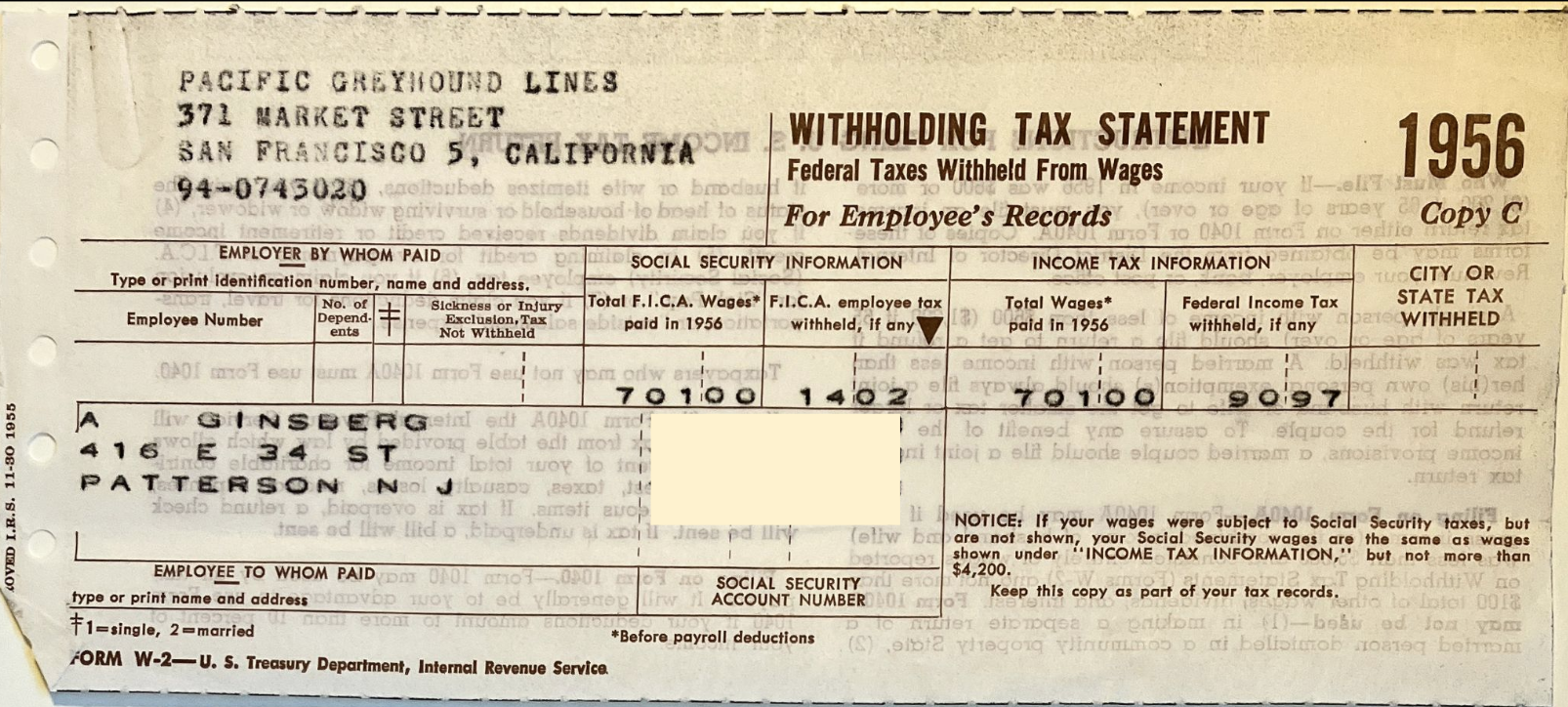
Poetry is not known as a lucrative pursuit. On rare occasions, however, particularly successful poets can make a living solely from their writing through book royalties and performances. While Allen Ginsberg was perhaps the most popular English-speaking poet in mid-to-late century America, his financial fortunes did not seriously catch up to his fame until several decades after publishing Howl and Other Poems in 1956. Examining Ginsberg’s IRS tax returns from 1946 to 1993 gives us an inside look at how he managed his rise to prominence in part by writing off business expenses for his work, as well as how he joined in popular tax protests of his time during the Vietnam War.
Ginsberg made a steady living throughout the 1960s and 70s, often earning around the US median wage for any particular year—equivalent to a plumber or high school teacher—which, given his own choice of vocation, is remarkable in its own right. As he approached retirement age, however, his finances became significantly more complex as the number of assistants and helpers on payroll grew, and his work expanded more confidently into photography and teaching. What began with the standard freelance techniques of a sole proprietor writing off the costs of his stationery eventually developed in his final years into the demanding compliance requirements of his own incorporated entity, “Ginsberg & Associates”, joined with his newfound regular income as a full-time professor.
The picture that emerges from examining Ginsberg’s tax data, and its associated correspondence, is one of an artist who was deeply skeptical of the ways in which his tax revenue was being spent by successive government administrations, and who worked constantly to channel his growing income towards friends and promising young writers, as well as the projects they undertook. While this began in the 1950s with Ginsberg spending about 8 times more in one year on writing checks to William Burroughs than he would each month to his landlord, this developed by the 1980s into a list of at least 30 “helpers” that included Alice Notley, Ted Berrigan, and Gerard Malanga—and the inevitable “1099” forms that paying them would generate.
While it’s clear that Ginsberg worked hard to maintain his position as a leading literary figure in late modern literature, suppositions that he was “rich” by the standards of his era overlook the ways in which he put his business receipts to work in supporting the work of both his peers, such as Burroughs, as well as Gary Snyder, for example, and a younger generation of those aspiring to uphold the many newfound social and political values that emerged from the Beat Generation’s arrival in postwar America. Rather than a narrative of accumulation through fame, it appears that there was a reciprocal relationship between the work of writing, performing, touring, teaching, mentoring, etc., and the accounting strategies that sustained such work.
For more on O’Hana’s research and this Lost & Found project, listen to his interview on the Cascadia Poets Lab here:
Watch the interview here:
Click here or on the image below to read the full interview transcript.
Author

Sam O’Hana
Lost & Found Archival Research Fellow
Related Events
Presentation
2025 Lost & Found Fellows Showcase: New Poetics and Archival Research Projects