People

Alexander Kwon
ERI/PS2 Public Research Fellow
Alexander Kwon is a Ph.D. candidate in Economics at the CUNY Graduate Center. His work focuses on causal inference, machine learning, and applied econometrics, with a particular interest in how research evidence can be generalized across populations to inform public decision-making. His research examines external validity, firm productivity, and the labor market behavior of older workers. Alexander is a 2026 ERI/PS2 Summer Fellow.
Researchers and policymakers often use evidence from one population to make decisions about another. But an effect estimated in one setting does not necessarily predict the effect in another, a problem known as external validity. My coauthor Kyungtae Lee and I studied whether machine learning can improve these predictions, particularly when the original effect is estimated using instrumental variables.
Our starting point was a common statistical problem: functional-form misspecification. Conventional methods often approximate relationships with relatively simple linear equations. But the real relationship between family background and college attendance, for example, may contain thresholds, curves, or interactions that a straight line cannot capture.
We compare a conventional instrumental-variable method, 2SLS with interacted fixed effects, with Double/Debiased Machine Learning. Our simulations show that the answer is not simply that machine learning is better. It depends on where the misspecification occurs. When the model incorrectly describes how the instrument or other characteristics predict treatment and outcomes, machine learning can substantially reduce prediction error by estimating those relationships more flexibly.
We also find that when the effect of the treatment itself changes nonlinearly across people, a machine-learning procedure with a simple linear final stage can still fail. Replacing that final stage with a more flexible specification dramatically reduced the error in our simulations.
We identify a separate problem as well. The people whose behavior changes in response to an intervention may differ across populations. We show how weighting toward those likely responders can reduce this source of prediction error.
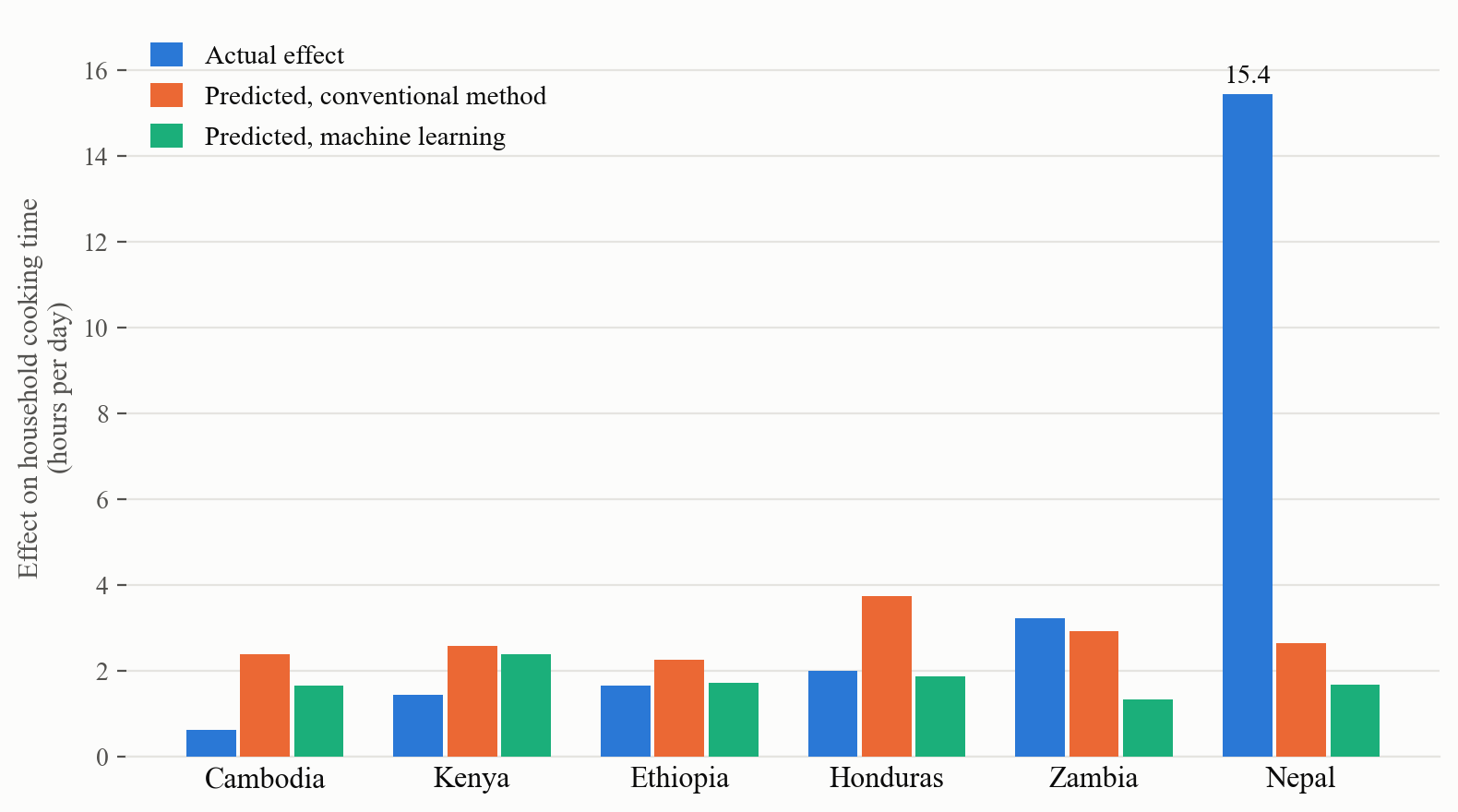
Finally, we test the methods using cooking-fuel data from six countries. A feasible machine-learning procedure predicts more accurately than the conventional method in four of six cases, but no method wins everywhere.
The main takeaway is that better prediction requires more than a more powerful algorithm. We need to know what part of the model is wrong before we know what kind of flexibility will help.
My website:
https://sites.google.com/view/alexanderkwon/home/
My coauthor is Kyungtae Lee, Ph.D. Program in Economics, CUNY Graduate Center:
https://sites.google.com/view/taelee
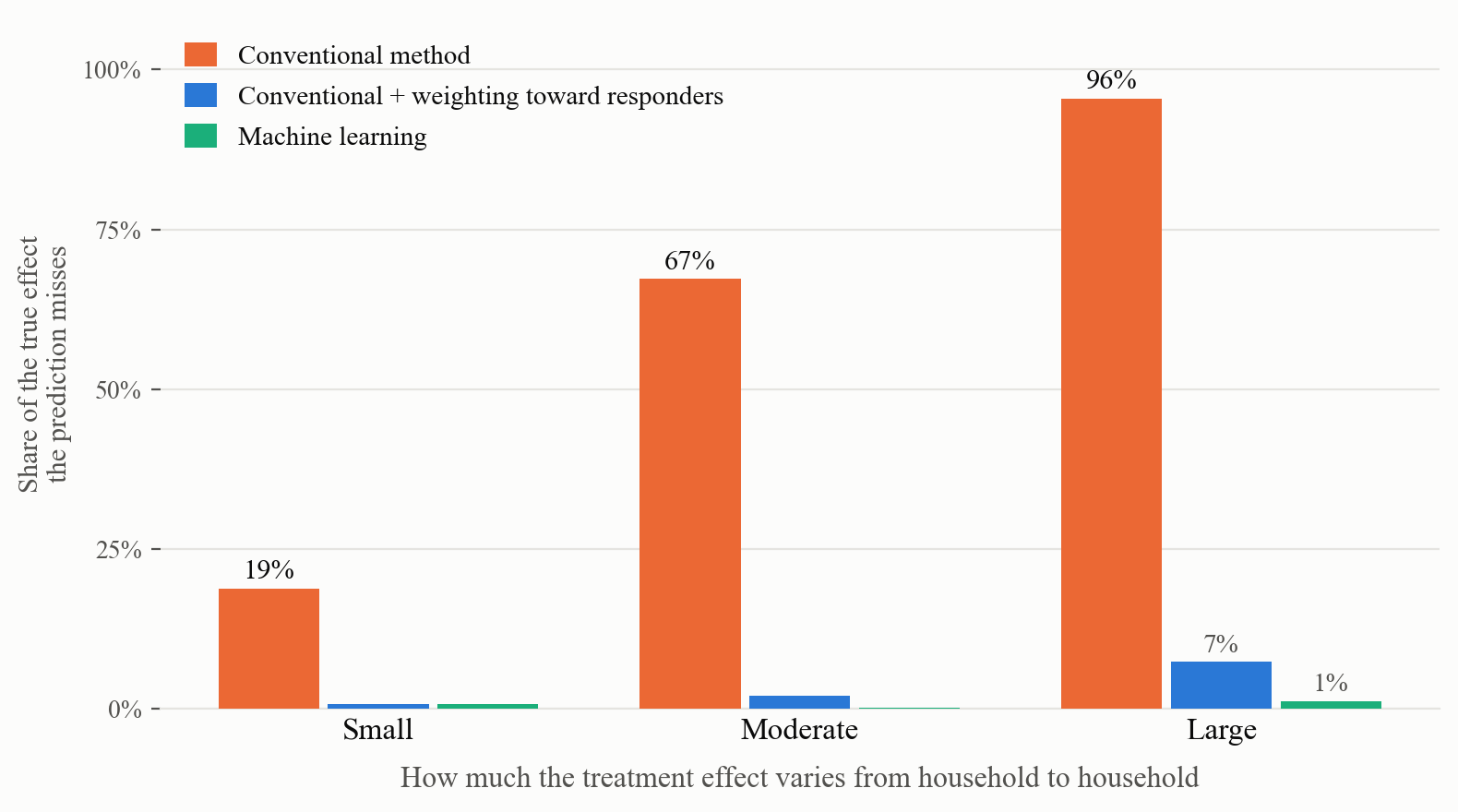
method can be scored against it. Bars show the share of the true effect each method misses
when predicting it for a new population. As treatment effects vary more across households,
the conventional method misses up to 96 percent of the effect. Weighting toward likely
responders and machine learning both repair most of the error. Image: Alexander Kwon.