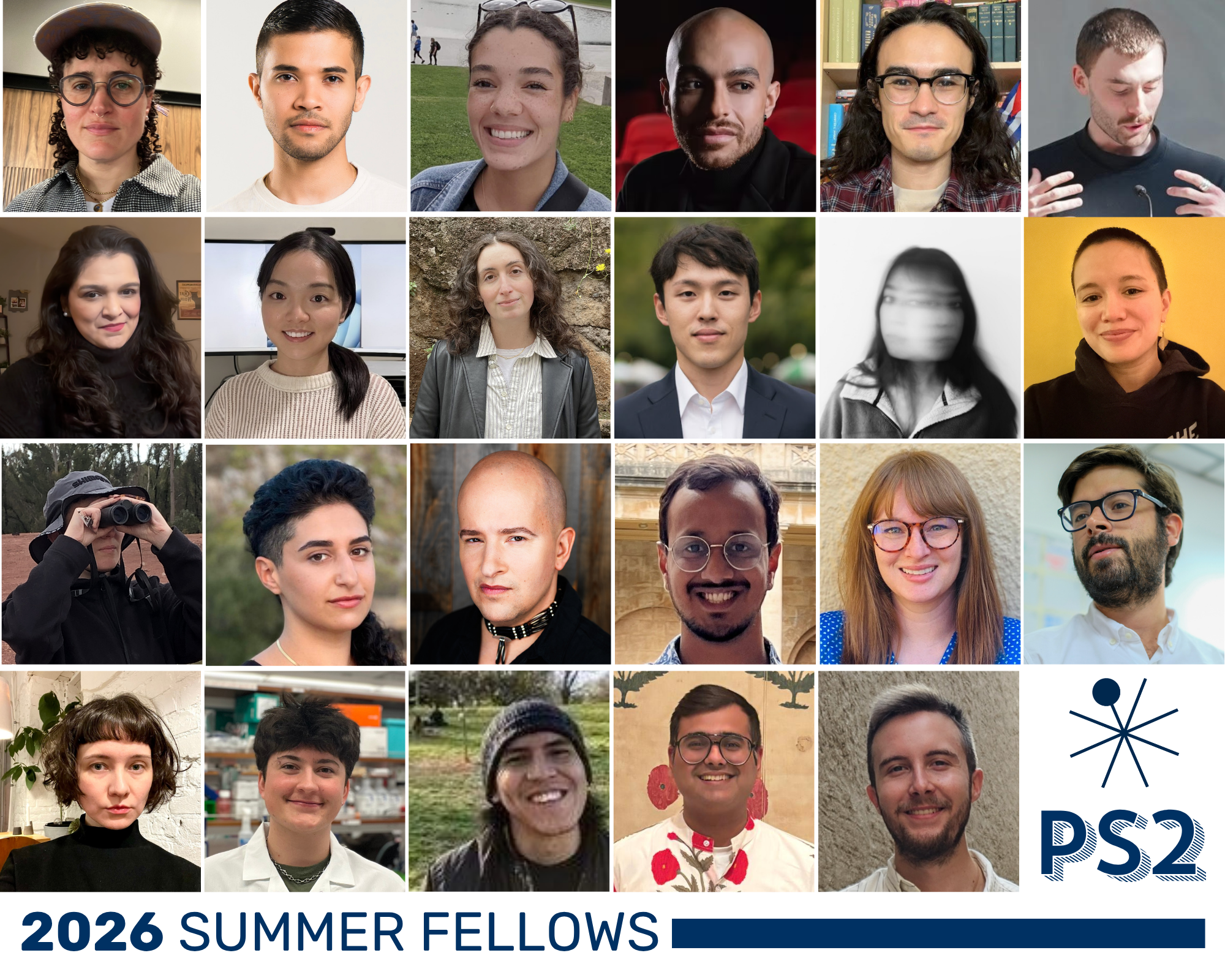
We’re thrilled to announce this year’s ERI/ PS2 Summer Public Research Fellows. A record twenty-three doctoral students at the CUNY Graduate Center from across a wide range of disciplines and methodologies will further their graduate research rooted in applied, activist, public-facing, and/or community-engaged scholarship.
This cohort represents the breadth and depth of academic programs that have long been at the forefront of public scholarship at the GC including Anthropology, Art History, Biology, Computer Science, Earth and Environmental Sciences, Economics, History, LAILAC, Political Science, Psychology, Sociology, Theatre and Performance, and Urban Education. We are so excited to see the results of this year’s cohort in the fall.
The ERI/ PS2 Summer Public Research Fellowship is made possible by generous funding from the Early Research Initiative overseen by the Provost’s Office at the CUNY Graduate Center.
Clairette Atri Mizrahi

Clairette Atri Mizrahi is from Mexico City and is a PhD candidate in Critical Social / Personality Psychology.
It’s hard to think in terms of “excitement” given that my research is in Beirut. I’m excited to visit The Maguen Abraham Synagogue in Wadi Abu Jamil.
Luis Banegas

Luis E. Banegas is a PhD student in Sociology at the CUNY Graduate Center, studying the relationship between immigration, law, and gender. His current project examines how immigration courts interpret violence against male asylum seekers — particularly in cases involving forceful gang recruitment — and whether they see (or don’t) this coercion as gender-based persecution meriting protection.
I am excited to go into the field and speak with people about their experiences with the immigration system. Thanks to the support of the Summer Public Research Fellowship, I will be able to map the key empirical and theoretical contours of decision-making in asylum cases, laying the groundwork for my dissertation.
Marisa Breathwaite

Marisa Breathwaite is a PhD student in Cultural Anthropology at the CUNY Graduate Center. Her research focuses on the emergence of femtech platforms in Cairo, Egypt and asks how AI-enabled femtech is situated within longer histories of development.
I’m looking forward to preliminary fieldwork in Cairo this summer where I will be exploring with my interlocutors the affordances of femtech and how femtech is experienced in the everyday, both on and offline. I also look forward to further developing and refining my research questions and dissertation proposal through this period of ethnographic research made possible by the ERI/ PS2 fellowship.
Adam Elsayigh

Cairo-born and Dubai-raised, Adam Ashraf Elsayigh is a playwright, dramaturg, and Ph.D. candidate in Theatre and Performance at the CUNY G.C. His plays – including Alaa: A Family Trilogy and Drowning in Cairo – have been developed or presented by NYTW, The Lark, Sundance, and Golden Thread. A Lucille Lortel Awards voter, in 2025, Adam was selected as World Theatre Day’s U.S. Emergent Artist. He holds a BA from NYU Abu Dhabi, MFA from Brooklyn College, and is a Georgetown Laboratory for Global Performance and Politics fellow.
Off-Broadway’s programming choices are usually explained through artistic vision. This summer, I’m testing a competing hypothesis: that money is doing a lot of the deciding. I’ll be building a public dataset tracking financial and programming records across four major Off-Broadway institutions from 2008 to 2025, developing early visualizations that map the relationship between funding structures and curatorial choices, and beginning conversations with artists about whether the patterns in the data match what they’ve already felt in the room. My aim is to turn shared intuition into a public resource the field can build on, argue with, and use.
Xavier Fitzsimmons Cruz

Xavier Fitzsimmons Cruz studies Latinx migration, labor, and public history, with a focus on archives, oral histories, and community memory in post-industrial Upstate New York. He is a second-year Ph.D. student in history at the CUNY Graduate Center and is committed to building community-centered archives that document the stories of Latinx communities in the United States.
I am most excited to work closely with community members and partners to document oral histories that recover Latinx experiences often erased from traditional archives. This research allows me to connect lived experiences of migration, deindustrialization, and racial backlash while contributing to a community-driven effort to preserve and bridge our stories to a broader historical struggle
Chris Harding

Chris Harding is a PhD candidate at the City University of New York, Graduate Center. His work focuses on labor and capital in the Mandate period (1922-1948) in Palestine. In 2024, his work, “Researching Palestine” featured in the Biennale De Venezia, as part of the exhibition South West Bank—Landworks, Collective Action and Sound and is available online at Jadaliyya. Recently he published an essay with the magazine Public Seminar titled, “A House in the Middle of the Road”, which examined the dual-colonisation of Palestine during the Great Revolt (1936-1939).
I am excited to return to the Dar Jacir Family archives in Bethlehem, Palestine this summer. Last summer I began working through magazines and newspapers from 1937-1947 in the archives that are unavailable elsewhere. In essays and op-eds Palestinian writers discussed the future(s) of Palestine and its people. I plan to complete my research in July and begin drafting a theoretical and historical overview of notions of temporality amongst Palestinians in this period of intense flux.
Diana Higuera

Diana Higuera-Cortes is a PhD student in the Latin American, Iberian, and Latino Cultures (LAILAC) program at the Graduate Center-CUNY. A former CUNY Humanities Alliance fellow, Diana teaches Spanish at Lehman College.
I am excited to spend my summer researching and collaborating with a group of ESOL students from different parts of Latin America. We will be designing an English material for immigrant workers who wish to state their rights and working conditions in industries such as cleaning, construction, and delivery. This will empower English learners to fight wage theft and linguistic injustice. The material will differ from traditional textbooks and resources that usually replicate dominant ideologies about language and the ways it perpetuates the marginalization of adult immigrant learners.
Chufeng Jiang

Chufeng Jiang is a PhD student in Computer Science at CUNY, with research interests in logic programming, constraint programming, and machine learning systems.
I am particularly excited to design 3D lane perception models that are robust to challenging real-world conditions. This fellowship offers a valuable opportunity to advance my work on safety-aware evaluation and scenario-level analysis, with the goal of contributing to more reliable and socially responsible intelligent transportation systems.
Googie Karrass

Googie Karrass (she/her) is a PhD candidate in Cultural Anthropology. Her dissertation examines polygenic embryo screening and how it is reshaping ideas about heredity and human difference, as well as the reproductive imaginaries that surround them. She is particularly interested in the ways that genomic frameworks are taken up in political projects and the porous boundaries between political and scientific and public discourse.
This summer, she is looking forward to developing research on how appeals to choice shape debates over polygenic embryo screening amid ongoing scientific and ethical contestation. She is particularly interested in how these debates unfold at a moment when reproductive autonomy is under pressure, complicating efforts to critically respond to these technologies.
Alexander Kwon

Alexander Kwon is a Ph.D. candidate in Economics at the CUNY Graduate Center. His work focuses on causal inference, machine learning, and applied econometrics, with a particular interest in how research evidence can be generalized across populations to inform public decision-making. His research examines external validity, firm productivity, and the labor market behavior of older workers.
What excites me most about this summer’s research is the opportunity to develop tools that help policymakers make better predictions for communities that were not directly studied in the original evidence. I am especially excited to explore whether machine learning can make causal research more useful across settings by producing more credible predictions of policy impacts for new publics.
Danning Li

Danning Li (She/her) is a PhD student in Cultural Anthropology at the Graduate Center and a teaching fellow at Hunter College. Her research focuses on the role of market logic, class, and consumer desire in shaping political subjectivity.
This summer I am excited to study Arabic intensively and spend time with Palestinian traders who source goods in China.
Noelle Mapes

Noelle Mapes is a PhD student in Urban Education at the CUNY Graduate Center whose research focuses on participatory democracy, teachers’ unions, and the political economy of schools. Noelle is a strike-ready member of PSC-CUNY and an organizer with MORE-UFT, a k-12 social justice caucus of the NYC teachers’ union.
This fellowship will support fieldwork on an urgent question: how do educators organize collectively to defend public schools as democratic institutions against austerity and privatization? I’m looking forward to spending the summer alongside Massachusetts school workers in meetings, actions, and conversations — developing that question together with educators at the center of this work.
Stella Maynard

Stella Maynard is a PhD student in Geography at the CUNY Graduate Center. Their dissertation project examines the changing geographies of policing in the South Pacific region.
This summer, I’m looking forward to visiting the National Archives of Papua New Guinea (Port Moresby) and the National Archives of Australia (Canberra). This period of preliminary fieldwork will allow me to refine my project’s scope, methodology, and key questions.
Foiniki Papadopoulou

Foiniki Papadopoulou is a PhD student in Cultural Anthropology at CUNY Graduate Center and a lecturer at Lehman College. Her research focuses on sites in Cyprus that operate simultaneously as material repositories of violence and as generative arenas where counterhegemonic historical discourses and political futures are imagined and experimented with.
I am looking forward to working with bicommunal and grassroots organizations in Cyprus over the summer and contributing to the expansion of open access archives that center marginalized collective and personal histories.
Opalanietet (Ryan) Pierce

Opalanietet Pierce is a PhD candidate at The CUNY Graduate Center and a member of the Nanticoke Lenni-Lenape tribal nation. He has taught at Boston University, The New School, and SUNY Purchase. His recent academic article, “The Natural Landscape of Native Puppetry” has been published in Puppetry International Research. As an artist, Opalanietet is Founder and Artistic Director of Eagle Project, and has performed at The Public Theater, New York City Opera at Lincoln Center, and gave the first-ever land acknowledgement at the Macy’s Thanksgiving Day Parade on NBC.
What excites me the most about the research I will be undertaking this summer is broadening my understanding on the scope and diversity of transnational Indigenous theatre in both Australia and New Zealand, and deepening my knowledge of the United States. Funding for travel is prohibitive, so these funds will enable me to develop relationships, see performances, and view archives in a way that no scholar of Indigenous performance, that I am aware of, has ever done before. This research will not only further my dissertation, but assist in creating the first-of-its-kind academic journal dedicated to global Indigenous performance ever.
Nikhil Ravipati

Nikhil Ravipati is a PhD Candidate in Cultural Anthropology. His research is set in the Malwa region of Punjab, India, where his interests span agrarian social movements, neoliberalism, and the politics of caste, class, and gender in rural life. He is particularly interested in how landless agricultural workers and poor peasants build broad-based coalitions to challenge dispossession and authoritarian populism.
This summer, I am look forward to developing a collaborative research plan alongside leaders and constituents of BKU (Ekta-Ugrahan) and the Sanjha Morcha – organizations at the forefront of India’s most transformative agrarian politics in decades. I want to understand how these movements have built unprecedented solidarities across caste, class, and gender, and what lessons their practice holds for progressive coalitions everywhere.
Taylor Rubin

Taylor Rubin is a Ph.D. student in Biology at CUNY Queens College and Graduate Center in the Urban Ecology Lab lead by Dr. Joanna Coleman. For her Ph.D., Taylor is investigating how scavengers that live in cities interact with our food waste and how that interaction may influence disease spread. Her long-term career goal is to pursue ecological research while working alongside community members and policymakers to translate scientific knowledge into meaningful change.
What excited me most about the research I will undertake this summer as a fellow is getting a peek into the lives of some of the non-human members of the NYC ecosystem. I’m excited to explore the connections between us, our food waste, scavenger communities, and pathogen transmission.
Guillermo Sardi Garcia

Guillermo Sardi is a PhD candidate in the Department of Political Science. His research focuses on the intersection of democratic backsliding, criminal governance, and state extralegal violence. He teaches at Lehman College and Fordham University on topics related to democracy, conflict, and security studies.
What excites me most about this summer’s research is the opportunity to incorporate the voices of participants I could not have reached remotely, especially community leaders, NGO workers, and activists who are often excluded from research and may not have reliable internet access where they live. Their perspectives provide localized knowledge that other participants cannot offer.
Irina Shirobokova

Irina Shirobokova (she/they) is a feminist geographer, Ph.D. candidate in Environmental Psychology at the Graduate Center, and researcher in the Cities ‘Becoming Lost’: the Ruptures of Grand Narratives of Modernity project at The Leibniz Institute for Regional Geography in Leipzig, Germany, where she explores space and time in utopia, artist-in-residence at the Pikene på Broen, Norway, Kirkenes. Irina’s current dissertation work is inspired by years of fieldwork in the Arctic’s peripheral cities. It asks what the politics of darkness might look like today and develops a grounded theory of darkness.
I am excited to advance our emerging initiative, NDARN (Negotiating Darkness: Artists Research Network), to the next stage this summer. It’s a network that aims to bring together people from places of polar night and other remote Nordic localities to share and exchange expertise in writing, the performing arts, and interdisciplinary research. And most importantly, to share our practices of engaging with darkness that challenge the Western notion of darkness as negative.
Ava Stoddard

Ava Stoddard is a third year Ph.D. candidate in the Zeglis Laboratory at Belfer Research Building, where they study the development of radiotheranostics for a rare pediatric disease called desmoplastic small round cell tumors (DSRCT). Ava attended Appalachian State University and graduated in 2023 with their B.S. in molecular and cellular biology, before attending CUNY for graduate school.
Studying an often-neglected pediatric disease is something that excites me about my summer research. There is a huge clinical gap in the care for patients with DSRCT, and I believe radiotheranostic tools can bridge that gap and make the clinical care for these patients supremely better. I’m grateful and excited to be a ERI/PS2 summer fellow.
Paulo Suarez

Paulo Suarez is an Anthropology Ph.D. Candidate with the CUNY Graduate Center. He studies housing, migration, and social movements in Los Angeles.
In a moment when fascism looks ardently to sustain itself domestically through coercion and consent, my project sheds light on how “the immigrant” serves as more than a pillar of the contemporary resentful structure of feeling uplifting American authoritarian hegemony. Instead, I look forward to showing how migrant politics, as that double-edged repressed object bent on imminent return, is one of the main paths through which the U.S. Left (particularly in Los Angeles) can build a popular mass movement and begin to gain forceful control over the conditions that define our current terrain of struggle.
Vinit Vyas

Vinit Vyas is a PhD student in Art History at the Graduate Center, CUNY. His interdisciplinary research focuses on gender, erotica, and sexuality, specifically issues of same-gender desire, transgender narratives, and gender ambiguity in early modern and colonial visual and material culture of South Asia. He has previously worked with institutions such as NID Ahmedabad, MAP Bangalore, MSU Baroda, and was an academic fellow at the Center for Black, Brown, and Queer studies.
I am excited to revisit various goddess temples in Gujarat to build a queer archive exploring the complex relationship between numerous Hijra and Transgender communities, regional goddesses, and yantras. This, I believe, is only a stepping stone to carve out a broader visual and material history of Transness in pre-modern South Asia.
Bret Windhauser

Bret Windhauser is a third-year student in the History Department. His work focuses on the British Mandate of Iraq and the legal regulations revolving around death, dying, and burial during that time. Imperial law and religious understandings of the body conflicted in court in cases pertaining to corpse smuggling and burial in important Shi’a shrine cities. As part of his PhD work, Bret is building out a website to provide visualizations and translations of his research in order to make it more widely accessible.
I am excited to conduct this research over the summer to find more information about a relatively elusive historical subject: East African sailors in the Persian Gulf region. The archival work I will be able to conduct in France this summer will facilitate a more nuanced investigation into these communities, which will help me write a more compelling and multifaceted dissertation.
PS2 (The Public Scholarship Practice Space (PS2) housed at The Center for the Humanities honors the past, present, and future of public scholarship at the CUNY Graduate Center. As part of that mission, we are committed to supporting the future of applied, activist, and community-engaged scholarship through the ERI/PS2 Summer Public Research Fellowship. This is our third year stewarding the program. Congratulations to our 2026 fellows.
Related Events

Related News


People

Prithi Kanakamedala
Faculty Coordinator (PS2)
Certificate Coordinator