People

Opalanietet (Ryan) Pierce
ERI/PS2 Public Research Fellow
Opalanietet Pierce is a PhD candidate at The CUNY Graduate Center and a member of the Nanticoke Lenni-Lenape tribal nation. He has taught at Boston University, The New School, and SUNY Purchase. His recent academic article, “The Natural Landscape of Native Puppetry” has been published in Puppetry International Research. As an artist, Opalanietet is Founder and Artistic Director of Eagle Project, and has performed at The Public Theater, New York City Opera at Lincoln Center, and gave the first-ever land acknowledgement at the Macy’s Thanksgiving Day Parade on NBC. Opalanietet is a 2026 ERI/PS2 Summer Fellow.
The past, present, and future collided in the summer of 2026 as I used the ERI/PS2 to travel internationally to Australia and Aotearoa (New Zealand) as well as to Minneapolis, Minnesota to learn more about the utilization of time in transnational Indigenous theatre. While in Melbourne, Australia (also known as Naarm), I attended the International Federation of Theatre Research (IFTR) conference and became part of the conference’s inaugural First Nations Circle. It is here where our presence with one another as Indigenous artists from around the globe were informed by our struggles of the past while our solidarity signaled imagining a powerful future.
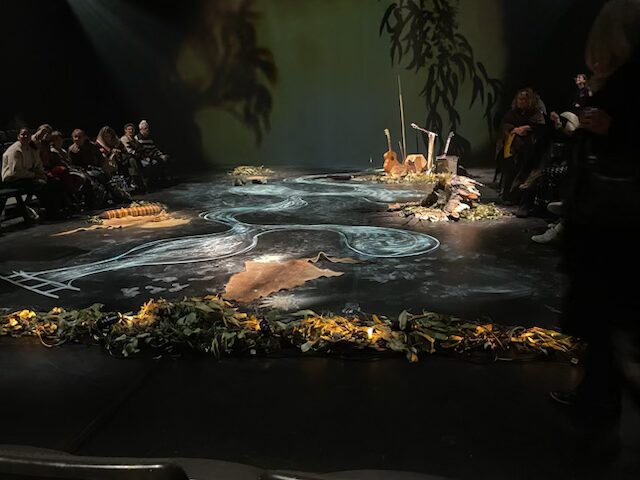
This harmonized with plays and rehearsals that I witnessed, including Ilbijerri’s production of Gunawarra: Re-Creation, written by Isobel Morphy-Walsh and directed by Andrea James. It is here where the traditional story of the Kulin nation about how the black swan (Gunawarra) got his feathers through being a victim of violence and experiencing a rebirth through the generosity of the crow paralleled the trauma and restoration of familial Taungurung women as they look to traditional stories to define their future. This accompanied my trip to Sydney (lands of the Gadigal) where I was invited to attend a workshop of Healing Scars, a performance art piece produced by Moogahlin Performing Arts, where the frenzied pace of urban life is put on hold as we experience a deeper sense of time with the creation of a natural Australian landscape, its trauma of development and colonialism, and its ultimate return to its natural state and a freeing of a people.
My travel abroad culminated in my visiting Massey University, near Auckland, Aotearoa, and viewing a rehearsal of Asra, created by Sumud Ensemble and under the directorial auspices of Rand Azou. Here the isolation of prison on stolen Indigenous temporality is juxtaposed with a culture of resistance as created by a multi-cultural ensemble from across a former imperial empire to imagine and create another future world. This harmonized with my trip within the continental United States to Minneapolis, Minnesota where I again was able to witness a rehearsal in-progress of an Indigenous adaptation of a production for youth, titled Maripos/Memengwaa, directed by New Native Theater founder, Rhiana Yazzie. While the play follows two neighbors trying to compete for the best garden, our protagonists realize that their attempts to control nature for their benefit, such as trying to capture a caterpillar and butterfly, ruin the cycle of freedom. It is through all these plays and my travels this summer where old relationships with Indigenous artists were renewed for more collaborative endeavors for the future. Freedom is a cycle that understands that the past still has visceral presence in the present, and that the seeds for a destined future of rebirth lie in the past that is equally manifested in the effervescent now.