People

Chufeng Jiang
ERI/PS2 Public Research Fellow
Chufeng Jiang is a PhD student in Computer Science at CUNY, with research interests in logic programming, constraint programming, and machine learning systems. Chufeng is a 2026 ERI/PS2 Summer Fellow.
When we drive, recognizing a lane feels almost automatic. We see painted lines, curves,
intersections, and changes in the road without consciously thinking about the geometry
beneath them. For an autonomous vehicle, however, understanding the same scene is a
difficult computational problem.
This summer, supported by the ERI/PS2 Summer Public Research Fellowship, I explored a
simple but important question: How can we help intelligent transportation systems
understand the road more reliably, especially when driving conditions become difficult?
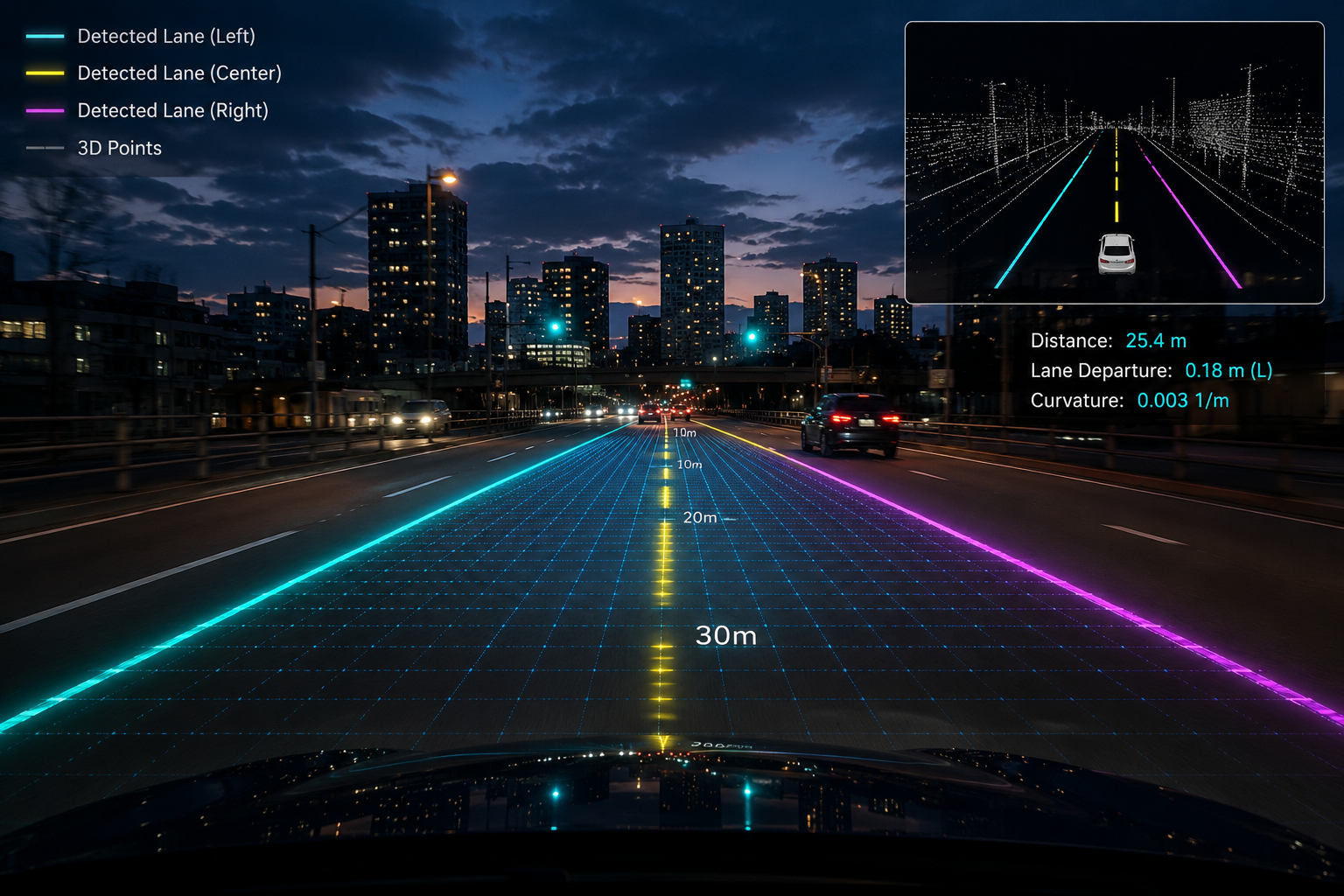
My research focused on 3D lane detection, a computer vision task that allows an intelligent
vehicle to estimate not only where lane markings appear in an image, but where the lanes
actually exist in three-dimensional space. This becomes especially important on curved
roads, hills, at night, or during adverse weather—situations in which even a small perception
error can affect the decisions a vehicle makes next. Our study therefore placed particular
emphasis on the road immediately ahead of the vehicle, where accurate geometry is critical
for short-horizon planning and control.
Working with my collaborator, Heng Li, I developed Tri-LaneNet, an artificial intelligence
model that combines three complementary ways of understanding a road scene: preserving
geometric structure, capturing local patterns such as lane edges and continuity, and
modeling broader contextual information. Rather than asking one representation to solve
everything, we wanted these different ways of “seeing” the road to work together.
Our experiments showed that this approach improved overall lane-detection performance
while also improving the localization of nearby lanes. It performed particularly strongly in
several challenging settings, including slopes, curves, extreme weather, and nighttime
scenes. This summer research ultimately resulted in our paper, “Tri-LaneNet: Enhancing
Intelligent Transportation Systems Perception Capabilities,” published in the proceedings of
the 50th IEEE Conference on Computers, Software, and Applications (COMPSAC 2026).
This project also changed how I think about artificial intelligence. A system can perform well
on average and still struggle precisely where reliability matters most. As AI increasingly
moves from laboratories into vehicles, streets, and other public spaces, I believe we need to
ask not only “How accurate is the system?” but also “When does it fail, and what happens
when it does?”
For me, that is where computer science becomes a public question.