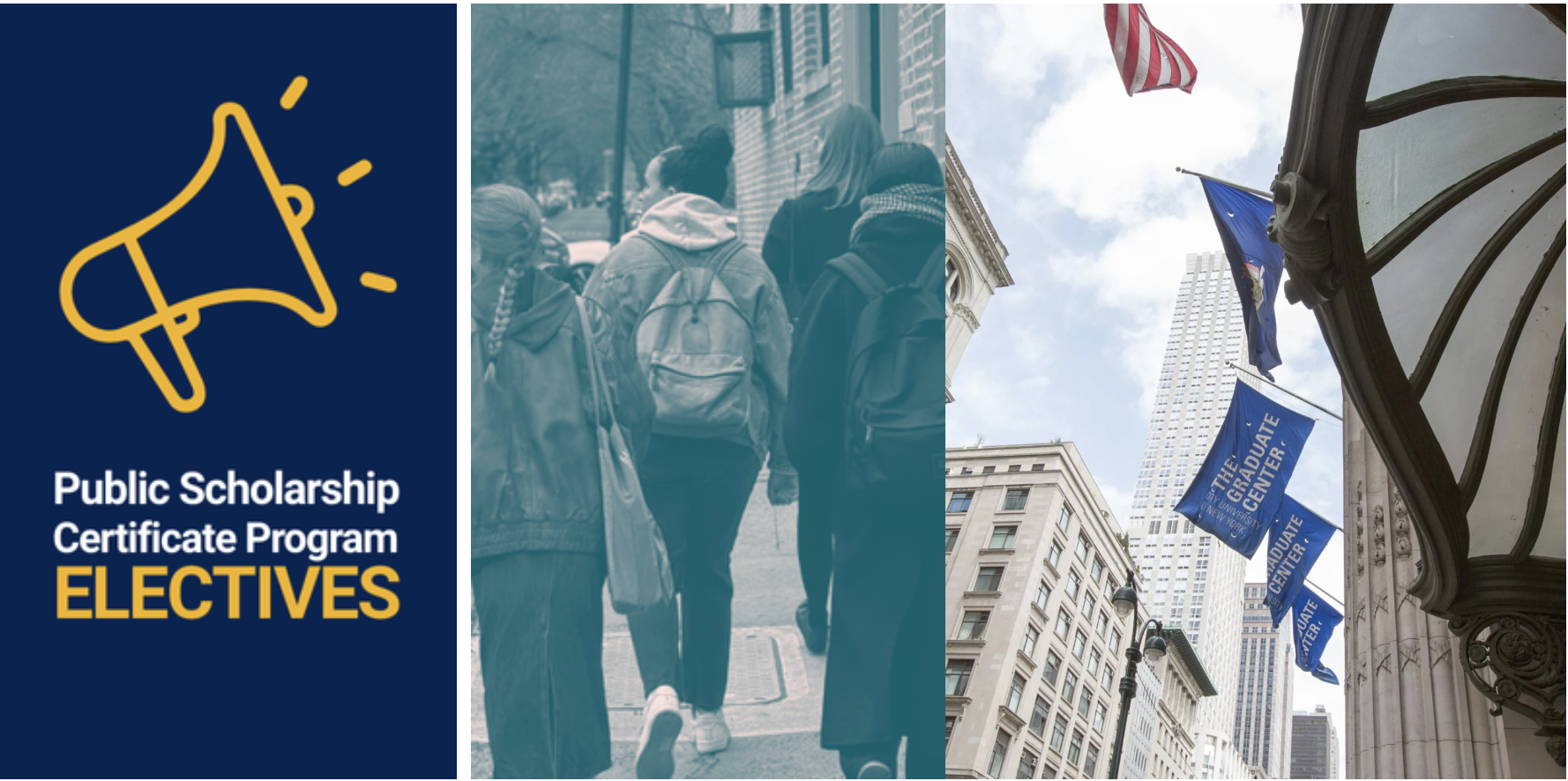

This fall we launched the Certificate Program in Public Scholarship at the CUNY Graduate Center.
It joins a suite of new academic programs which include the Certificate Program in LGBTQ Studies, and the M.A. and Ph.D. in Black, Race, and Ethnic Studies.
Students are required to take to two core courses:
- Introduction to Public Scholarship (3 credits) offered in Fall only, and
- Social Justice and Public Scholarship (3 credits) offered in Spring only
in addition to two electives taken from a rich range of our existing courses and programs that represent the GC’s longstanding tradition of justice-forward, interdisciplinary, non-extractive models of inquiry, knowledge production, and collaboration.
While not an exhaustive list, here’s some of our recommended electives for Spring 2026 for the Public Scholarship Certificate Program:
ANTH 70500/ EES 79904 – Decolonizing Methodologies. 4 credits. Monday, 2pm-4pm. Prof. Naomi Schiller, In Person — Fulfills Research Methods requirement for Cult & Ling Anth students.
BRES 70002 – 01 Interdisciplinary Theories and Research on Race and Ethnic Studies. 3 credits Wednesday, 4:15pm-6:15pm. Prof Jean Beaman, In Person
This seminar introduces major interdisciplinary theoretical perspectives that inform research and scholarship on race and ethnic studies in the U.S. and beyond. The seminar highlights the centrality of interdisciplinary, multidisciplinary, and transdisciplinary approaches to the study of race and ethnicity. It also examines the core concepts that have informed the field, including intersectionality, indigeneity, diaspora, transnationalism, racism, and decolonization. It also introduces core components of research design, including the politics and ethics of research, how to develop research projects, research methods in the humanities (e.g., archival methods, oral history, auto/biography, visual methodologies, discourse analysis) and in the social sciences (e.g., ethnography, interviews, surveys, geographic information systems, and quantitative analysis of existing data).
DHUM 74500 (54959) – Digital Pedagogy 2: Theory, Design, and Practice. 3 credits. Thursday, 4:15pm-6:15pm, Prof. Shawna Brandle, Online
In the first digital pedagogy course, students were introduced to the history and contexts within which technology has been integrated into teaching, learning, and research at the college level. In the second core course, students will continue with that investigation as they begin to carve out space for their own work. In Spring 2026, the course will focus on opening our digital pedagogy – exploring open educational resources and open pedagogy, along with related opens: open access and open GLAM (Galleries, Libraries, Archives, and Museums). We’ll dig into how open educational practices can be (but are not necessarily) adapted to be accessible, inclusive, and culturally responsive, and explore the range of ways open practitioners are responding to AI.
The focus of the course topics will be on the why’s, how’s, and where’s of open educational practices, with a special focus on critical digital pedagogy. The work of the semester will culminate in a project selected by each student to further their exploration specific to their own educational context: projects might be OER they create, courses they design, research studies, or substantial grant proposal drafts. The course incorporates hands-on exploration of educational uses of new-media applications and open possibilities. The course will use an open pedagogy approach to teaching and learning, including a co-created syllabus wherein students will have significant say in the selection of course materials and assignments.
DHUM 78000-01 (54961) – Special Topics: Digital Memories: Theory and Practice. 3 credits. Monday, 4:15pm-6:15pm, Prof. Aránzazu Borrachero, In Person
Memory Studies, an interdisciplinary field focusing on “how, what and why individuals, groups and societies remember, and forget” (Memory Studies), has experienced important paradigm shifts since its inception in the 1980s. The onset of digital media is responsible for the latest and, arguably, most radical changes.
This course explores how the past is constructed, archived and communicated through digital media from a sociocritical angle: What is the potential of digital memory and storytelling projects to change or break power structures? Has digital technology opened spaces for contesting traditional narratives of the past? Is civic action shaped by digital memory initiatives? Are digital memory initiatives shaped by civic action?
With these questions as a framework, we will analyze key concepts in Memory Studies, such as collective memory (Maurice Halbwachs), cultural memory (Aleida and Jan Assman), transnational memory (Astrid Erll), and postmemory (Marianne Hirsch) –concepts, all of them, interrogated by the emerging field of Digital Memory Studies (Andrew Hoskins). Armed with this theoretical work, we will examine a diversity of digital memory and storytelling projects, from well-established and institutionalized ones (e.g. Imperial War Museums, Forced Labor 1939-1945, Memorial Democràtic) to community-led projects and/or projects explicitly engaged in counter-hegemonic memory-making (e.g. 858 Archive, Documenting the Now, Torn Apart/Separados).
This course utilizes a project-based pedagogical approach to the study of digital memory. You will complete two interrelated projects: first, you will collaborate in the writing and publication of Digital Memory Project Reviews, Volume VI (see Digital Memory Project Reviews for Volumes I-V). This analytical work will familiarize you with project design, content collection, content management, and online publication. You will apply these concepts and skills to your second class project: developing a digital memory archive.
EES 79903 (55969) History and Theory of Socially Engaged Art. 3 credits Monday, 2pm-5pm, Prof. Gregory Sholette, Course open to all GC Students. In Person.
An increasing number of artists, curators, and critics have recently turned their energies toward a new type of participatory socially engaged art making. What had previously been marginalized is now gaining more mainstream attention, with a new prominence in museums, biennials, but also on the streets and other public spaces. Even the New York Times has hailed the emergence of this tendency as “social practice art.” The aim of this seminar is to survey, critique and historicize the theory and practice of social practice art as well as activist, interventionist, public, participatory and community-based art operating within and across fields such as performance, urban studies, environmental science and other socially engaged disciplines. The class will focus on such questions as: Why is it useful, even necessary, to understand the history and theory of social practice art? Where should we look to find the historical roots of social practice art? Are these within the history of art, or external to it, or crossing a line between two spheres of cultural interpretation and understanding? And what is the “social”? In an increasingly privatized society how do we define and operate within a concept of the public sphere? And how are both mainstream and alternative types of cultural institutions responding to the increasing interest in socially engaged art by emerging artists? Through lectures, readings, discussions, and student research presentations we will seek to position socially-engaged visual culture and the shifting role of the artist within an historical, ideological, and critical framework. If possible, guest speakers and offsite visits will also be added as available.
HIST 79500 Writing History with the Five Senses. 3 Credits Wednesday, 6:30pm-8:30pm. Professor Tanisha Ford. In Person
This seminar takes seriously the craft of writing. Historians draw from deep and varied sources (oral interviews, newspaper articles, objects, letters, government documents, etc.) and weave them into narratives that are both analytical and alive. Yet we are rarely taught how to do so. This course invites students to think about the art of craft: how to use the five senses to bring dimensionality, tone, and voice to historical writing. Readings span narrative histories, memoirs, novels, hybrid texts, and books on craft, all offering models for how history can come to life on the page. To be clear, this is not a course in critical fabulation, an often misinterpreted and misapplied theory and method. While we will read some novels to understand fiction craft, this course is not about confronting the “gaps and silences” in the archive. Students will explore narrative structure, sentence-level rhythm, and sensory evocation as tools for making argument and meaning. The course emphasizes dramatic tension, texture, and creative strategies that complement scholarly analysis. Assignments include creative nonfiction exercises and opportunities to rework your own research and writing using the techniques studied. This seminar is ideal for students with some prior research experience who have produced at least one substantive research paper (e.g. a first- or second-year paper) or biography/memoir chapter. Most importantly, it is for those eager to experiment across genres and to encounter history—and their own writing practice—with renewed confidence and creativity.
HIST 79500/MALS 74900/WSCP 81000 Special Topics in Public Scholarship. 3 credits. Wednesday, 4:15pm-6:15pm. Professor Prithi Kanakamedala. In Person
New York City’s landscape contains the racialized and gendered stories of New Yorkers past. Using various case studies including the work of artists, historian-curators, and oral historians, and site-specific work such as Abolitionist Park Place, students will participate in walking or teaching tours (during class time), and site visits to repositories such as the New York Public Library and the Brooklyn Public Library. Students will design their own oral history projects and/ or digital projects as part of a semester-long project. Please allow for travel time (up to max 1 hour) when scheduling other classes.
IMS 75000 (56169) The Politics of U.S. Immigration: Past Lessons, Future Directions. 3 credits. Wednesday, 4:15pm-6:15pm. Prof. Sayu Bhojwani. In Person
This course explores the politics of immigration nationally and in New York City since the September 11 attacks and aims to create a blueprint for 2026 and beyond. Students will assess contemporary debates and policies on immigration and integration by analyzing the candidates, platforms, and policies that shaped the conversation since 2001. With new leadership in New York City and local responses from around the country, a portion of the course will focus on activating students’ imagination about messaging and policies for this moment and beyond.
LGBTQ STUDIES/ WSCP81000 Foundations of Queer Studies – Praxis. 3 credits Wednesday, 6:30pm-8:30pm, Prof. Justin Brown, Hybrid Synchronous
Building upon Foundations of Queer Studies I: Epistemologies, Foundations of Queer Studies II: Praxis explores the concept of praxis and its differentiation from theory, model, and framework. The course excavates how praxis operationalizes and puts theory into action. Students will survey distinctive (non)traditional methods. A deeper dive will move toward the “queering” of methodology and intersections with traditional investigative strategies often used within disciplines that inform LGBTQ studies such as literature, cultural studies, social sciences, history, humanities, women’s and gender studies, humanities, and sexuality studies. Course content will examine the implications of “queering” praxis on historical and current social change and cultural shifts in local, national, and global societies. Through applied areas such as health, law, education, business, and journalism, students will contrast praxis approaches and assess their utility to address queer-focused social justice issues. Students will formulate the expansive roles of ethics and reflection in “queering” methodology and “queering” praxis. While examining real-world praxis application to address LGBTQ issues, in an applied project, students will bridge epistemology to praxis. Students will critique if and how processes of praxis begin with theory and end with theory being reframed.
PSC 73905 / EES 79903 Environmental Justice Policies and Practices. 3 credits Wednesday, 2pm-4pm, Prof. Tammy Lewis
This course focuses on the distributional dimensions of environmental degradation and environmental protection globally, domestically and in New York City. We will explore the social processes that generate synergistic race and class stratification, and how they impact the distribution of ecological costs and benefits. Substantive areas of focus will include the class and racial segregation of urban neighborhoods, the siting of hazardous facilities in communities of color, unequal protection of environmental health, unequal distribution of urban environmental amenities, and climate injustice. The course will also examine the social origins and impacts of a distinct environmental justice movement that emerged from BIPOC and working-class communities that are most at risk from climate change. Both successes and ongoing struggles in the EJ movement will be explored, with emphasis on NYC.
PSC 83300/ SOC 81200 Public Sociology, Ethnography, Research Design, and Methods: Fighting Inequality and Injustice. 4 credits Tuesday, 2pm-4pm. Prof Robert Smith.
This course focuses on publicly engaged sociology (often called public sociology) and social science that seek to fight inequality and injustice. The course tries to address a key problem in graduate school and academic careers: most of us go into sociology or other social sciences because they help illuminate problems in the world, but academic life and careers increasingly pull us away from the engaged work that addresses or fights those problems. A key goal of this course is to offer students examples of how to do strong empirical, academic research while also engaging with strategic actors so our work can have an impact. The course will start by offering students strong grounding in research design and corresponding methods for case oriented research and qualitative methods, to enable students using these methods to understand, clearly write about, and defend the epistemic and methodological underpinnings of their case study research, in academic settings, like grant proposals and papers, and applied settings working with stakeholders, and even in sometimes hostile settings like litigation.
** Please note: Students that are taking PSC71300 Research Design with Prof. Smith in fall 2025 are eligible to register for PSC83300 in the spring and are encouraged to do so.
SOC 85000 Reimagining Policing and Public Safety. 3 credits. Wednesday 6:30pm-8:30pm, Prof. Alex Vitale
This course will examine the origins and historical function of police and explore competing discourses and practices concerning the direction of policing and the production of public safety, including “reform,” “defund,” “back the blue,” and “abolition.” We will incorporate theoretical literatures to help explain the interaction between neoliberal austerity and the use of police to manage a growing number of social problems, such as homelessness, sex work, youth violence, untreated mental health conditions, and harmful substance use, with special attention given to violence reduction efforts. Epistemological issues will be explored through an abolitionist lens.
Related News
News
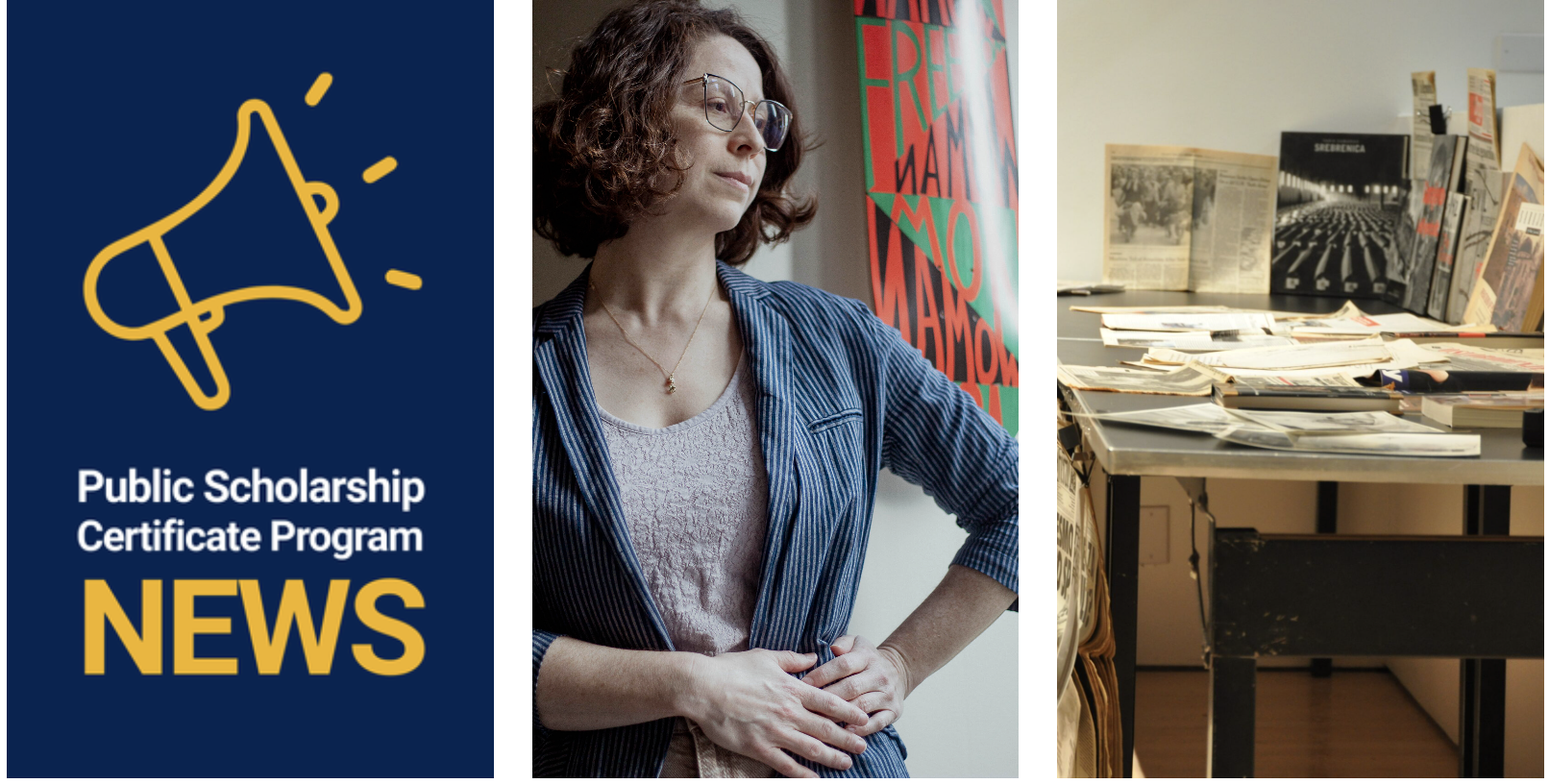
Kendra Sullivan teaches Social Justice & Public Scholarship, Spring 2026
News
Fall 2025 Electives, Public Scholarship Certificate Program
News
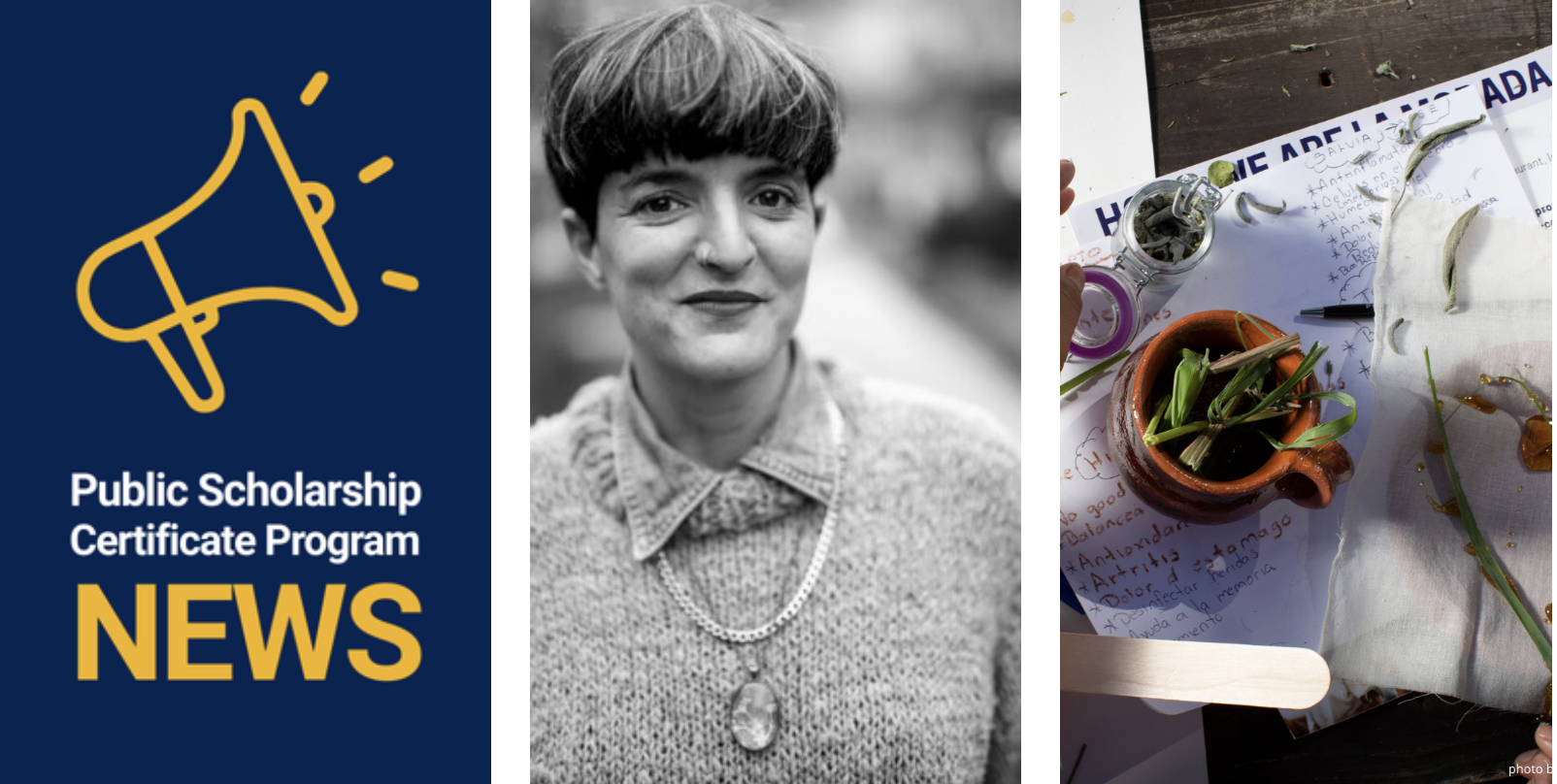
Ángeles Donoso Macaya teaches Introduction to Public Scholarship, Fall 2025
Fellowships & Opportunities

Summer Public Research Fellowships from ERI & PS2
Projects

People

Prithi Kanakamedala
Faculty Coordinator (PS2)
Certificate Coordinator