
This fall we launched the Certificate Program in Public Scholarship at the CUNY Graduate Center.
It joins a suite of new academic programs which include the Certificate Program in LGBTQ Studies, and the M.A. and Ph.D. in Black, Race, and Ethnic Studies.
Students are required to take to two core courses:
- Introduction to Public Scholarship (3 credits) offered in Fall only, and
- Social Justice and Public Scholarship (3 credits) offered in Spring only
in addition to two electives taken from a rich range of our existing courses and programs that represent the GC’s longstanding tradition of justice-forward, interdisciplinary, non-extractive models of inquiry, knowledge production, and collaboration.
While not an exhaustive list, here’s some of our recommended electives for Fall 2025 for the Public Scholarship Certificate Program:
UED 72100 / WSCP 81000 Scholar-Activist Praxis Monday, 630 – 830 PM, 3 credits, Bishop
Choosing to teach for justice in the U.S. in 2025 is a daring act. The landscape of the moment is stark: teachers can lose their jobs for teaching diverse and inclusive content; K-12 schools and universities stand to lose their funding for supporting equity efforts. Current attacks on teaching and learning inside educational institutions and out-of-school spaces are attempting to seed curricular fear and evoke an intellectual paralysis, hoping that educators and researchers will succumb to forms of self-censorship and engage in what CUNY professor Michelle Fine calls “anticipatory obedience.” As scholar-activists, we resist these efforts. The focus of this course will be on examining the socio-political conditions of two major facets of scholar-activist academic work: (1) culturally sustaining teaching and learning; and (2) forms of public scholarship that do not shy away from the pervasive dangers of the moment. We will read the work of scholar-activists working at/from/despite the margins of academia in the U.S. and internationally in order to illuminate routes and forge trajectories we can take to teach for peace and publish for justice. The final project of this course will provide enrolled students with options to create content for wider distribution that aligns with their scholar-activist goals.
PSYC79200/WSCP 81000 Research Methods and Ethics in Environmental Psychology Thursday, 9:30 AM – 11:30 AM, Michelle Fine *INSTRUCTOR PERMISSION REQUIRED.
Contact Michelle Fine ([email protected]) to ask for permission to enroll. If the instructor agrees to add you to the class, forward the email exchange to our APO ([email protected]) with your CUNYFirst ID number*
We begin… asking to whom are we, as social scientists, accountable, and for what? And how do we best honor the struggles of today, to provoke an imagination for what could be?
This course blends methods and ethics throughout – with attention to whose knowledge is honored, how the APA has handled ethics protocols and violations (e.g. Guantanamo/disability testing/conversion therapies, and the apology to people of color), and we will work with Ms. Banchick from the ETHICS unit to address how the Graduate Center operationalizes ethical practice. Every paper, and every presentation, will center ethics and methods.
Each week you will have access to a “classic”/contemporary/critical/transnational offering. We consider some of the following positions to ground us:
‘[t]he crisis consists precisely in the fact that the old is dying and the new cannot be born; in this interregnum a great variety of morbid symptoms appear’. Antonio Gramsci, Prison Notebooks, 1930
The American Psychological Association failed in its role leading the discipline of psychology, was complicit in contributing to systemic inequities, and hurt many through racism, racial discrimination, and denigration of people of color, thereby falling short on its mission to benefit society and improve lives. APA is profoundly sorry, accepts responsibility for, and owns the actions and inactions of APA itself, the discipline of psychology, and individual psychologists who stood as leaders for the organization and field. Apology to People of Color for APA’s role in promoting, perpetuating and failing to challenge racism, racial discrimination and human hierarchy in the U.S. 10.29.2021
“From the vantage point of the colonized, a position from which I write, and choose to privilege, the term ‘research’ is inextricably linked to European imperialism and colonialism. The word itself, ‘research’, is probably one of the dirtiest words in the indigenous world’s vocabulary. When mentioned in many indigenous contexts, it stirs up silence, it conjures up bad memories, it raises a smile that is knowing and distrustful. It is so powerful that indigenous people even write poetry about research… Just knowing that someone measured our ‘faculties’ by filling the skulls of our ancestors with millet seeds and compared the amount of millet seed to the capacity for mental thought offends our sense of who and what we are. It galls us that Western researchers and intellectuals can assume to know all that it is possible to know of us, on the basis of their brief encounters with some of us. It appalls us that the West can desire, extract and claim ownership of our ways of knowing, our imagery, the things we create and produce, and then simultaneously reject the people who created and developed those ideas and seek to deny them further opportunities to be creators of their own culture and own nations.” ― Linda Tuhiwai Smith, Decolonizing Methodologies: Research and Indigenous Peoples
“Why am I compelled to write?… Because the world I create in the writing compensates for what the real world does not give me. By writing I put order in the world, give it a handle so I can grasp it. I write because life does not appease my appetites and anger… To become more intimate with myself and you. To discover myself, to preserve myself, to make myself, to achieve self-autonomy. To dispel the myths that I am a mad prophet or a poor suffering soul. To convince myself that I am worthy and that what I have to say is not a pile of shit… Finally I write because I’m scared of writing, but I’m more scared of not writing.” ― Gloria E. Anzaldúa
PSYC 80103/SSW/UED/AFCP/WSCP 81000 Anti-racist Methodologies & Research Ethics for Black Participatory Community Engaged Research Monique A. Guishard, PhD, Tameka Battle, EdD, & Justin T. Brown, PhD, MPH
In response to troubling movements to delegitimize/disappear critical race Black and Latine/x Studies from higher education (López et. al, 2021; Russel-Brown, 2022), and with hopes of providing substantive training for the next generation of Black & Latine/x scholars, we have developed a transgressively imagined syllabus for an Anti-racist Methodologies and Research Ethics for Black Participatory Community Engaged Research course. The fundamental objective of this course is to support graduate students with designing, conducting, ethically evaluating, and producing intersectional critical race scholarship (and policy) that can be utilized to address inequities rooted in systemic racism. This 3-credit, 3-hour course was designed with funding support from the Black, Race, and Ethnic Studies (BRES) Curriculum Development Faculty Fellowship program and as a function of that was envisioned as a core course under the Research Approaches with a Qualitative Emphasis area. In graduate research methods courses, there are often sparse or superficial attempts to infuse moments of criticality, by including whiffs of intersectionality praxis, critical race theories/methodologies, decoloniality, white queer theory, and BIPOC feminist perspectives. Research ethics training is designed similarly, with readings, practices, and theoretical frameworks that center cis-white normative ethics as they pertain to mostly individual research participants. These traditions are troubling, particularly when rich tomes of place-based and community-centered scholarship exist. This course pushes the academy to rethink graduate training curricular frames in keeping with aims of the CUNY Black, Race and Ethnic Studies Initiative Council and Collaboration Hub.
DHUM 70000 – Introduction to Digital Humanities (52976) In person Tuesday, 6:30 – 8:30 PM, 3 Credits, Profs. Krystyna Michael ([email protected]) and JoJo Karlin ([email protected])
What are the digital humanities, and how can they help us think in new ways? This course offers an introduction to the landscape of digital humanities (DH) work, paying attention to how its various approaches embody new ways of knowing and thinking. What kinds of questions, for instance, does the practice of mapping pose to our research and teaching? How do you think like a humanist with and about data? When we attempt to share our work through social media, how is it changed? How can we read “distantly,” and how does “distant reading” alter our sense of what reading is?
Over the course of this semester, we will explore these questions and others as we engage ongoing debates in the digital humanities, such as the problem of defining the digital humanities, the question of whether DH has (or needs) theoretical grounding, controversies over new models of peer review for digital scholarship, issues related to collaborative labor on digital projects, and the problematic questions surrounding research involving “big data.” The course will also emphasize the ways in which DH has helped transform the nature of academic teaching and pedagogy in the contemporary university with its emphasis on collaborative, student-centered and digital learning environments and approaches.
Among the themes and approaches we will explore are evidence, scale, representation, genre, quantification, visualization, and data. We will also discuss broad social, legal and ethical questions and concerns surrounding digital media and contemporary culture, including privacy, intellectual property, artificial intelligence, and open/public access to knowledge and scholarship.
Though no previous technical skills are required, students will be asked to experiment in introductory ways with DH tools and methods as a way of concretizing some of our readings and discussions. Students will be expected to participate actively in class discussions and online postings (including on our course blog and in collaborative annotations) and to undertake a final project that can be either a proposal for a digital project or a seminar paper. Students completing the course will gain broad knowledge about and understanding of the emerging role of the digital humanities across several academic disciplines and will begin to learn some of the fundamental skills used often in digital humanities projects.
HIST 79600 Oral History Methods and Practices 3 Credits, Tuesdays, 2:00 PM to 4:00 PM, Fully In-Person Professor Anne Valk
This seminar centers on the skills and perspectives needed to undertake applied oral historical research and writing. Combining historiographical reading and hands-on methods, the course introduces students to the contributions and challenges of oral history, a discipline of widespread use in both academic and public history projects. We will consider important topics including: the narrator-interviewer interaction; the effects of the interview on narrators and interviewers; cross-cultural and cross-class interview dynamics; ethics and legal issues in oral history; the impact of digital technology; translating the oral testimony into a written document; analysis and interpretation of the interview; archival repositories for oral testimonies; and the role of the community in the dissemination and reception of oral historical projects. As part of the course, students will be expected to conduct their own interviews and complete a final research project, focused either on historiographical developments or an original oral history project.
Related News
News
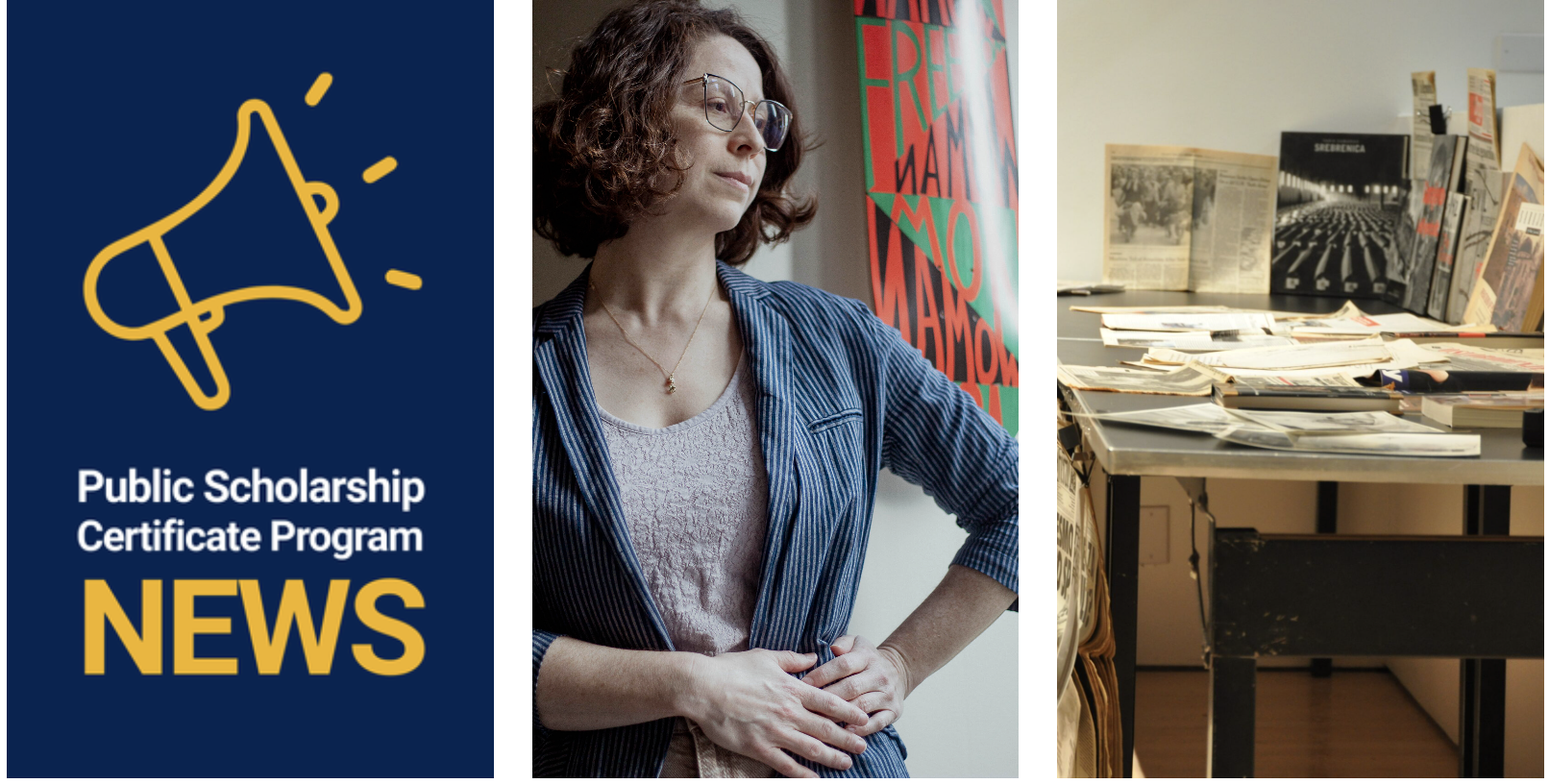
Kendra Sullivan teaches Social Justice & Public Scholarship, Spring 2026
News
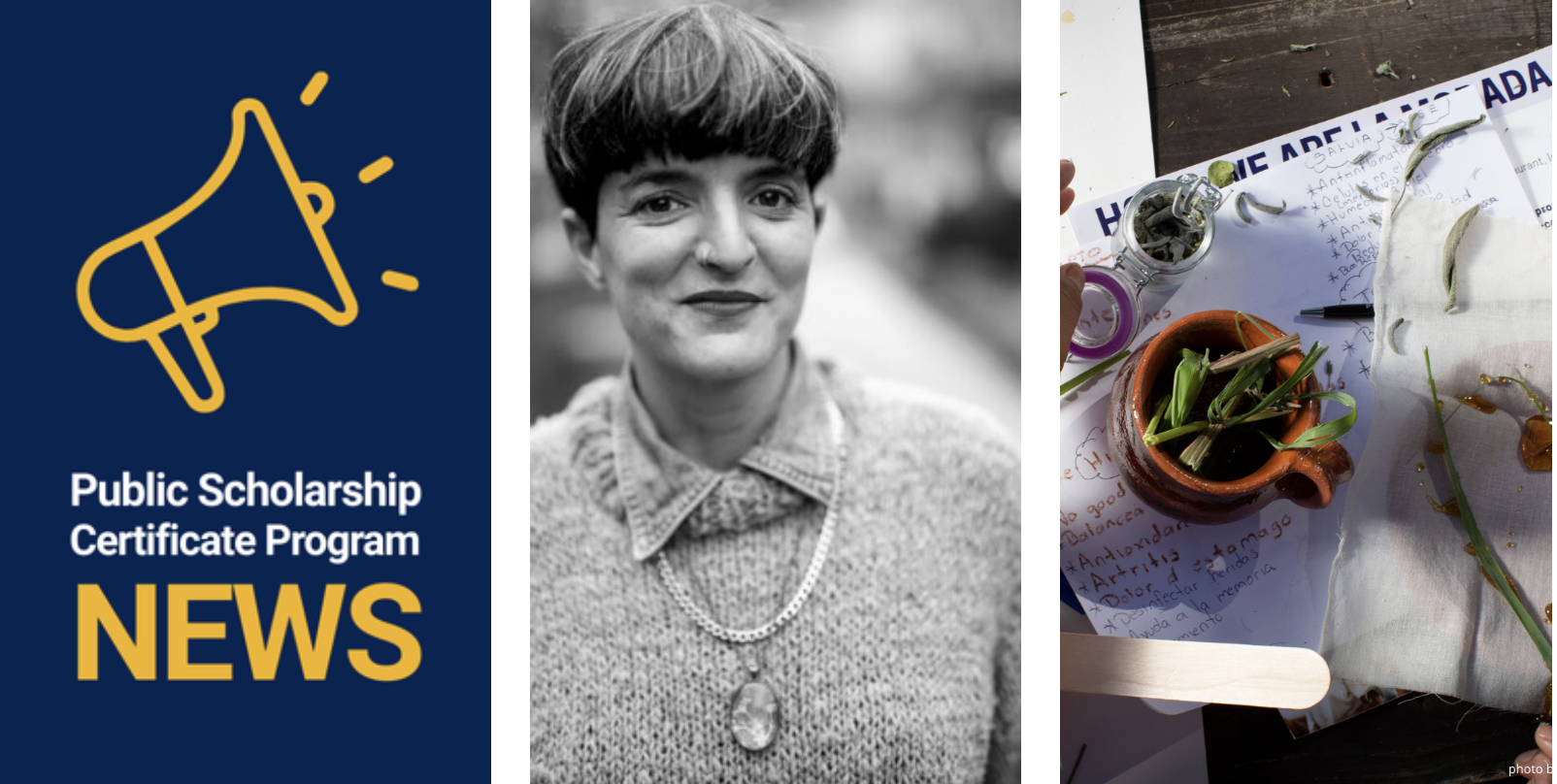
Ángeles Donoso Macaya teaches Introduction to Public Scholarship, Fall 2025
Fellowships & Opportunities

Summer Public Research Fellowships from ERI & PS2
News
Spring 2026 Electives, Public Scholarship Certificate Program
Projects

People

Prithi Kanakamedala
Faculty Coordinator (PS2)
Certificate Coordinator