Archives in Common from La Morada to BMCC: Learning from and with recetarios
November 21, 2025
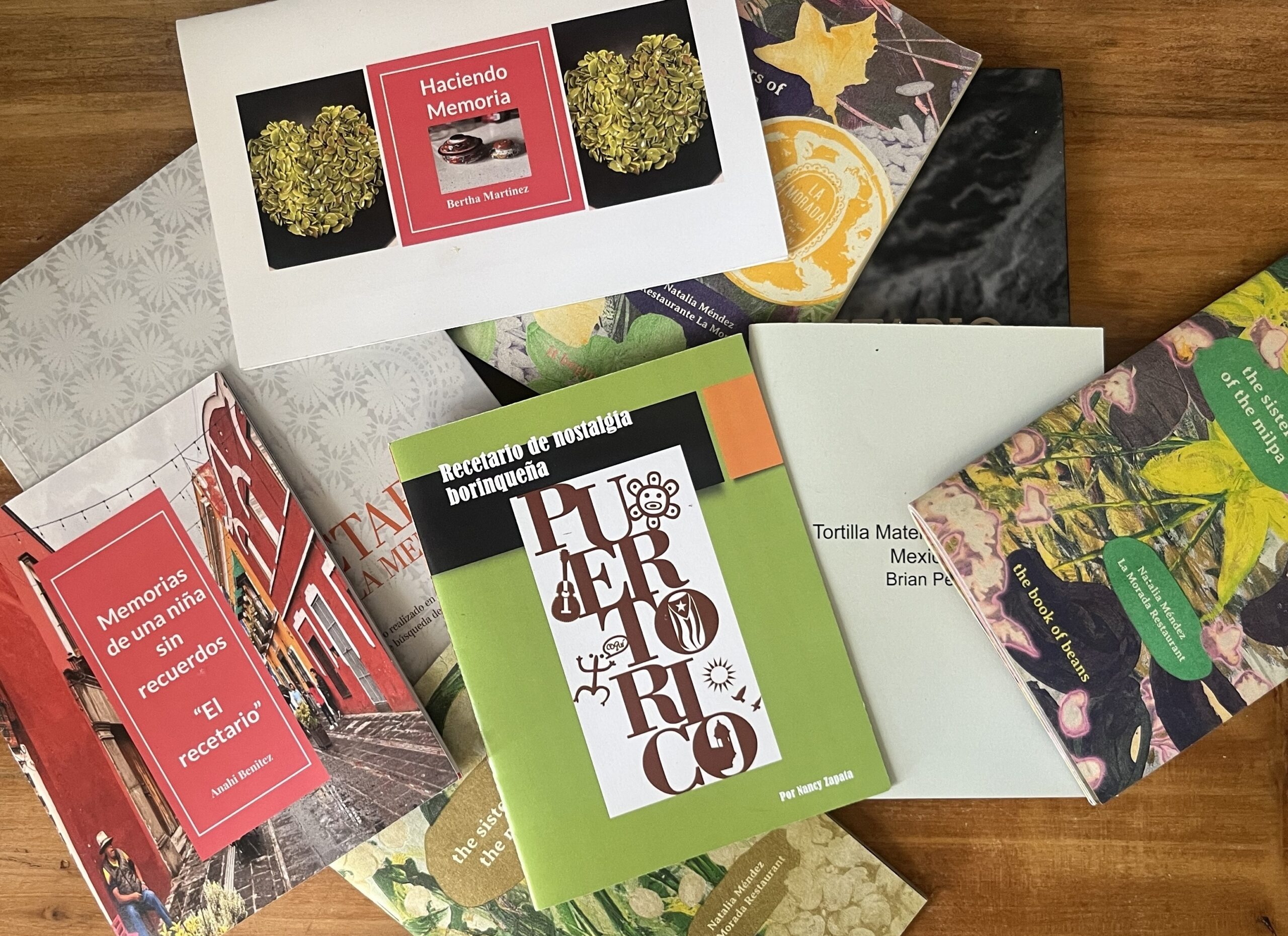
We are honored to present the work of Ángeles Donoso Macaya, faculty lead of Archives in Common, and four of her students, Anahí Benítez Hidalgo, Richard Cuevas, Bertha Martinez, and Nancy Zapata, from her Literature and Civilization of Latin America course at Borough of Manhattan Community College (BMCC). Read more about the inspiration for the projects and the students’ recipe books below.
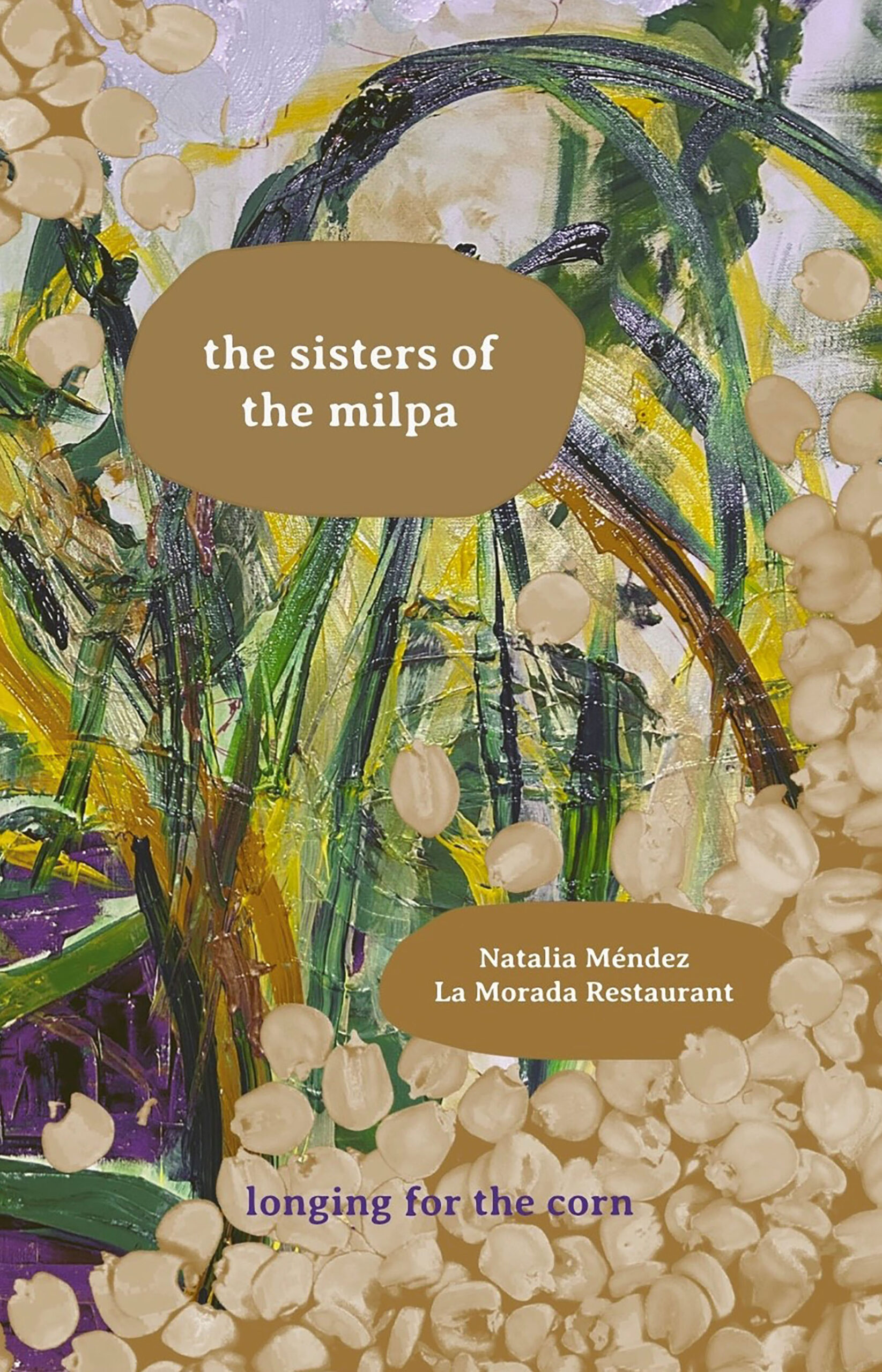
“Knowing is breathing and beating. And it supposes a metabolism and a rhythm with the cosmos,” says Aymara sociologist, activist, and poet Silvia Rivera Cusicanqui about research and writing.1 This passage has stayed with me for years, and I always return to it when I write about the recetarios, or recipe books. In this quote, Rivera Cusicanqui links not only the work of the intellect (talking, listening, and writing—all forms of knowing) to that of the body (breathing, feeling, eating), but also the body to the cosmos. I learned a similar idea from Chef Natalia Méndez, co-founder of the restaurant La Morada in the South Bronx and author of Las hermanas de la milpa (The Sisters of the Milpa), a bilingual recipe book series that seeks to disseminate indigenous knowledges and practices, and at the same time to conceptualize and expand the ways of doing mutual aid —the very heart of our collaborative project Archives in Common.
While working on The Sisters of the Milpa, listening to Chef Natalia, I realized how radically precarious and interdependent our human bodies are: we need food, water, and oxygen to survive; we cannot take care of ourselves or sustain others if we don’t also take care of the earth and the plants that grow in it. Chef Natalia said, “We want you to learn about the plant and its seed—where and when it’s planted, how it grows—and hopefully be inspired to plant it in a pot or a garden. In this, The Sisters of the Milpa is consistent with everything we do in the kitchen at La Morada.”

Last semester (Spring 2025), The Sisters of the Milpa recipe book series became a source of inspiration for my Literature and Civilization of Latin America course at Borough of Manhattan Community College (BMCC). Some students created recipe books as their final cultural project. The beauty of these books—which showcase work by photographers Camila Falquez, Zahara Gómez, and Cynthia Santos-Briones, as well as paintings by Marco Saavedra, and are designed and printed in riso by Amanda Chung of Lucky Risograph Press—taught students to be intentional about their own designs. We spent some time in class talking about the images and the colors each individual would use in their cookbooks. Some students decided to illustrate recipes with family photos; others took pictures of the dishes they were preparing; some chose illustrations and elements that highlighted the textures and colors of each dish.

A second source of inspiration for this project was Recetario para la memoria, a collaboration originally conceived by photographer Zahara Gómez. Working with different groups of mothers who have been searching for decades for their missing children in Mexico, Zahara has produced two eloquent recipe books to date—one in Sinaloa and one in Guanajuato. As The Sisters of the Milpa, the Recetario para la memoria is made out of tenderness and love, but also out of grief. Thus, in the second volume, created in collaboration with groups of searchers of disappeared people from Guanajuato, journalist Daniela Rea says: “The way we learn to cook and the people we learn to cook from filter the outside world. The dishes we choose hold family stories and daily routines. What we eat tells our story; it also tells the story of our land. And that land has changed over time. In that field that fed them is where their families search for them”.2

Bottom: a double-space spread of the Sinaloa edition, created by Zahara Gómez Lucini in collaboration with the Rastreadoras del Fuertes. The black and white photo shows an adult woman standing in front of a kitchen counter. Photograph by Zahara Gómez Lucini.
When we read and discussed the Recetario para la memoria, described by their creators as a “gastronomic, social, and photographic project,” we couldn’t help but reflect on the connection between the experiences of these mothers, sisters or cousins who became searchers, the experience of displacement that Chef Natalia described in Longing for Corn, and the ongoing reality faced by hundreds of thousands of displaced people in the United States, in Europe, in North Africa, in Palestine, and beyond.
Hence, in class, we also talked about the weaponization of starvation as a form of genocidal violence, about the territorial dispossession that has left hundreds of thousands of farmers without access to cultivable land and their crops, about the proliferation of genetically modified seeds that threatens the survival of native seeds and goes against food sovereignty, and more. Because of all of this, in their own cookbooks, my students unilaterally underscore the importance of culinary traditions as a form of resistance and as a tool against oblivion. Four students—Anahi, Richard, Bertha, and Nancy, listed here in alphabetical order—share their recollections and what they learned from this experience below.

Memories of a Child with no Memories: the Recipe Book
Anahí Benitez Hidalgo
I have to be honest: before working on this project, I never thought about food as a form of resilience, as a way of communicating something bigger than just fulfilling a basic necessity. For me, it is important to remember how this project started. Although I cannot take credit for the recipes, I share a little bit of my story as an act against forgetting and to honor the memory of those who are no longer with us.
I interviewed some family members and asked them about their favorite food dishes and the connections, memories, or any other reasons that made this dish their favorite. I wrote four recipes that I chose for different reasons. I chose “Tortitas de papa” (potato patties) because it is one of my favorite dishes and reminds me of my childhood; “Sopa de letras”, because it is my daughter’s favorite, and also because I think that a homemade soup always provides you with that warm feeling of safety. I wrote about “Chilaquiles” because, as the meme says: “The secret of world peace is on chilaquiles: chill all, kill less”—and I think that message is beautiful. Finally, I chose “Mole poblano” because I assumed it had always been my father’s favorite dish, but after the interview with him, I realized I was wrong. “Do you know how to cook?” was the first question I asked my father, to which he replied, “In my own way, I know how to cook.” Then he told me that when he was a kid, his favorite dish was “rajas con crema” (poblano pepper strips in cream sauce), which his paternal grandmother, Josefina, used to cook. This made me realize all of the many things that I didn’t know about my father.

A screenshot of a photo found on Reddit/Mexico, the message reads: “The secret of world peace lies in chilaquiles: chill all, kill less”.
Working on Memorias de una niña sin recuerdos: el recetario made me consider my relationship with food more deeply; this relationship has been close to me since I was very young—and I mean this quite literally because my parents owned a restaurant. Maybe this doesn’t sound too specific, but many things were different during my upbringing. As the youngest of five sisters, I remember that, as a child, my parents worked all day, and we spent little time at home. Every day after school, we had to go to the restaurant for lunch because we had no food at home. Sure, we had basic things like coffee, cereal, ham, and bread, but if we wanted to have a proper meal, the restaurant was the place to go.
This upbringing taught me a lot. For example, I learned from my parents that, as chef Natalia says in The Sisters of the Milpa, “where one eats, ten can eat.” This was because my father, whom everyone called “Tío Charly” back then, had countless nephews who worked as waiters, whom he fed along with us at the restaurant.
Although it wasn’t what I wanted as a child, growing up in the family restaurant shaped me and led me to where I am today. For a time, I even studied to become a chef. My plan was to inherit my parents’ restaurant to continue the family tradition. However, two years into the associate degree program, I realized that Gastronomy wasn’t for me. So now, here I am, writing about a cookbook in which I sought to recall, through pleasant and not-so-pleasant experiences, what food meant to the people I love.
“El dinero se hace trabajando, no ayunando”, said my dad at some point in our interview. This phrase means something like: “Money is made by working, not by fasting,” but I think it does not have the same weight in English that it has in Spanish. As an adult, my father started cooking for himself and his family. He never had any formal training; he simply learned by watching the people who cooked at home, like his abuela Josefina. Seeing his face illuminate as he shared his memories of the dishes she prepared was heartwarming. For a second, I could imagine my father as a kid with that innocence, emotion, and happiness that food as a memory can bring back for him.
Food wasn’t my first thought when it came to the question: How would you like people to remember you? Now, I think I get it. Cooking may not be my strongest skill, but if, through food, I can share memories and love with the people I care about, I think it’s worth a try.
Puerto Rican Soul Food
Richard Cuevas
My Grandfather’s Pasteles
My grandfather worked from the age of 5, beginning on a farm in Cuba, until the age of 80, cleaving meat at butcher shops 12 hours a day, 6 times a week, for 50 years here in New York. His only day of rest was Sunday.
Pasteles were abuelo’s specialty. They were so special to him that occasionally, especially during the winter months, he would dedicate the entirety of his only day of rest to their preparation and assembly—a lengthy, hours-long process, usually made quicker with the help of my grandmother and her two sisters, who lived in the apartment above theirs. This recipe is born of that fortitude, collaboration, and constant dedication that remained, despite fatigue from tribulations that come with living in this city as people in their circumstances.
Here exists the resistance, that indomitable spirit we maintain and cultivate despite the labors of life, and in the face of things that seem so much bigger than ourselves. In my interview with my grandfather, he described the preparation of his pasteles as a soothing process, something that brought him tranquility. Having been accustomed to decades of preparing food, whether in butcher shops, on a farm, or in the small kitchen of his New York City apartment, he never grew tired of it.
What he described as a relaxing, perhaps even mundane procedure was, in truth, a ritual of silent devotion, an homage to a home whose sugarcane fields had long been left behind, replaced with tall concrete buildings and loud train cars packed with people. On those occasional Sundays, with the foreign, biting cold of New York winter knocking on the window, my grandfather made sure to honor a culture kept alive hundreds of miles from its place of origin, through his hands, the grinding of plantains, and the folding of malanga leaves.
My Grandmother’s Sorullitos de Maíz
The first Puerto Rican food I ever learned to make myself was sorullitos de maiz. The taste of cornmeal is laced with comfort and nostalgia for me. This is all my grandmother’s fault. It has been two years since her passing, and she was quite sick for the last eight years she was with us, so little by little, we got used to not seeing her in the kitchen. The memory of the flavor of her food faded with the passage of time.
I spent a good amount of my early childhood with my grandmother. My mother raised my two siblings and me by herself and worked constantly. School was difficult for me. Although I loved to learn, the teachers and students around me made school a place of scorn and hostility. I only found peace and a place to escape in my grandmother’s house, who lived with her two sisters in the apartment above her house. I grew up watching them all sit at her kitchen table, talking, arguing, laughing, and gossiping, only catching some phrases here and there due to my then-poor Spanish skills. I would sit there, small and quiet, either helping peel oranges, standing on a chair helping wash my grandmother’s hair in the sink, or kneading dough for sorullitos, listening to their quick boricua Spanish. Though I barely understood it at the time, I was still at peace.
Every time I begged my mother to let me play hooky, I went to my grandmother’s house and waited until 5 pm came around, and she would pick me up. My grandmother always cooked us dinner on those days, and dinner inevitably turned into a mini weekday feast, as my Titi’s (my mom’s sisters who lived close by), and my great-aunts from upstairs would join if they knew abuela was cooking for more people than just her and abuelo.
On those occasions, when everyone was scattered around the kitchen and living room, inhaling their rice and beans, she would take out a small metal pot, pour in a half or so cup of oil, and drop three sorullitos in it, one just for her and two just for me.

Now, a decade and a half after those days that felt like they would last forever, I knead the cornmeal with much bigger hands. Although my grandmother may no longer be here to see me toss them in the hot oil without fear, I get to steal moments from the past each time I sit at my table and eat a sorullito.
Doing Memory Work
Bertha Martínez
Food has always been very important to me; “FOOD IS SACRED,” my grandmother used to say. And I remember that every time we ate, we had to “BE STILL”—we had to show respect for the food and the table—otherwise, God would punish us. Obviously, it makes me laugh now, but back then, I was terrified of disobeying my grandmother. Wasting food wasn’t an option. How wonderful it would have been for my cousins and me to be spoiled by abuela like grandmothers spoil their children today. Of course, I am not really complaining; these are simply anecdotes I carry in my heart and that I now feel inspired to share. We are fortunate to have had the privilege of being under abuela’s tutelage.
Scents and flavors evoke specific moments and bring back childhood memories. Moreover, through recipes, I was able to connect more deeply with people who have been special throughout my life. Talking about and then cooking these recipes myself made me relive moments and feel proud of who I am and where I come from. With my mother-in-law, for instance, we talked about the taquito con sal, the easiest of all recipes and the one with the most meaning, especially for those of us who once lived in Mexico. I interviewed her for this project when she visited us at the end of April 2025. She told me that when she was little, they didn’t have enough to eat. So, she would put the nixtamal on the firewood, and once it was cooked, she would grind it in a hand mill to make masa. She would then make tortillas and, according to her, since there wasn’t enough money to buy meat, the tortillas fresh off the griddle with a little salt tasted delicious. They would also serve them with salsa or beans if they had some.
I already knew about this little salt taco that my mother-in-law mentioned because my grandmother used to tell us about the hardships she had endured as a child. My grandmother also described how blessed she was that her parents had irrigation, and therefore she never lacked corn for nixtamal.
The dishes I wrote about in my recipe book hold very precious memories for me. For instance, I wrote about the huaxmole or huaxmolli, a word that comes from Nahuatl and means guaje stew. In the Mixteca region of Puebla, where I am from, it was usually served only at special celebrations or as part of a ritual. Today, it remains a traditional dish, and although it’s easy to find in some fondas (small, informal restaurants), it’s not often eaten. And although the Mixteca region of Puebla is very hot, this dish is still enjoyed hot!
It is incredible to me how much you can learn from a story, a person, and a dish. Working on this recipe book for my Literature and Civilization of Latin America course allowed me to look deeper into a dish and the hands that cook it, and to consider and reflect on the soil where the ingredients and food in general are grown. Everything begins with a seed and takes shape and life through its root.
And as I delved deeper into the subject, I felt a strong connection to my country and was also grateful to have witnessed what working in the fields entails. Creating this recipe book helped me recall many moments in my life: those from my childhood, the memory of my father and his favorite dessert, and the memory of my brother refusing to pick the limes for the agua fresca. And, of course, the memory of my family united, which I relive every time I eat these dishes. The seed and the root represent the beginning, the growth, and my deep connection to my origins. This is also the knowledge I take with me as a student.

Borinquen Nostalgia Recipe Book
Nancy Zapata
When Professor Ángeles first assigned this recipe book project to our class, I was very excited because I considered this an arts activity, something that would get my creative juices flowing. But what I did not expect was to reminisce about my childhood, to be reminded of specific people, to miss our family gatherings, or to feel so many emotions.
Food has always been a very important part of my culture, no matter where I’ve lived. But for me, the most special memories, the ones I cherish the most with love and nostalgia, originated in Puerto Rico when I was little. Back then, everything was simpler and more innocent, and my two sisters and I would spend our time playing in the yard when my mom wasn’t working, eating fruit straight from the trees or the yard. My favorites were mango, soursop, and quenepas.
I remember watching my mom pick cilantro from the yard to add to the beans, to which she also added pig’s feet—something that I never liked, but my mom loved. Sometimes she would take a machete to peel, open, and cut a coconut, then chop and grate it to make coconut candy for us. I really loved that. Sweets have always been my favorites, like guava pastries, papaya preserves, and flan. This recipe book also reminds me of my grandmother’s rice with crabs, which is so good that my brother and I usually end up fighting for the leftovers, and of my father’s pepper steak, which we haven’t had since he passed away about 14 years ago.

Preparing and organizing this cookbook has made me think about the importance of family traditions and how much I miss the parties we used to have when I was a child. We always got together during the holidays, especially Thanksgiving and Christmas, and there was always so much food, music, and just pure enjoyment and happiness.
Unfortunately, most of the family members we used to gather with moved to Florida, and I’ve only seen them about 6 times in over 20 years. Although I am lucky that we have stayed in touch, it is not the same. This recipe book has inspired me to have a family reunion with everyone I miss. I hope you have good memories like I do and that you continue your family traditions, especially the ones that make you happy.
- Quoted in Verónica Gago, 2016, “Silvia Rivera Cusicanqui: Against Internal Colonialism”, Viewpoint Magazine, October 25, 2016, https://viewpointmag.com/2016/10/25/silvia-rivera-cusicanqui-against-internal-colonialism
↩︎ - Daniela Rea, 2021, “Este campo nos alimentaba, ahora aquí nos buscan”, in Recetario para la memoria, edited by Daniela Rea, Clarisa Moura, Zahara Gómez Lucini. p. 21.
↩︎
Related Publications


Ángeles Donoso Macaya
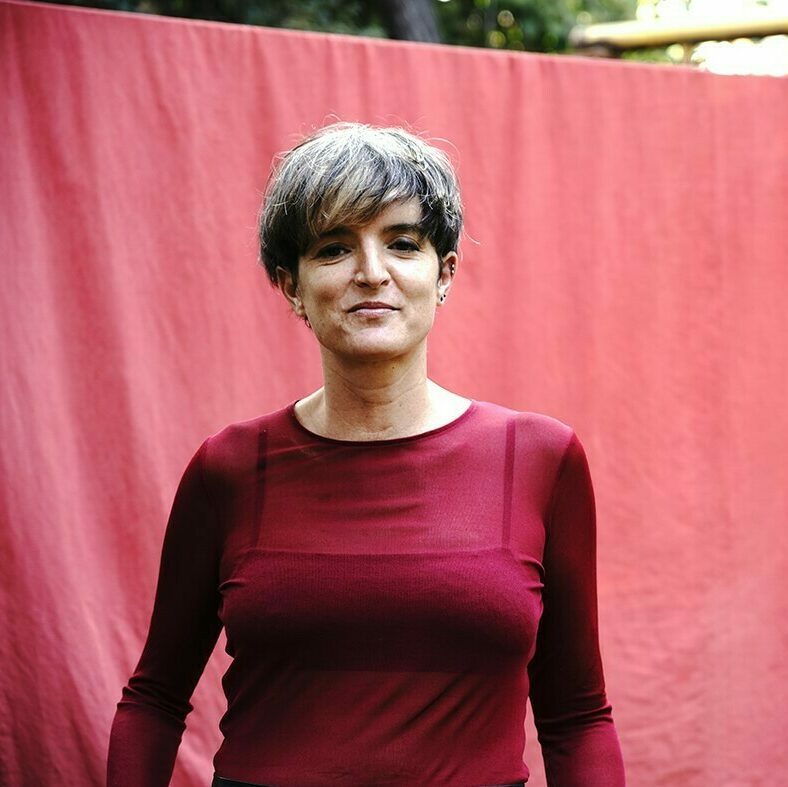
Ángeles Donoso Macaya is a feminist immigrant educator, researcher, writer and activist from Santiago, Chile, based in New York City. She is Professor of Latin American Visual Studies in the Ph.D. Program in Latin American, Iberian, and Latino Cultures at the CUNY Graduate Center, and Professor of Spanish at the Borough of Manhattan Community College, CUNY. Her research centers on Latin American photography theory and history, counter-archival production, human rights activism, documentary film, (trans)feminisms in the Southern Cone, and public humanities scholarship. She is the author of La insubordinación de la fotografía (Metales Pesados 2021) / The Insubordination of Photography: Documentary Practices under Chile’s Dictatorship (University Press of Florida 2020; 2nd edition 2023), which received the Best Book Award in Latin American Visual Culture (LASA 2021), Best Book Award in Recent History and Memory (LASA 2022), and an Honorable Mention Award for the Socolow-Johnson Prize (CLAH 2022); of the autobiographical essay Lanallwe (Tusquets 2023); and co-author, along with photographer Paz Errázuriz, of archivo imperfecto/imperfect archive (Metales Pesados 2023). Her most recent articles have appeared in The Routledge Companion to Photography, Representation and Social Justice (2023), Journal of Latin American Cultural Studies/Travesía (2023), Oxford Research Encyclopedia of Latin American History (2021),Cold War Camera (Duke UP 2023) and Photography and its Publics (Bloomsbury Press 2020), among others. Between 2020-2023, she was Faculty Lead of Archives in Common: Migrant Practices/ Knowledges/Memory, part of the Mellon Seminar on Public Engagement and Collaborative Research at the Center for the Humanities at the Graduate Center, CUNY. Ángeles was a 2021-2022 Mellon/ACLS Community College Faculty Fellow and a 2023 Center for the Humanities Faculty Fellow at the CUNY Graduate Center. She is also member of the activist research collective somoslacélula, which creates video-essays that respond to pressing matters.