People

S. Maynard
ERI/PS2 Public Research Fellow
S. Maynard is a PhD student in Geography at the CUNY Graduate Center. Their dissertation project examines the changing geographies of policing in the South Pacific region. Stella is a 2026 ERI/PS2 Summer Fellow.
I’m sitting in a padded chair, in a ballroom, in a swanky hotel, in Port Moresby, Papua New Guinea. I’m listening to a British gold mining executive present to a conference of industrial and extractive companies. “Unfortunately,” the executive said, “when the good lord put the gold in the ground there, he also put a village on top of it.” The executive is describing, in great detail and at great length, how his company was successfully able to dispossess the Indigenous landowners who lived in and around the gold deposits his company was so eager to get at. He walks the audience – mostly Australian and British men – through the specifics of what he called “the village relocation plan.” I take a note in my journal: this room is full of foreign capital licking its lips.
Glaringly absent from that conference was any mention of the conditions of possibility for the continued expansion and reproduction of the foreign-owned extractive industry in Papua New Guinea and the South Pacific writ large: violence, organized through the carceral and coercive capacities of the state. As ecological collapse and national indebtedness and economic immiseration intensify across the South Pacific, imperial governments continue to send a peculiar form of ‘aid’ to the region: police. Between 2018 and 2024, the Australian Federal Government brokered more than 60 security agreements with Pacific Island nations, significantly outpacing those made by the United States, New Zealand, and China. More than half of these agreements directly relate to police transnationalism – that is, the transnational exchange of police doctrine, weapons, equipment, funding, personnel, and training programs.
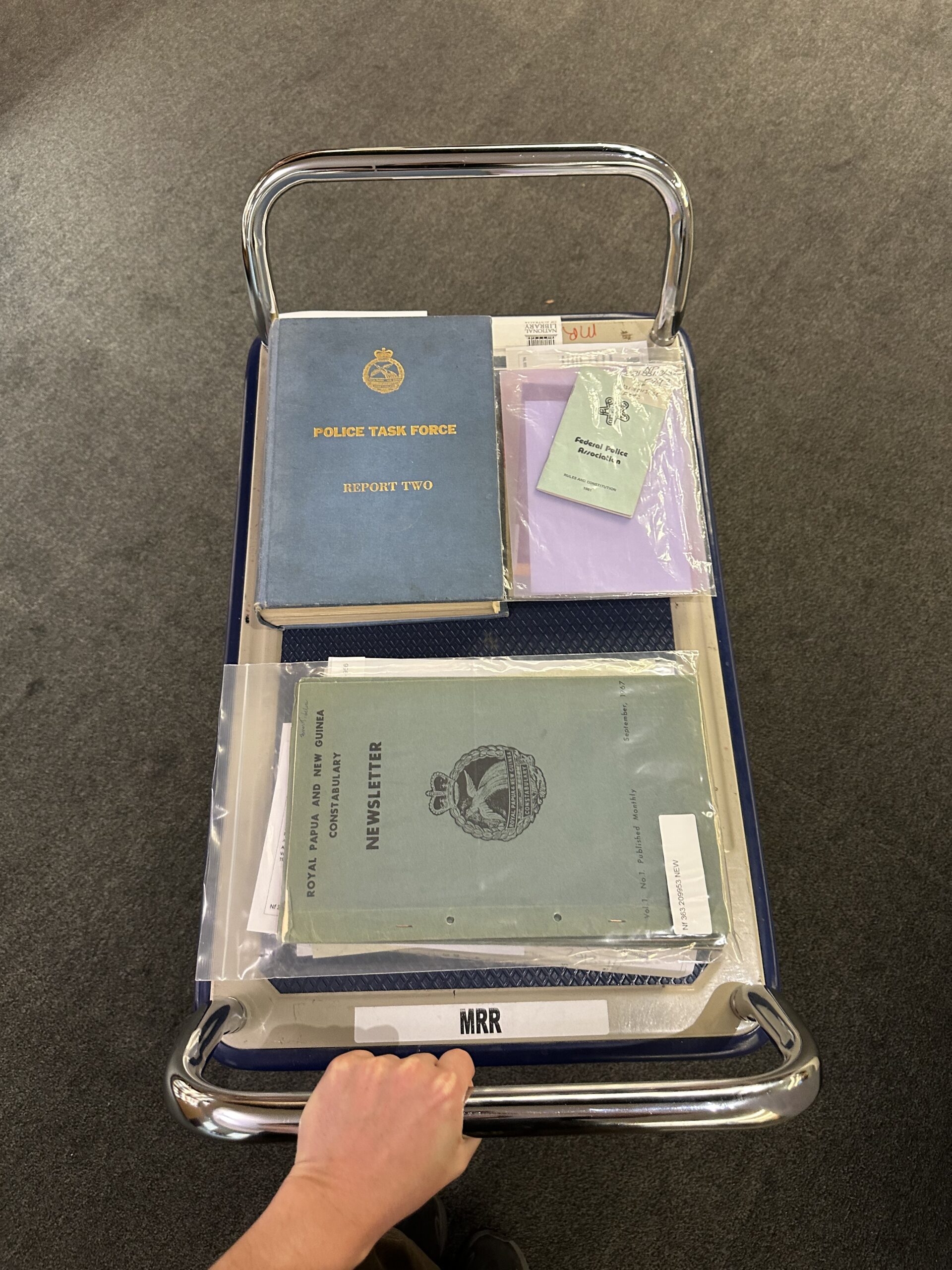
In Summer 2026, the ERI/PS2 Fellowship enabled me to travel to Australia and Papua New Guinea on a preliminary fieldwork trip. During this time, I visited the National Archives of Australia, where I was able to access a trove of undigitized material, most of it from 1970-1980 – the period in which Papua New Guinea gained self-government and formal flag independence from its colonial occupier, Australia. These once-confidential internal security assessments, departmental reports, ministerial briefings, telegrams and cablegrams between police commissioners, press releases, newspaper clippings, and training materials provide invaluable insight into how policing articulated with the lively political-economic changes unfolding in the era of decolonization. Later, in my visit to Port Moresby, I conducted informal interviews with a range of people who occupy vastly different positions in the regional landscape of power relations, from rural Indigenous land rights activists and anti-extraction organizers, to foreign mining company executives, economists, government advisors, a former police commissioner, and workers from international aid organizations. As I return from this preliminary fieldwork visit, I am trying to make sense of these archival materials and conversations, to better understand why, how, and to what effect carceral development and organized violence has been made into a crucial pillar of economic development agendas in the South Pacific post-2000.