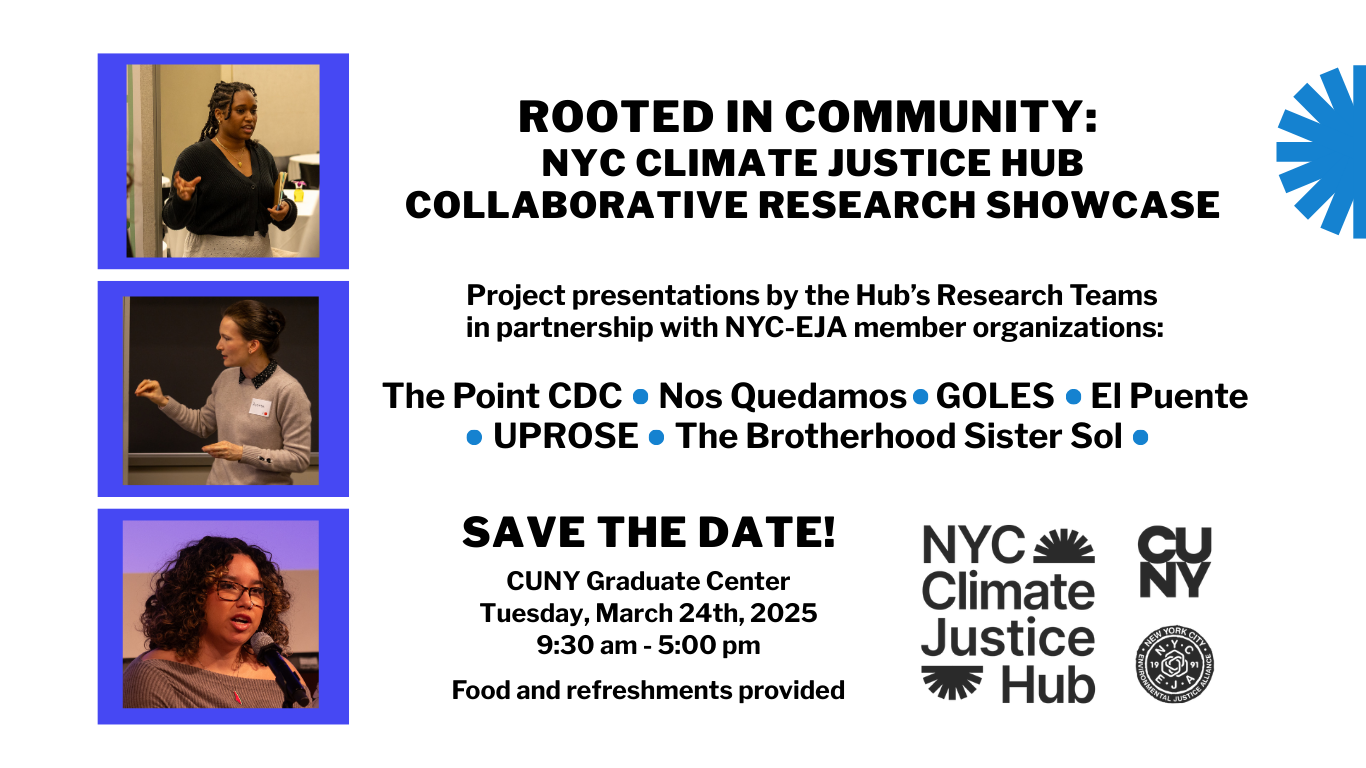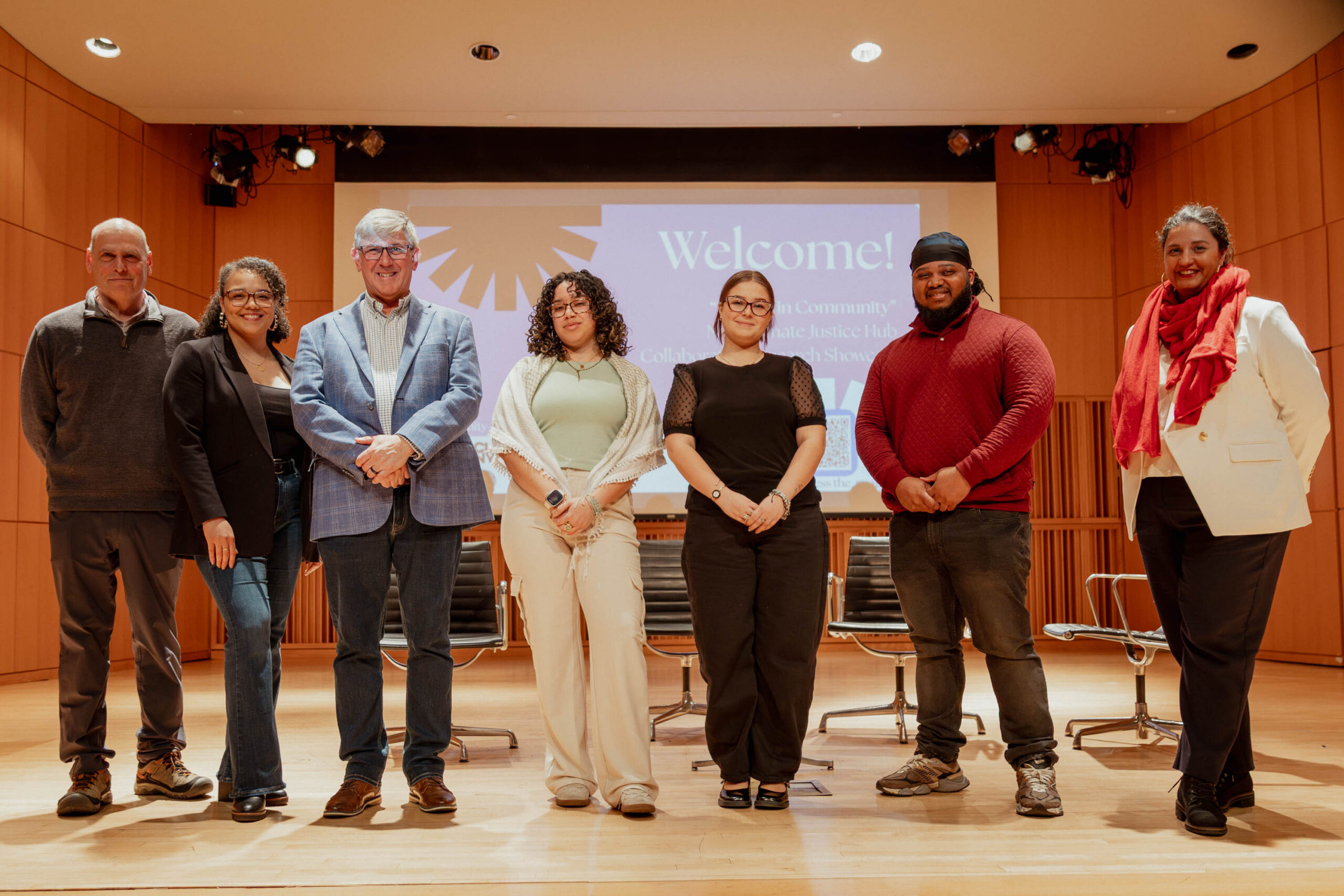
Seven Hub Research Teams came together at the CUNY Graduate Center for a special occasion in late March: the “Rooted in Community:” Collaborative Research Showcase. During this interactive, full-day event, the teams shared the outcomes of the projects they have been working on during the past two years.
The Hub’s Research Teams serve the New York City Environmental Justice Alliance (NYC-EJA)’s city- and statewide-level campaigns and initiatives, as well as six of its member organizations: The Point CDC, Nos Quedamos, GOLES, The Brotherhood Sister Sol, El Puente, and UPROSE. The teams consist of staff from the organizations and CUNY faculty and students.

Unlike traditional university-community partnerships, the Hub’s Research collaborations are “rooted in community”—the theme of this year’s Showcase—which means that community organizations set the research agenda, goals, and priorities, while academics provide technical assistance and consultation.
“In traditional research projects, universities dictate the research priorities. These relationships can be extractive, and communities often feel like universities are pulling whatever data from them without much in return. In our case, research was community-driven, and research priorities were shaped by our members,” said Eddie Bautista, NYC-EJA Executive Co-Director and Hub’s Co-Director.
GOLES
During the Showcase, Good Old Lower East Side (GOLES) and their Research Team presented the project “Listening to LES: Community Driven Climate Resilience and Environmental Justice Insights from the UrVoice Survey.”

The team co-developed the +UrVoice Survey, a community-led questionnaire administered to over 800 LES residents in English, Spanish, and Chinese. The survey explored the intersection of tenants’ housing conditions and environmental justice in the LES.
Analysis of the survey results revealed a critical gap between residents’ concerns about climate risks, such as flooding and extreme heat, and the ability to prepare for them, shaped by broader structural issues, like housing affordability. The research highlighted how LES residents’ voices have historically been excluded from resilience planning—and why community-led data collection is essential to filling those gaps.
“Our priority for this was really to document the residents’ experiences and identify what some of their EJ priorities were,” said Cesar Reyes, Director of Organizing at GOLES, during the presentation.
The Point CDC
The Point CDC, based in Hunts Point, South Bronx, joined the Showcase with the project “Plug into Justice: Community Energy Infrastructure in Hunts Point” alongside their Research Team. The work explores community-led energy infrastructure solutions (such as community-owned solar systems and electric truck charging hubs) in Hunts Point to reduce energy costs, address pollution, repurpose underutilized industrial land, and build long-term climate resilience.

“We’re looking at energy equity and resiliency: if there are power outages or the climate emergencies that we know are coming, how can our neighborhood be resilient and be prepared for that?” said María Reyes, Hub Advocate at The Point CDC.
CHAMP-EJ
After The Point CDC, Peter Marcotullio, Geography Professor at Hunter College, and Victoria Sanders, Climate and Health Programs Manager at NYC-EJA, presented “Breaking Through the Smog: Excessive Heat and Air Pollution in NYC EJ Communities” on NYC-EJA’s Community Heat and Air Monitoring Project for Environmental Justice (CHAMP-EJ).
The project traces and collects data on heat vulnerability and air pollution in NYC’s environmental justice communities to advocate for stronger environmental laws that protect the neighborhoods that are most affected by these climate issues.

“Unfortunately, lived experiences (of the people in the communities) are not seen as sufficient to push policy and push changes at the city and state levels. So we really want to make sure we can support lived experience with data, so that we can then push for better policy moving forward,” said Victoria Sanders.
EL PUENTE
Next, El Puente and its Research Team presented “Southside People Over Pavement: Mobility Justice, Street Reclamation and Redesign from Los Sures”. The team conducted a mobility study in Los Sures, Williamsburg, combining GIS data and community engagement to identify high-collision zones, pollution exposure near the Brooklyn Queens Expressway (BQE), and gaps in pedestrian and bike infrastructure. They are proposing green corridors and open streets, expanded bike networks, and reducing harmful truck routes through residential areas.

“We wanted to identify the community needs around mobility, transportation infrastructure, and transportation justice,” said Dwayne Baker, professor at Queens College and team support at El Puente. He added that community engagement was essential for this work, as the researchers wouldn’t have understood their necessities “just from GIS maps or looking at numbers across the neighborhood.”
UPROSE
UPROSE, based in Sunset Park, Brooklyn, and their Research Team presented the project “Mapping a Just Transition: A Vision for Community-Centered Urban Agriculture in Sunset Park.”

The team’s work supported the implementation of its GRID 2.0 strategy (a plan to decarbonize Sunset Park) through tools like GIS mapping. They developed a real estate mapping initiative of waterfront properties and a dynamic web-based map to track land use and inform community-led planning for a just transition in Sunset Park, involving urban agriculture, food sovereignty, and local economic development.
“The grid 2.0 plan was born out of almost a decade of community engagement, having conversations with folks who live on the ground,” said Ahmad Perez, Infrastructure Coordinator at UPROSE.
WE STAY/NOS QUEDAMOS
We Stay/Nos Quedamos, based in Melrose, South Bronx, and their Research Team developed the project “From Maps to Advocacy: A Community-Based Curriculum for Environmental Justice, Community Organizing, and Advocacy.”

The team designed a community-based curriculum that grounds environmental and housing justice in the lived realities and histories of the South Bronx, and that trains youth in GIS mapping, storytelling, advocacy, and community organizing. The curriculum is rooted in the history of the Melrose community and prepares residents to shape future planning processes.
“The CUNY curriculum has helped me to strengthen my role as a youth organizer and to strengthen my knowledge on environmental justice. I’m grateful for this curriculum. It’s just so wonderful,” said Elijah Rodriguez, youth leader at Nos Quedamos.
BROSIS
The last presentation of the day was “Growing Community Composting in NYC: The BroSis HotBox Model, the NYC 1K Composting Systems Initiative, and an Online Map and Platform” on the project developed by The Brotherhood Sister Sol, based in Harlem, in collaboration with the CUNY Urban Food Policy Institute.

Their purpose was to advance community composting in NYC and support BroSis’s 1K Composting Systems NYC campaign, which aims to establish 1,000 local composting sites across all five boroughs.
BroSis’ project documented and scaled community composting by analyzing existing and newly gathered data, collecting community narratives and lived experience, and building an interactive online map to visualize BroSis’s existing and planned HotBox composting systems, a scalable solution designed for urban organic waste processing.

Composting “reduces greenhouse gases and it supports healthy communities,” said Nando Rodríguez, Hub Advocate at BroSis, during the Showcase.
LOOKING AHEAD
Across presentations, participants highlighted that combining academic tools with community experience yields more meaningful and actionable insights. “The work has been truly collaborative,” said Daniela Castillo, Program Director, Green Light District at El Puente during the team’s presentation.

“Community-led research partnerships have never been more important. The work that we hear about today illustrates that and inspires us to move forward on that,” said Michael Menser, Co-Director of the NYC Climate Justice Hub.
When closing the Showcase, Kendra Sullivan, Co-Director of the NYC Climate Justice Hub and Director of the Center for the Humanities at the CUNY Graduate Center, said, “I hope that this marks an interstitial moment where we get to reflect on past successes, and plan for what’s coming up. I’m thinking about how CUNY can really get behind communities and help transform the world they see into the world we all need. Let’s just keep building these pathways through our relationships, our research, and our actions. It’s all so good, and it’s all exactly what is needed”.
Learn more about the Research Teams here and about their projects here!
Related event