Federico García Lorca: From the Archive into the World—An Interview with Laura García-Lorca
Federico García Lorca: From the Archive into the World—An Interview with Laura García-Lorca
$10.00
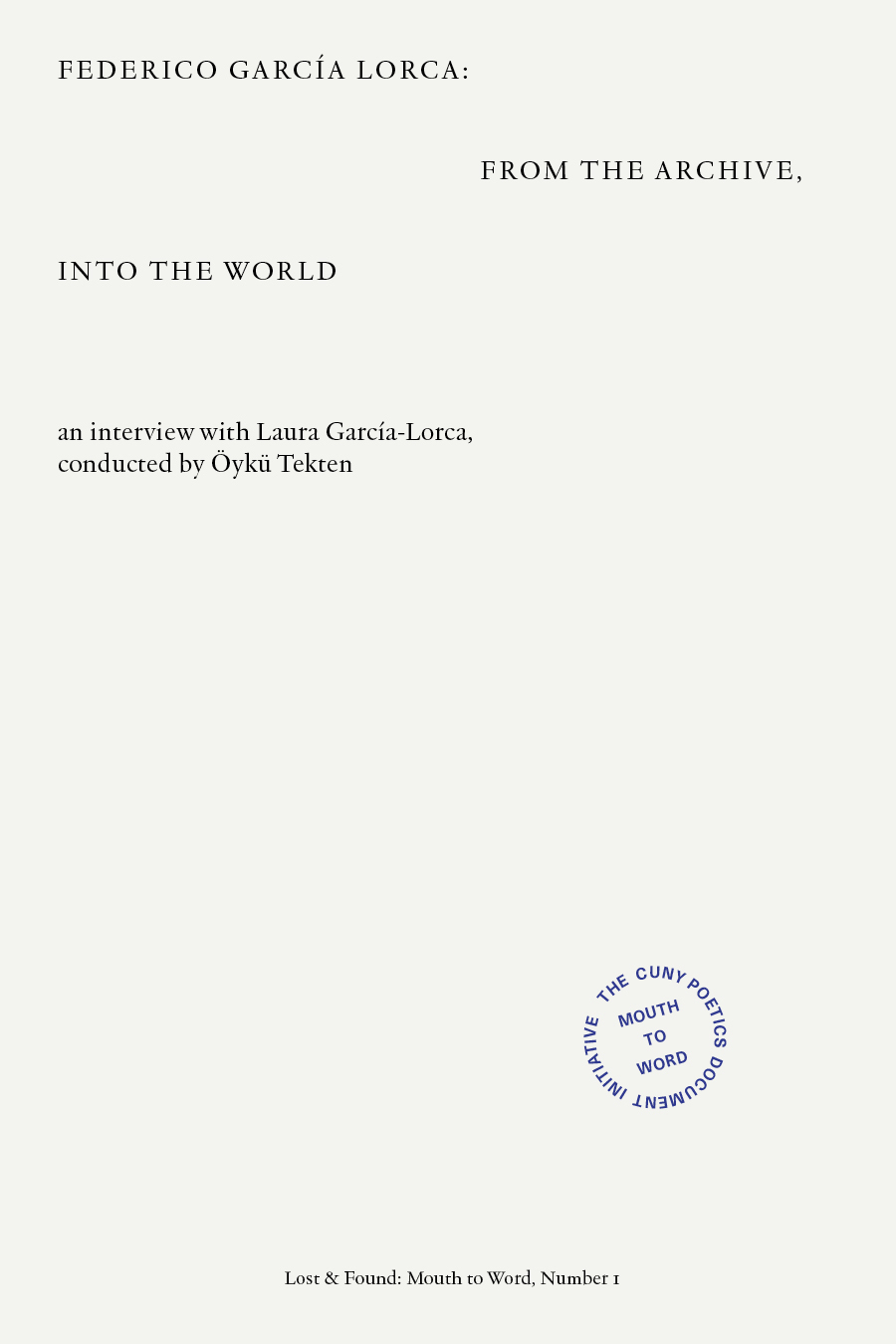
Authors: Laura García-Lorca, Öykü Tekten
Editor: Öykü Tekten
Series: Lost & Found Mouth to Word
Pages: 20 pp, softcover, saddle-stitch binding
ISBN: 978-1-958675-04-5
In this intimate and deeply illuminating interview, Laura García-Lorca—niece of the poet, playwright, and artist Federico García Lorca—opens the doors to one of the most significant literary archives of the 20th century. Speaking with rare candor, she retraces the turbulent path of her family’s exile after the Spanish Civil War and reveals how, scattered across countries and decades, they fought to protect Federico’s manuscripts, letters, drawings, and personal effects from loss, censorship, and political erasure.
Enriched with never-before-seen photographs from the García-Lorca family album, this chapbook offers a rare visual and emotional dimension to the family story. These intimate images—snapshots of family gatherings, moments of exile, and the quiet persistence of daily life—add depth to a narrative shaped by art, memory, loss, and resilience.
Part biography, part cultural history, part personal testimony, this remarkable interview invites readers into the private world behind the Lorca family. It is an essential work for anyone interested in Lorca, the Spanish diaspora, archival survival, and the complex ways in which families carry and protect their past.
See more of the book in the image gallery below:


Author and Editor Bios
Laura García-Lorca, President of the Federico García Lorca Foundation, studied Spanish Literature at the University of Cambridge and Drama at the CET (Centro de Estudios Teatrales) in Madrid, as well as at the John Strasberg Studio in New York. She worked as a script supervisor and assistant director with Ricardo Franco, Iván Zulueta, and Adolfo Arrieta. As a writer, she contributed to the magazine Sur Express and was hired as an editor to launch Vogue magazine in Spain where she served as deputy director from 1989 to 1993. From 1994 to 1995, she oversaw the organization of Fernando de los Ríos’ archive at the Residencia de Estudiantes. In 1995, she was appointed director of the Huerta de San Vicente, initiating the project to transform Federico García Lorca’s family home into a house-museum. In 2005, she began the construction of the Federico García Lorca Center in Granada that houses the Foundation’s entire collection. She is also a trustee of the Francisco Giner de los Ríos Foundation and a board member of the Teatro Real.
Öykü Tekten is a poet, translator, archivist, and editor. She is a founding member of Pinsapo Press, and a contributing editor and archivist with Lost & Found: The CUNY Poetics Document Initiative. She serves as the general editor of the Kurdish Poetry Series for Pinsapo Press, co-edits the Best Literary Translations Anthology (Deep Vellum). Her translation work includes Separated from the Sun by İlhan Sami Çomak (Smokestack Books, co-translation); Selected Poems by Betül Dünder (Belladonna*) and Earthly Conditions by Birhan Keskin (World Poetry Books, forthcoming Fall 2025).
Federico García Lorca (June 5, 1898 – August 18 or 19, 1936) was a Spanish poet, playwright, and theater director. He was an influential member of the Generation of ’27, an avant-garde group of writers and artists who helped shape modern Spanish literature and arts. His first book, Impressions and Landscapes (1918), a prose work in the modernista tradition, chronicled Lorca’s sentimental response to a series of journeys through Spain as a university student. His most celebrated Andalusian works include the poetry collections Gypsy Ballads (1928) and Lament for the Death of a Bullfighter (1935), as well as the plays Blood Wedding, (1932), Yerma (1934), and The House of Bernarda Alba (1936). Lorca travelled to the United States and Cuba (1929–1930) which inspired Poet in New York, a collection of poems published posthumously in 1940. Characterized by vivid, often hallucinatory imagery, free-verse structure, and a deep engagement with themes of urban decay and social injustice, the work represents a bold departure from his earlier style. The collection echoes the influence of Charles Baudelaire, Edgar Allan Poe, T.S. Eliot, and Stephen Crane, while also paying tribute to Walt Whitman. In 1931, Lorca became the director of Teatro Universitario La Barraca, a student theater company funded by the Ministry of Education under the Second Republic. Tasked with bringing classical Spanish theater to rural communities, the group toured the country, offering free performances to audiences who had little access to live theater. Lorca was assassinated by the Franco regime during the early months of the Spanish Civil War.

About Lost & Found Mouth to Word
Building on Lost & Found’s working motto, “follow the person,” our new series, Mouth to Word, moves from live encounter to printed text. Projects may take the form of transcribed interviews or lectures and include newly researched archival material related to the encounter. Adding to our chapbook series and collaborative work in Lost & Found. Elsewhere, Mouth to Word adds a new dimension to our collaborative approach to the presentation of archival research. Lost & Found is published by the Center for the Humanities at the CUNY Graduate Center. For more information, visit lostandfoundbooks.org.
Related Products